
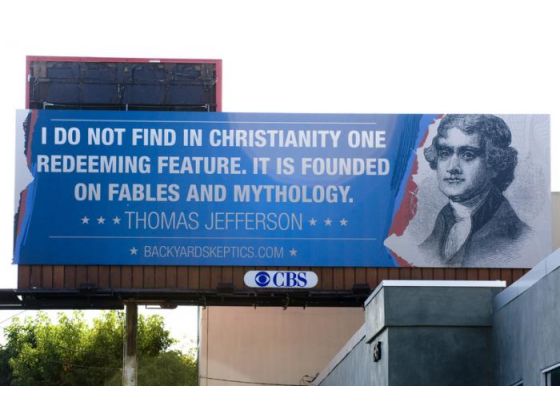
 I love our country.
I cherish the memory of those who have fought and died to keep us free.
I write with reverence of our Founding Fathers, men of faith, who, in turn, wrote:
We hold these truths to be self-evident, that all men are created equal, that they are endowed by their Creator with certain unalienable Rights, that among these are Life, Liberty and the pursuit of Happiness.
…and, evidently, the right to make a total jackass out of one’s self.
Jon Cassidy, writing for the Orange County Register, reported on 10/26/11, that:
A group of atheists called Backyard Skeptics is planning to unveil a billboard at 1545 Newport Blvd., Wednesday afternoon with a quote from Thomas Jefferson bashing Christianity.
The quote reads, “I do not find in Christianity one redeeming feature. It is founded on fables and mythology.”
There’s one problem: There’s no evidence Jefferson ever said it. The Jefferson Library Collection at Monticello lists it on a page of spurious Jefferson quotes.
Bruce Gleason, whose group paid for this and other recent atheism billboards that have gone up in O.C. in recent months, said Wednesday he wasn’t sure about the origin of the quote.
He agreed that Monticello was an authoritative source.
“You’re absolutely right,” he said. “I should have done the research before I put my billboard up.”
The quote on the billboard is an abridged version of a quote that first appeared in a 1906 book called “Six Historic Americans,” by John E. Remsburg, who attributed it to a “Letter to Dr. Woods.”
It reads: “I have recently been examining all the known superstitions of the world, and do not find in our particular superstition (Christianity) one redeeming feature. They are all alike, founded upon fables and mythologies.”
The Jefferson Library knows of no letter to a Dr. Woods ever written by Jefferson, or of any appearance of the phrase anywhere in his writings.
For some misguided reason, atheists have latched on to Thomas Jefferson as a poster boy for their faith.
Perhaps it’s because Jefferson was such a brilliant man and a prolific, thoughtful writer, that atheists simply misunderstand what he wrote about being a Christian:
The doctrines of Jesus are simple, and tend all to the happiness of man.
The practice of morality being necessary for the well being of society, He [God] has taken care to impress its precepts so indelibly on our hearts that they shall not be effaced by the subtleties of our brain. We all agree in the obligation of the moral principles of Jesus and nowhere will they be found delivered in greater purity than in His discourses.
I am a Christian in the only sense in which He wished anyone to be: sincerely attached to His doctrines in preference to all others.
I am a real Christian – that is to say, a disciple of the doctrines of Jesus Christ.
Seems pretty straightforward and easy to understand to me.
Or, perhaps is that “Separation of Church and State Thingy” that atheists, especially the bitter individuals at the Freedom From Religion Foundation, always bring up as their reason for trying to erase Christianity from American life.
David Barton answered that assertion quite nicely, when he wrote on wallbuilders.com that:
Jefferson penned that phrase to reassure the Danbury (CT) Baptist Association that because of separation of church and state, the government would never interfere with their public religious expressions. For the next 150 years, federal courts followed Jefferson’s intent and attached his separation metaphor to the Free Expression Clause of the First Amendment, thus consistently upholding public religious expressions. However, in 1947, the Supreme Court reversed itself and began applying the phrase to the Establishment Clause instead, thus causing federal courts to remove rather than preserve public religious expressions.
The proof is abundant that this was not Jefferson’s intent. For example, two days after Jefferson wrote his separation letter, he attended worship services in the U. S. Capitol where he heard the Rev. John Leland preach a sermon. (As President of the Senate, Jefferson had personally approved the use of the Capitol Building for Sunday worship services.) The many diaries of Members of Congress during that time confirm that during Jefferson’s eight years, he faithfully attended church services in the Capitol. In fact, he even ordered the Marine Band to play the worship services there. Jefferson also authorized weekly worship services at the War Department and the Treasury Building.
And on December 23, 1803, Jefferson’s administration negotiated – and the Senate ratified – a treaty with the Kaskaskia Indians that stated “the United States will give annually for seven years one hundred dollars for the support of a priest” to minister to the Indians (i.e., federal funds for Christian evangelism!) Jefferson also signed presidential documents, closing them with the appellation, “In the Year of our Lord Christ.” There are many similar surprising facts about Jefferson that are fully documented historically, but that have been ignored for the past 50 years.
So would religious conservatives and Thomas Jefferson really be on opposite sides of the church/state issue? Probably, for I doubt that conservatives would agree with using federal dollars for evangelization.
Well, gosh. That blows that argument out of the water, doesn’t it?
Golly, Eight Per Centers. You’ve built your whole Jeffersonian Fan Club around a false assertion.
…That’s not your only one.
 Kingsjester's Blog
Now you’re just trying to get on my good side KJ! You are already there buddy!
LikeLike
Excellent, KJ, THIS is what it’s all about. You nailed it!
LikeLike
Yeah, the guys sponsoring the billboard blew it–their bad.
But resorting to the likes of Barton to blow separation of church and state out of the water? That’s rich. As revealed by the meticulous analysis of Chris Rodda and many others, zealotry more than fact shapes his work, which is riddled with shoddy scholarship and downright dishonesty. See Chris Rodda, Liars for Jesus: The Religious Right’s Alternate Version of American History (2006) (available free on line http://www.liarsforjesus.com/); http://www.patheos.com/Resources/Additional-Resources/Should-Christians-Trust-David-Barton-John-Fea-05-11-2011.html. Rodda presents Barton’s claims, reviews the evidence and explanations he offers, and then shines a bright light on the evidence omitted, misinterpreted, or even made up by Barton, all with documentation and references so complete one can readily assess the facts for one’s self without the need to take either Barton’s or Rodda’s word for it. (Among Barton’s deceits are those he mentions in your brief quotation of him; I’ll not lengthen this comment with explanations here; they are readily available at the foregoing link.) The irony is that, by knowingly resorting to lies, this would-be champion of a religious right version of history reveals his fears that the real facts fall short of making his case.
Separation of church and state is a bedrock principle of our Constitution much like the principles of separation of powers and checks and balances. In the Constitution, the founders did not simply say in so many words that there should be separation of powers and checks and balances; rather, they actually separated the powers of government among three branches and established checks and balances. Similarly, they did not merely say there should be separation of church and state; rather, they actually separated them by (1) establishing a secular government on the power of the people (not a deity), (2) saying nothing to connect that government to god(s) or religion, (3) saying nothing to give that government power over matters of god(s) or religion, and (4), indeed, saying nothing substantive about god(s) or religion at all except in a provision precluding any religious test for public office. They later buttressed this separation with the First Amendment, which constrains the government from undertaking to establish religion or prohibit individuals from freely exercising their religions. The basic principle, thus, rests on much more than just the First Amendment.
That the phrase “separation of church and state” does not appear in the text of the Constitution assumes much importance, it seems, to some who may have once labored under the misimpression it was there and, upon learning they were mistaken, reckon they’ve discovered a smoking gun solving a Constitutional mystery. To those familiar with the Constitution, the absence of the metaphor commonly used to name one of its principles is no more consequential than the absence of other phrases (e.g., Bill of Rights, separation of powers, checks and balances, fair trial, religious liberty) used to describe other undoubted Constitutional principles.
Some, like Barton, try to pass off the Supreme Court’s decision in Everson v. Board of Education as simply a misreading of Jefferson’s letter to the Danbury Baptists–as if that were the only basis of the Court’s decision. Instructive as that letter is, it played but a small part in the Court’s decision. Perhaps even more than Jefferson, James Madison influenced the Court’s view. Madison, who had a central role in drafting the Constitution and the First Amendment, confirmed that he understood them to “[s]trongly guard[] . . . the separation between Religion and Government.” Madison, Detached Memoranda (~1820). He made plain, too, that they guarded against more than just laws creating state sponsored churches or imposing a state religion. Mindful that even as new principles are proclaimed, old habits die hard and citizens and politicians could tend to entangle government and religion (e.g., “the appointment of chaplains to the two houses of Congress” and “for the army and navy” and “[r]eligious proclamations by the Executive recommending thanksgivings and fasts”), he considered the question whether these actions were “consistent with the Constitution, and with the pure principle of religious freedom” and responded: “In strictness the answer on both points must be in the negative. The Constitution of the United States forbids everything like an establishment of a national religion.”
LikeLike
Dadgum, son. Are you tryng to filibuster, obfuscate, or both?
You mean Chris Rodda, the woman who is the Senior Research Director of the Military Religion Freedom Foundation, Atheist, author, and blogger?
Established in 2006, the Military Religious Freedom Foundation (MRFF) describes itself as “a watchdog group” that is “dedicated to ensuring that all members of the United States Armed Forces fully receive the Constitutional guarantees of religious freedom to which they and all Americans are entitled …” The organization’s primary objective is to eradicate the religious bias and “coercion” that it deems prevalent among high-ranking Christian members of the U.S. military. Toward that end, MRFF functions as “a clearinghouse for violations reported by military and civilian personnel,” offering “complete anonymity” to all complainants.
Headed by retired Air Force lawyer Michael L. “Mikey” Weinstein, MRFF declares: “At a time when the United States is encouraging greater religious freedom in Muslim nations, it is imperative [sic] upon America to show by example that religious pluralism is a viable and preferred option. Any sign of hypocrisy in United States policy … toward the free exercise of religion within the military makes it more difficult to convince others to follow our nation’s chosen path.”
In December 2006, MRFF issued a “Compliance Report on the Pervasive Violations of the United States Constitutional Religious Freedoms of Military Personnel.” “Military and civilian personnel,” says this document, “are subjected to blatant and unlawful displays of religiosity at mandatory formations, religious bias, and illegal proselytizing by their peers and superiors alike.” The report identifies “pervasive violations of United States Constitutional religious freedoms of military personnel” in five major areas:
(a) Blatant displays of religious symbolism on military garb: “The 523rd Fighter Squadron [in the Air Force] is known as the ‘Crusaders.’ … Members of the Squadron wear patches which prominently feature a large cross — an unmistakable emblem of the Christian faith — as well as other accoutrements of the historically dressed crusaders: broadsword and armored helmet. This unabashed display of religiosity creates a divisive atmosphere among Air Force personnel. … The Squadron’s patch and promulgation of the idea that the United States military is fighting a religious war, jeopardizes the safety and success of the men and women battling religious fundamentalism overseas.”
(b) Placement of a biblical quotation above the door of the Air and Space Basic Course classroom: “Air and Space Basic Course (ASBC) is a mandatory six-week training course for all Air Force officers … at Maxwell Air Force Base, Alabama. … Prominently displayed over the doorway [of the classroom] is a quote from the Old Testament. … [I]t comes from a passage, Isaiah 40:31, that promises restored vigor to those who worship — ‘But they that wait upon the Lord shall renew their strength; they shall mount up with wings as eagles; they shall run, and not be weary; and they shall walk and not faint.’ This quote … has caused numerous officers to complain of feeling both uncomfortable and isolated. … Only those Christian officers who ‘wait upon the Lord,’ apparently, will ‘mount up with wings as Eagles.'”
(c) Illegal use of official military e-mail accounts to send e-mails containing religiousrhetoric: “The e-mail below,” says MRFF, “was widely distributed on November 22, 2006 [by Staff Sergeant Jessica M. Wilson], through an official Air Force e-mail account … This e-mail clearly violates the separation of church and state and also violates military regulations”:
“Here’s wishing you all a safe, wonderful, Happy Thanksgiving!!! May it be filled with love, family, and lots of good food!! I love you all! Be well!! Remember that it is not about celebrating the Pilgrims, or the football game, and all that but more about being a day to thank the Lord our God for all we have. All that is good comes from God and we need to worship, honor, and praise Him for all we have now and all He has saved us from and for all that is to come. All Glory Be To God!!”
The email also contained eight Old Testament quotes on the subject of gratitude to God.
(d) Attempts by missionary organizations to train active-duty military personnel to evangelize their subordinates and peers: “It is … the duty of military leadership to provide an egalitarian environment for all who choose to serve. Organizations such as the Force Ministries and the Officers’ Christian Fellowship (OFC) make this nearly impossible to accomplish. Force Ministries … places their [sic] staff — retired and currently enlisted military personnel — on and near military bases and campuses throughout the world. At these ‘strategic locations’ Force Ministries’ missionaries work actively to train the men and women of our nation’s armed forces to evangelize their military peers and subordinates. … The OFC has a similar mission …”
(e) Military leadership openly discussing their commitment to bring religion into the military: At issue was a video produced by Christian Embassy, an organization whose mission is “to help diplomats, government leaders and military officers find real and lasting purpose through faith and encouragement.” The video, which appeared on Christian Embassy’s website, carries a disclaimer that says “the views expressed by any government officials in this video are their personal views and are not intended to represent the U.S. government nor any department in which they serve.”
Notwithstanding the disclaimer, MRFF states: “[S]erious violations were committed by prominent figures featured on the organization’s ten-minute promotional video. … [S]everal members of military leadership appear in the video, dressed in full uniform openly discussing their personal connection to Jesus and how they make this connection part of the work they do in their professional capacity each day. [They] state that, among other things, with the help of Christian Embassy, they hold bible studies while on duty in the workplace, many times in their offices.”
Characterizing such public displays of faith by high-ranking military personnel as examples of “fanatical unconstitutional religious persecution,” Mikey Weinstein says these incidents create an “internal national security issue every bit as great as the one we’re fighting outwardly. The jihadists, the insurrectionists, everybody from the head of Hamas, Hizbollah, the Islamic Jihad, the al-Aqsa Martyrs Brigade[s], they see us as invading American imperialists and crusaders.” “It’s egregious beyond the pale,” adds Weinstein. “We apparently have a radicalized, evangelical Christian Pentagon within the rest of the Pentagon. … When we’re facing a global war on terror against what we call Islamic extremists, it certainly doesn’t help when we have apparently a viewpoint from the cognoscenti and glitterati, the leadership of the Pentagon, pushing a particular virulent worldview down the throats of people who are helpless to argue against it.”
That’s who you quoted?
The MRFF Board of Directors is headed by Kristen Leslie (an assistant professor of Pastoral Care and Counseling at Yale Divinity School), and David Antoon (a former U.S. Air Force commander who vocally opposes the “extreme Evangelical coercive overtones influencing the Academy.”
Some notable members of the MRFF Advisory Board are former U.S. Ambassador Joseph Wilson; Smita Singh, Director of the William and Flora Hewlett Foundation’s Global Development Program; and Richard T. Schlosberg III, the immediate past President and CEO of the David and Lucile Packard Foundation.
Nope. Never heard of her.:)
LikeLike
I’m sure the MMRF appreciates your reposting of its views and all and I gather you find some humor in that, but do you have anything serious to say?
LikeLike
Just giving a little background information to those not familiar with the pundit you decided to post.
Here’s something serious for you:
No matter how hard you try, you can not revise history. Nor can you separate the belief system of 75% of Americans from their daily life or try to regulate when and where Americans can live out their faith. Atheists comprise only 8% of America’s population, and regardless of their erroneous notion of their intellect being superior for not believing in the existence of Our Creator, Christian Americans will not forget, nor surrender the role that Christianity has played in shaping the great country on the face of God’s green Earth.
And that is what makes you guys so bitter.
LikeLike
Nicely done, KJ.
LikeLike
kingjester,
However serious your comment may be, it is way, way off target.
Separation of church and state is not an atheist concept. Nor does it matter one wit what percentage of the population is atheist, Christian, or whatever.
While the religious views of various founders are subjects of some uncertainty and controversy, it is safe to say that many founders were Christian of one sort or another. In assessing the nature of our government, though, care should be taken to distinguish between society and government and not to make too much of various founders’ individual religious beliefs. Their individual beliefs, while informative, are largely beside the point. Whatever their religions, they drafted a Constitution that establishes a secular government and separates it from religion as noted earlier. This is entirely consistent with the fact that some founders professed their religiosity and even their desire that Christianity remain the dominant religious influence in American society. Why? Because religious people who would like to see their religion flourish in society may well believe that separating religion and government will serve that end and, thus, in founding a government they may well intend to keep it separate from religion. It is entirely possible for thoroughly religious folk to found a secular government and keep it separate from religion. That, indeed, is just what the founders did.
It is instructive to recall that the Constitution’s separation of church and state reflected, at the federal level, a “disestablishment” political movement then sweeping the country. That political movement succeeded in disestablishing all state religions by the 1830s. (Side note: A political reaction to that movement gave us the term “antidisestablishmentarianism,” which amused some of us as kids.) It is worth noting, as well, that this disestablishment movement largely coincided with another movement, the Great Awakening. The people of the time saw separation of church and state as a boon, not a burden, to religion.
This sentiment was recorded by a famous observer of the American experiment: “On my arrival in the United States the religious aspect of the country was the first thing that struck my attention. . . . I questioned the members of all the different sects. . . . I found that they differed upon matters of detail alone, and that they all attributed the peaceful dominion of religion in their country mainly to the separation of church and state. I do not hesitate to affirm that during my stay in America, I did not meet a single individual, of the clergy or the laity, who was not of the same opinion on this point.” Alexis de Tocqueville, Democracy in America (1835).
LikeLike
There is a difference between being “religious” and being a Christian. A Christian can no more turn on and off his faith than he can stop breathing and live. You seek to pigeonhole Christianity to a faith which is practiced solely in churches and the believers’ home. Unfortunately for you and those like you who seek to put Christianity out of sight, and out of mind, amd to try to remove it from public life, Christian Americans are fighting back.
There are more quotes from de Toqueville than you wrote:
He published a second volume of Democracy in America in 1840, in which he described:
“Christianity has therefore retained a strong hold on the public mind in America … In the United States … Christianity itself is a fact so irresistibly established, that no one undertakes either to attack or to defend it.
LikeLike
I agree with you that the founders would not establish a government that is inherently at odds with their religious convictions. Moreover, given the republican nature of our government, I think it is only natural and expected that the laws enacted by our government–in both the founders’ time and today–largely reflect Christianity’s dominant influence in our society.
That said, there is no reason to suppose that Christianity or theism is an inherent aspect of our constitutional government. Indeed, any such claim is antithetical to the constitutional principle against government establishment of religion. By founding a secular government and assuring it would remain separate, in some measure at least, from religion, the founders basically established government neutrality in matters of religion, allowing individuals to freely choose and exercise their religions and thus allowing Christianity (and other religions) to flourish or founder as they will. As noted above, it is to be expected that the values and views of the people, shaped in part by their religions, will be reflected in the laws adopted by their government. There is nothing in the Constitution that requires or calls for this; it is simply a natural outgrowth of the people’s expression of political will in a republican government. To the extent that the people’s values and views change over time, it is to be expected that those changes will come to be reflected in the laws adopted by their government. There is nothing in the Constitution to prevent this; indeed, just the opposite–the Constitution establishes a government designed to be responsive to the political will of the people. It is conceivable, therefore, that if Christianity’s influence in our society wanes relative to other influences, that may lead to changes in our laws. Nothing in the Constitution would prevent that–and moreover the establishment clause would preclude Christians from using the government to somehow “lock in” (aka establish) Christianity in an effort to stave off such an eventuality.
It is important to distinguish between the “public square” and “government” and between “individual” and “government” speech about religion. The constitutional principle of separation of church and state does not purge religion from the public square or, as you put it, “put Christianity out of sight”–far from it. Indeed, the First Amendment’s “free exercise” clause assures that each individual is free to exercise and express his or her religious views–publicly as well as privately. The Amendment constrains only the government not to promote or otherwise take steps toward establishment of religion. As government can only act through the individuals comprising its ranks, when those individuals are performing their official duties (e.g., public school teachers instructing students in class), they effectively are the government and thus should conduct themselves in accordance with the First Amendment’s constraints on government. When acting in their individual capacities, they are free to exercise their religions as they please. If their right to free exercise of religion extended even to their discharge of their official responsibilities, however, the First Amendment constraints on government establishment of religion would be eviscerated. While figuring out whether someone is speaking for the government in any particular circumstance may sometimes be difficult, making the distinction is critical.
Nor does the constitutional separation of church and state prevent citizens from making decisions based on principles derived from their religions. Moreover, the religious beliefs of government officials naturally may inform their decisions on policies. The principle, in this context, merely constrains government officials not to make decisions with the predominant purpose or primary effect of advancing religion; in other words, the predominant purpose and primary effect must be nonreligious or secular in nature. A decision coinciding with religious views is not invalid for that reason as long as it has a secular purpose and effect.
Wake Forest University recently published a short, objective Q&A primer on the current law of separation of church and state–as applied by the courts rather than as caricatured in the blogosphere. It also answers most of your numbered questions. I commend it to you. http://tiny.cc/6nnnx
LikeLike
DouginDeep – I’ve been more than gracious in allowing you to reply. However, in your desire to filibuster and bloviate, you take up too much bandwidth. Write your own blog. You’re spam.
LikeLike
You present a great argument. It’s been my experience with lawyers that they possess the amazing ability to passionately, articulately and tirelessly argue the pro and con of any issue. Who would have thought!
LikeLike