 Do you remember the Lehman Brothers Disaster? No. It wasn’t some accident like Mrs. O’ Leary’s cow starting the Great Chicago Fire.
Here’s a history lesson, courtesy of The New York Times:
Lehman Brothers was founded in 1850 by two cotton brokers in Montgomery, Ala. The firm moved to New York City after the Civil War and grew into one of Wall Street’s investment giants. On Sept. 14, 2008, the investment bank announced that it would file for liquidation after huge losses in the mortgage market and a loss of investor confidence crippled it and it was unable to find a buyer.
In March 2010, a 2,200-page document laid out in new and startling detail how Lehman used accounting sleight of hand to conceal the bad investments that led to its undoing. The report, compiled by an examiner for the bank, concluded that, among other things, the firm’s demise was the result of bad mortgage holdings and, less directly, demands by rivals like JPMorgan Chase and Citigroup, that the foundering bank post collateral against loans it desperately needed.
Lehman also used a small company — its “alter ego,” in the words of a former Lehman trader — to shift investments off its books, according to an article in The New York Times in April. The relationship raised new questions about the extent to which Lehman obscured its financial condition before it plunged into bankruptcy.
It is no secret that Europe is in the middle of a government debt crisis.
However, now, worry is spreading across the continent that one of Europe’s major banks may fail, which would, in turn, ignite a financial panic such as one sparked by Lehman’s bankruptcy in September 2008.
European leaders, trying desperately to stave off financial disaster, have come up with a plan to use hundreds of billions of euros of bailout money to prevent any major bank from failing.
The catch to the plan lies in the doubt concerning the ability of Europe’s banks to last through the crisis, since some of them are having a harder time procuring the loans they need for their daily operations.
Meanwhile, our banking corporations, in an attempt to protect themselves, are increasingly cautious of making new short-term loans in some cases and are in the process of refusing to conduct business with their European business associates, a strategy while helpful to our country, will magnify the funding problems of European banks.
Withdrawals such as these, only on a much larger scale, basically forced Lehman to declare bankruptcy, as banks, hedge funds and others stopped doing business with them, oblivious to the fact that their actions contributed to a much broader market crisis.
If this disaster comes to pass in Europe, America would be next in line due to the symbiotic relationship of the world’s financial system.
Furthermore, the banking systems of other nations could topple like dominoes in a line.
The financial markets began showing their growing concern over the situation yesterday. Stocks in the United States and Europe fell 1 percent and European bank stocks fell 5 percent or more after losing heavily in recent weeks.
European bank shares are now at their lowest point since March 2009, mirroring the situation following Lehman’s collapse.
Investors continued to buy United States Treasury bonds, however, as yields on two-year bonds briefly touched 1.90 percent, the lowest ever, before closing at 1.98 percent.
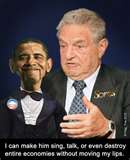 Per George Soros, a.k.a. “The Puppet Master”, things are not looking good:
This crisis has the potential to be a lot worse than Lehman Brothers. That is why the problem is so serious. You need a crisis to create the political will for Europe to create such an authority, but there is still no understanding as to what the authority will do.
Soros was referring to the lack of an authoritative pan-European body to handle such an huge banking crisis.
Why is Soros complaining? This is the type of situation that this financial vulture lives for.
From one of my previous posts, Black Thursday…Almost:
George Soros set up the now famous Quantum Fund as one of the world’s first Hedge Funds. It took money from the wealthy and invested in risky but potentially highly profitable international deals.
It did very well out of the collapse of fixed exchange rates in the 1970s and the deregulation of global capital markets. By 1980, George Soros was worth more than £16.5 million and his fund £67 million. The stage was set for his intervention in the Exchange Rate Mechanism, a system established in 1979 for controlling exchange rates within the European Monetary System of the European Union (EU) that was intended to prepare the way for a single currency.
Around spring 1992, Soros had decided that the pound would have to be devalued because it had been pushed into the Exchange Rate Mechanism at too high a rate.
He knew that the Bundesbank was in favor of a devaluation of both sterling and the Italian lira and believed it would have to happen because of the disastrous impact that high British interest rates were having on asset prices.
Soros spent the next few months in preparation to profit from that devaluation. He borrowed sterling heavily, reportedly to the tune of £6.5 billion, and converted that into a mixture of Deutschmarks and French francs.
On Black Wednesday, September 16, 1992, Soros won his bet. The UK Conservative government was forced to withdraw the Pound from the European Exchange Rate Mechanism (ERM) due to pressure by currency speculators, most notably Soros himself.
In the following days, he took care of business, paying back what he borrowed and ending with a profit of around £1 billion. At the same time, Soros bought as much as £350 million of British shares, gambling that equities often rise after a currency devalues.
He later admitted that his actions had benefited no one but himself.
If I were the financial and political leaders of Europe and America, I would keep an eye on The Puppet Master.
But, then again, no one asked me.
 Kingsjester's Blog
soros is one evil dude….
LikeLike
REALLY good post my friend!! See you tonight Kj.
LikeLike
Thank you, my brother. I’ll be there.
LikeLike
So on one hand you quote Soros as warning folks about the potential for problems and then on the other – you write “keep an eye on the puppet master” Huh?
If anyone, not just Soros, who by the way has mostly retired from the financial world, wanted to mess with Europe’s financial house why would they bother to warn people about the mess?
LikeLike
What is it about Deceitful people that you don’t understand? Considering that Soros is widely known in Europe as “The Man Who Broke the Bank of England”, I stand by what I wrote.
LikeLike
Ahhh, Soros. The money man behind the obamanation…The obamanation shuts down Gulf oil drilling, Soros “invests” in Brazil’s oil, oil rigs make their way from the Gulf to Brazil, the obamanation gives Brazil $Billions to help them develop their newly found deepwater oil reserves — coincidence?…
LikeLike