
 I remember it like it was yesterday. I was staying with my elderly parents between marriages. On Feb. 11, 1994, Memphis was hit by the worst ice storm the area had seen in 50 years. The magnitude of the storm would set the standard by which all others have been measured since.
Like other Memphians, I woke up that Friday morning to the sound of power lines snapping and sparking. Exploding electrical transformers provided an eerie green lighting to the predawn skies. I had to make an 18 mile drive to work, because some brilliant plastic surgeon decided a teenage girl had to have her nose job videotaped that morning. So I put cinder blocks in the back of my 1990 Dodge Dakota long bed pickup truck, and off I went, heading to downtown Memphis in the early morning hours, in the middle of an ice storm.
Memphis looked like a war zone.
The area lost thousands of trees due to the weight of the ice. This, in turn, led to massive power outages.
Fully 1/2 of Shelby County, Tennessee, 250,000 to 300,000 utility customers, were left without electricity. Most customers had power restored within a few days, however, some were without power for more than two weeks.
The ice storm was responsible for more than a dozen fires. Schools,businesses and government agencies all had to shut down.
Shelters were opened, including The Pyramid, for people forced from their homes by cold.
A University of Memphis professor was killed when a tree limb crashed onto his car near Audubon Park. And two men, in separate incidents, died of apparent carbon monoxide poisoning, trying to heat their homes.
Meanwhile, back at home, I took care of my parents and made sure that they were warm and fed. Our power was restored in a few days. Luckily, we had plenty of batteries for the transistor radio and our flashlights. However, sleeping in our clothes and winter coats did get old, quickly.
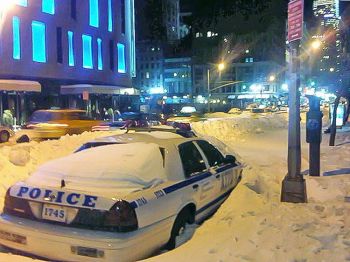 I was reminded of the 1994 Memphis ice storm while reading accounts of the blizzard that has buried the Big Apple, along with the rest of the East Coast.
From myfoxny.com:
The chairman of the Municipal Labor Committee, Local 831, which represents men and women of the New York City Sanitation Department says there is no truth behind a rumor that his members worked slower during the blizzard of 2010.
Speaking with Good Day New York on Wednesday, four days after the first snow fell in a 20+ downfall across the tristate, Harry Nespoli said his workers don’t “mess around with the snow.”
Local politicians and residents where streets have not been cleared from the snow are angry. From all accounts, the response to the blizzard was inadequate.
“There is nothing to that (rumor.) I’m working very closely with the city. They worked 14 hour shifts. They’re getting annoyed over the fact that people are thinking there is a job action,” answered Nespoli.
The labor leader points fingers at Mother Nature.
“We had a blizzard. There were also an unusual amount of people on the streets on Sunday night and those cars never made it back to the curbs,” added Nespoli about the stranded vehicles and the difficulty they posed in getting plows through certain areas.
Some 40 hours after New York City became buried under 20 ” of snow, Hizzoner Mayor Bloomberg pleaded with New Yorkers Tuesday to have patience and told them that plows still might not reach every street within the next 24 hours.
At a meeting in Brooklyn, one of the hardest hit burroughs, he said:
We cannot do everything all the time and we are doing the best we can. We are trying to get to every street as fast as we can and as safely as we can.
I’m angry too.
Yeah, but you’re supposed to be in charge.
Bloomberg recited a litany of excuses for the poor response: the heavy winds, a shortage of tow trucks and private plows, motorists abandoning their cars and blocking streets, ambulances mired in the snow by trying to drive down blocked streets, and people jamming 911 with non emergency calls.
He defended not declaring a snow emergency, by claiming “that would have made the situation worse,” by forcing motorists to move parked cars from major streets. About 1,000 stuck vehicles have been removed from just three major expressways, but the mayor said that some 40 city ambulances and just under 300 buses remain stuck in the snow.
This was the sixth largest snowstorm in the history of New York City. It dumped two feet of snow and left many of those living in the outer boroughs and small suburban side streets, feeling trapped or ignored, as the city’s priority was to dig out Manhattan first.
I can sympathize with you guys. The movers and shakers in Memphis had their power restored first, too.
 Kingsjester's Blog
Wonder how many private companies were able to do their jobs, as in plowing out parking lots and such….
LikeLike
They had plenty of notice that this was coming. Bloomberg’s Katrina?
LikeLike
Maybe Mayor Bloomberg should put a little salt on it before it starts to smoke.
LikeLike
HA !!!
LikeLike
New York couldn’t handle snow! Pfffft!
LikeLike
While salt, caloric postings on menus, buying guns out of state, and smoking dope were priorities for the Mayor, it appears being ready for the first snow storm of the season wasn’t…
LikeLike
Bloomberg won’t be the first Mayor run out of town by a blizzard. The winter of 1977 saw seven feet of snow paralyze Chicago. Mayor Bilandec, who was serving temporarily after the death of Hizhonor Mayor Daily, and heavily favored in the 78 election was defeated by the first and only female mayor of Chicago, Jane Byrne. Why do people stay most angered over weather related hardships as opposed to corrupt politicians?
LikeLike