
 As Hurricane Earl steams toward the East Coast of the United States, Barack Hussein Obama (peace be unto him) and his administration are brokering the first face-to-face negotiations between Israel and the Palestinians in almost two years.
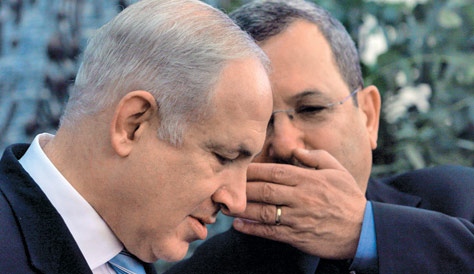
Israeli Prime Minister Benjamin Netanyahu and Palestinian President Mahmoud Abbas will sit down together today for the first of what Obama and his State Department hope will be a series of meetings that lead in a year’s time to an agreement on the creation of a Palestinian state.
According to Obama, speaking from the White House:
This moment of opportunity may not soon come again.
Obama said he was “cautiously hopeful” about the talks, which begin with dim expectations and have been marred by two shooting attacks against Israelis in as many days.
Held at the State Department by Secretary of State Hillary Rodham Clinton and special Mideast peace envoy George Mitchell, the two leaders’ discussions face numerous obstacles, not least renewed violence and provocations from Israelis and Palestinians opposed to Obama’s goal of an independent Palestine and secure Israel.
Gunmen from the militant Palestinian Hamas group, which opposes the talks, killed four Israeli residents of a West Bank settlement on Tuesday as Netanyahu, Abbas and the leaders of Egypt and Jordan convened in Washington. And on Wednesday, hours before the leaders were to eat dinner together at the White House, gunmen wounded two Israelis as they drove in their car in another part of the West Bank. Hamas claimed responsibility for that attack as well.
The top Hamas leader in the Gaza Strip rejected compromise with Israel in a fiery speech Wednesday.
Addressing Hamas members, Gaza strongman Mahmoud Zahar said the movement would resist peace efforts and criticized the Palestinian president for joining the negotiations:.
Today marks the start of direct negotiations between someone who has no right to represent the Palestinian people and the brutal occupier, to provide a cover for Judaizing Jerusalem and stealing the land.
Palestinian Authority President Mahmoud Abbas and Hamas have been battling each other since the group seized Gaza from Abbas’ forces in a violent takeover in 2007, leaving him only in control of the West Bank.
Before the White House dinner with Netanyahu, Abbas, Egyptian President Hosni Mubarak and Jordan’s King Abdullah II, Obama said they all had a stake in the peace efforts as leaders and fathers.
Obama asked in the packed East Room of the White House:
Do we have the wisdom and the courage to walk the path of peace?
Each of the leaders expressed hopes for a breakthrough, with the U.S. playing the role of peace broker, but the event was subdued, reflecting broad pessimism about chances of success after nearly two decades of failed peace talks.
Israelis “recognize that another people shares this land with us,” Netanyahu said at the White House on Wednesday. However, he added that any agreement must guarantee Israel’s security and could not be a repeat of Israel’s unilateral withdrawals from Gaza and Lebanon, where territory evacuated was seized by Iran-backed militants who launched further attacks on Israel.
Netanyahu said:
We left Lebanon, we got terror. We left Gaza, and we got terror once again. We want to ensure that territory we concede will not be turned into a third Iranian-sponsored terror enclave aimed at the heart of Israel.
Abbas joined Netanyahu in declaring that it was time to seize the moment:
We don’t want blood to be shed, neither that of Palestinians nor of Israelis. We want peace, we want normal life. We want to live as partners and neighbors
But Israel, Abbas added, needs to give the Palestinians tangible signs, including freeing all Palestinian prisoners and freezing all settlement construction on land the Palestinians want for their future state.
The talks will face their first test within weeks, at the end of September, when the Israeli government’s declared slowdown in settlement construction is slated to end.
According to Palestinians, settlement construction will torpedo the talks. The Israeli government is divided over the future of the slowdown, and a decision to extend it could tear apart Netanyahu’s coalition. Netanyahu has given no indication so far that it will continue beyond the deadline. Speaking to Clinton on Tuesday, Netanyahu said his government’s decision on a 10-month freeze that would end in September remained in effect.
Direct Israeli-Palestinian negotiations broke off nearly two years ago, in December 2008, and the Obama administration has spent its first 20 months in office trying to get the two sides back to the bargaining table. Despite the success in launching the talks, gaps between the sides are wide, distrust remains after years of violence and deadlock, and expectations are low.
But American officials are pushing to get the two sides to agree to a second round of talks, likely to be held in the second week of September.
That could be followed by another meeting between Obama, Netanyahu and Abbas on the sidelines of the U.N. General Assembly near the end of the month in New York. The stated goal is to reach a final peace settlement within one year.
After listening to the Mideast leaders he convened Wednesday night, Obama pronounced himself carefully optimistic:
I am hopeful, cautiously hopeful, but hopeful.
As Obama attempts to complete his plan to divide Israel, Hurricane Earl is barreling toward America’s East Coast. Coincidence? Not according to believers like William Koenig, author of Eye to Eye – Facing the Consequences of Dividing Israel.
On the back cover of this book, last updated in 2006, Koenig asks:
What do these major-record setting events have in common?
The ten costliest insurance events in U.S. history
The twelve costliest hurricanes in U.S. history
Three of the four largest tornado outbreaks in U.S. history
The two largest terrorism events in U.S. history
All of these major catastrophes and many others occurred or began on the very same day or within 24-hours of U.S. presidents Bush, Clinton and Bush applying pressure on Israel to trade her land for promises of peace and security, sponsoring major land for peace meetings, making major public statements pertaining to Israel’s covenant land and /or calling for a Palestinian state.
In his book, Koenig presents significant events during Israel’s struggle for existence from its forming to 2006 and their correlation with natural disasters and terrifying events that occurred at the same time that Israel’s sovereignty was threatened in some way.
These two events happening simultaneously gives those of us who believe in the Sovereignty of God and His promises to His chosen people, pause to reflect on the administration’s policy toward Israel and its consequences.
 Kingsjester's Blog
Until Hamas and other terrorist organizations are rejected by Arab countries, there will be no peace.
LikeLike
The Peace Talks will be like the wind that comes from Earl….over after the storm.
LikeLike
I’m with Lady in Gray.
Why don’t members of the “religion” of peace lead by example? Because “Peace” is just another word to be thrown around as a means to an end, not an end.
LikeLike
“This moment of opportunity may not soon come again.”
I have some rage over this quote.
One, is that this proves for the gazillionth time that he thinks he sounds smart and says nothing of substance.
Two, is that EVERY moment IS an opportunity.
Obama is a negative nelly, a party pooper, a downer, a brewing storm, a dark soul. There is no peace in him- he should stay far away from these talks.
LikeLike
The previous commenters have been right on target! This is going to be all about the ONE, it is not about the PEACE…
LikeLike
I read a book recently about the Book of Ezekiel and it’s predictions of Israel’s future. It says that Israel will be attacked, nobody will come to their aid and God will intervene.
I didn’t know about these other things.
LikeLike