“Obamanomics”: The Rich Get Richer. Middle and Lower Class Suffer.

ObamaTransparentBranco852014We can’t have special interests sitting shotgun. We gotta have middle class families up in front. We don’t mind the Republicans joining us. They can come for the ride, but they gotta sit in back.- Barack Hussein Obama
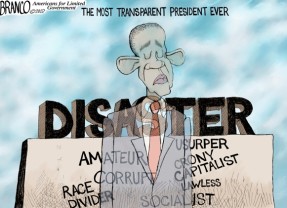
When Barack Hussein Obama first ran for the Presidency of the United States in 2008, he claimed that his economic policies would “foster economic growth from the bottom up and not just from the top down.” Obama promised to put in place “an immediate rescue plan for the middle class” and would end the “tired, worn-out, trickle-down ideologies we’ve been seeing for so many years.”

Obama got everything that he wanted in his first two years in the White House, when Democrats had solid control of Congress — a massive stimulus, auto industry bailouts, temporary middle class tax cuts, vast new regulations on businesses and ObamaCare.

But,  all of his brilliant Socialist Economic  Policies produced the exact opposite of what he’d promised.

So, he pounded his them of “Class Warfare” even harder.

So much so that, during his Re-election Campaign in 2012, President Barack Hussein Obama said,

This country doesn’t just succeed when just a few are doing well at the top. It succeeds when the middle class gets bigger. Our economy doesn’t grow from the top down — it grows from the middle out. We don’t believe that anybody is entitled to success in this country,” said Obama. “But we do believe in opportunity. We believe in a country where hard work pays off and responsibility is rewarded, and everybody is getting a fair shot and everybody is doing their fair share and everybody is playing by the same rules.

On July 24, 2013, Newly-Re-elected President Obama began a series of Stump Speeches titled, “Growing the Economy From the Middle Class Out”.  Here’s an excerpt of the first speech:

…With an endless parade of distractions, political posturing and phony scandals, Washington has taken its eye off the ball. And I am here to say this needs to stop. Short-term thinking and stale debates are not what this moment requires. Our focus must be on the basic economic issues that the matter most to you – the people we represent. And as Washington prepares to enter another budget debate, the stakes for our middle class could not be higher. The countries that are passive in the face of a global economy will lose the competition for good jobs and high living standards. That’s why America has to make the investments necessary to promote long-term growth and shared prosperity. Rebuilding our manufacturing base. Educating our workforce. Upgrading our transportation and information networks. That’s what we need to be talking about. That’s what Washington needs to be focused on.

And that’s why, over the next several weeks, in towns across this country, I will engage the American people in this debate. I will lay out my ideas for how we build on the cornerstones of what it means to be middle class in America, and what it takes to work your way into the middle class in America. Job security, with good wages and durable industries. A good education. A home to call your own. Affordable health care when you get sick. A secure retirement even if you’re not rich. Reducing poverty and inequality. Growing prosperity and opportunity.

So, who is it that is keeping America’s Middle Class from prospering?

I’ll give you a clue: His initials are B.H.O.

The Washington Times reports that

Under President Obama, the richest 10 percent were the only income group of Americans to see their median incomes rise, according to a survey released this week by the Federal Reserve.

The Fed data covered the years 2010-2013, during which period Mr. Obama constantly campaigned against income inequality and won re-election by painting his Republican rival as a tool of Wall Street plutocrats.

“Data from the 2013 [Survey of Consumer Finances] confirm that the shares of income and wealth held by affluent families are at modern historically high levels,” the report said in noting that the median income fell for every 10-percent grouping except the most affluent 10 percent. 

“The 2013 SCF reveals substantial disparities in the evolution of income and net worth since the previous time the survey was conducted, in 2010,” the report stated. The SCF is conducted by the Federal reserve triennially and compiles information about family incomes, credit use, net worth and finances.

The 2010-2013 SCF found that even though real gross domestic product grew by 2.1 percent and civilian unemployment fell from 9.9 percent to 7.5 percent, only families at “the very top of the income distribution saw widespread income gains,” though mean median income levels still lagged behind 2007 numbers.

The report comes just a week after AFL-CIO President Richard Trumka said the union group would not endorse any more Democrats that are following President Obama’s economic policy.

“We will call in and question all of the candidates,” he said. “One of our biggest concerns is who is the candidate’s economic team, because if the present economic team doesn’t change, you are going get the same results.”

The survey also found that family in the middle income bracket (40th to 90th percentiles) saw “very little” change in average real incomes and still have not recovered losses from 2010 and 2007. Families at the bottom of the income distribution continued to see “substantial declines” in average real incomes, a continuing trend from the previous two surveys.

The top percentile of Americans also increased their wealth share since 2010, corresponding to a loss in wealth for the bottom 90 percent of Americans, according to the Fed data.

“The wealth share of the top 3 percent climbed from 44.8 percent in 1989 to 51.8 percent in 2007 and 54.4 percent in 2013. … The share of wealth held by the bottom 90 percent fell from 33.2 percent in 1989 to24.7 percent in 2013,” the report stated.

The prosperous years during the Reagan Presidency marked a period of economic progress for Middle Class Americans. Middle Class Income increased 11 percent after adjustment for inflation, while nearly 20 million new jobs were created.

Those Liberal critics of the 1980s, who argue that the Middle Class shrank in number during those years, are half -right for the wrong reasons. The proportion of Middle Class Americans did indeed decline, but this reflected an upward movement of households into the high income category. Meanwhile, the proportion of Low Income Households declined, as more became middle class. The income growth during the Reagan Presidency increased the size of the pocketbooks of Americans at all income levels.

During Obama’s time in office, America’s major corporations have been hit with punitive measures, including high corporate tax rates and Obamacare, which has caused them to “down-size” their employee rolls and to relocate their call centers to companies like India, which has effected the rest of our economy.

Trickle-Down Economics was simply common sense. Capitalism is the engine that drives America’s economy.

When those who actually hire Americans are attacked by an Administration, naturally, those consequences are felt by those in lower economic strati (that’s you and me, boys and girls).

Obama’s “Trickle-Up” Economic Policy has been a miserable failure.

Because, as Lady Margaret Thatcher once said,

The problem with Socialism is that eventually you run out of other people’s money.

Until He comes,

KJ

Until He Comes,

KJ


America: No God = No Peace

American ChristianityHave you noticed a general unhappiness in our country? People don’t seem to smiling as easily any more. They don’t seem to be as outgoing and friendly. They tend to pass each other on the street, and, even if they know one another, they just keep on walking.  Let’s explore some possible reasons…

Breitbart.com reports that…

Only a third of U.S. adults say they are very happy — minorities show particularly pronounced declines in the past two years, a U.S. survey indicates.

A Harris Poll of 2,345 U.S. adults surveyed online April 10-15 by Harris Interactive found certain groups, such as minorities, recent graduates and the disabled, trended downward in the last couple of years.

“Our happiness index offers insight into what’s on the minds of Americans today and is a reflection of the state of affairs in our country,” Regina Corso, senior vice president of the Harris Poll, said in a statement. “While the attitudes on the economy may be improving, we’re seeing that this is not translating into an improvement in overall happiness.”

Since last measured two years ago, the Happiness Index was especially low among the Hispanic-American population. It is important to note that a causal link cannot be established, it might not be a coincidence that this drop coincides with a political landscape that has seen frequent, sometimes contentious, discussion of immigration policy in recent months, Corso said.

Americans earning under $50,000 per year were less likely to qualify as very happy than in 2011 — down from 33 percent to 29 percent among those earning less than $35,000, and from 35 percent to 32 percent among those earning between $35,000-$49,999.

Those 50 and older were more likely to be very happy than younger people.

If money CAN buy happiness, we’re in a heap o’ trouble…because none of us have any.

According to an article posted on Friday by CBSMoneywatch.com…

Increasing housing prices and the stock market”s posting all-time highs haven’t helped the plight most Americans. The average U.S. household has recovered only 45 percent of the wealth they lost during the recession, according to a report released yesterday from the Federal Reserve Bank of St. Louis.

This finding is a very different picture than one painted in a report earlier this year by the Fed that calculated Americans as a whole had regained 91 percent of their losses. The writers of the report released yesterday point out that the earlier number is based on aggregate household-net-worth data. However, this isn’t adjusted for inflation, population growth or the nature of the wealth. Further, they say much of recovery in net worth is because of the stock market, which means most of the improvement has been a boon only to wealthy families.

“Clearly, the 91 percent recovery of wealth losses portrayed by the aggregate nominal measure paints a different picture than the 45 percent recovery of wealth losses indicated by the average inflation-adjusted household measure,” the report said. “Considering the uneven recovery of wealth across households, a conclusion that the financial damage of the crisis and recession largely has been repaired is not justified,” the researchers said.

Household wealth plunged $16 trillion from the top of the real estate bubble in the third quarter of 2007 to the bottom of the bust in the first quarter of 2009. By the last three months of 2012, American households as a group had regained $14.7 trillion.

The report says almost two-thirds of the increase in aggregate household wealth is due to rising stock prices. This has disproportionately benefited the richest households: About 80 percent of stocks are held by the wealthiest 10 percent of the population.

Much of the total wealth of middle- and lower-income households is based on home values, not stocks. Even though home prices have increased nearly 11 percent in the past year, they remain about 30 percent below their peak.

While Americans continue to pay down their debt, the report says debt levels and problems with rebuilding net worth are the main reasons the recovery has been so slow. Also, the people who bore the brunt of the recession through job losses and reduced income were the ones who had borrowed the most.

The report found that members of the households that suffered the most financially were less educated, relatively young or black or Hispanic, or some combination of these factors. Those families tended to have low savings and high debt, with much of their wealth based on housing.

The poorest households have felt the sharpest losses as a consequence of the recession: “While many Americans lost wealth during the Great Recession, younger, less-educated and nonwhite families lost the greatest percentage of their wealth,” James Bullard, president of the St. Louis Fed, said in a statement. “Household deleveraging, or paying down debt, has played a key role in the recent recession and the slow recovery.”

Americans are being besieged from all sides. Not only is the government taking our money, but, this new Progressive Culture around us, is succeeding in eliminating Godly Influences from our everyday life.

Gallup.com tells us that…

Over three-quarters of Americans (77%) say religion is losing its influence on American life, while 20% say religion’s influence is increasing. These represent Americans’ most negative evaluations of the impact of religion since 1970, although similar to the views measured in recent years.

Americans over the years have generally been more likely to say religion is losing rather than increasing its influence in American life. In addition to the previous peak in views that religion was losing its influence measured in 1969 and 1970, at least 60% of Americans thought religion was losing its influence in 1991-1994, in 1997 and 1999, in 2003, and from 2007 to the present.

Americans were more likely to say religion was increasing rather than decreasing its influence when the question was first asked in 1957, in 1962, at a few points in the 1980s during the Reagan administration, after the 9/11 terrorist attacks in late 2001 and early 2002, and in 2005. The high point for Americans’ belief that religion is increasing its influence, 71%, came in December 2001.

These perceptions of religion’s influence in American society are not related to Americans’ personal religiosity, as measured by church attendance or the self-reported importance of religion in one’s life. In general, highly religious Americans are neither more nor less likely to say religion is losing its influence than those who are not religious. There is, however, a modest relationship between Americans’ ideology as well as partisanship and their views of the influence of religion, with liberals and Democrats more likely than conservatives and Republicans to say religion’s influence is increasing in American society.

And, of course Progressives would be saying that, because the religion they are referring to is a modified “Christianity”, which preaches the salvation of the “Collective” and “Social Justice” for all.

Working hand-in-hand with “The State”, i.e. the Obama Administration, Liberal/Progressive Churches preach this watered-down version of the Gospel to their unwitting congregations, “tickling their ears” and telling them that whatever gets them through the night, is alright.

In these Progressive Churches, the glorification of social programs and modern culture has taken the place of the Glorification of God and the hunger for His Word.

I mean, Gay Marriages are being performed in America’s National Cathedral in Washington, DC!

And, in churches around the country, Bible Studies, Youth Meetings, and Choir Practices, have been replaced with Studies on Philosophy, Voter Registration, sponsored by Organizing For America (Obama), and Yoga Classes.

The very Progressives in Power who have been whining for years about the Separation of Church and State, are the ones responsible for the removal of religion from American’s Everyday Life.

And, the worst part about it…Americans let them.

As I have gotten older (54), I have noticed that, concerning the two generations that have come after me, have consciously moved away from organized religion. Their movement is a result of Christ not being taught in their homes, and parents and other adult role models not providing a Godly example in their young lives, as they were growing up.  Without someone providing that example in their young lives, as my Daddy did for me, they have no Anchor to hold them steady through the Storms of Life and no Solid Rock upon which to stand.

And, unfortunately, that lack of Moral Compass, not only affects these two newest generations of adults, but all of those in their lives, and, eventually, society, as well.

Which is why we are now living in an America, which is well on its way to embracing a nanny-State Mentality, complete with its Situational Ethics and “50 Shades of Gray” Morality.

Gallup.com tells us that 78% of Americans proclaim Christ as their Personal Savior. 

Well, Americans, its time to return to Him.

For our sake, our children’s sake, our grandchildren’s sake, and our country’s sake.

If we ever forget that we are One Nation Under God, then we will be a nation gone under.- Ronald Reagan

Until He Comes,

KJ