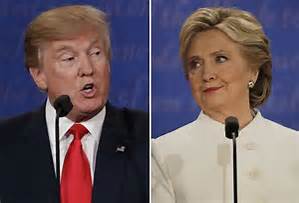
 Judging from the reaction of average Americans on the “New (Social) Media” this morning, Donald J. Trump won last night’s Final Presidential Debate, at times driving his opponent, Hillary Clinton, to the verge of having a good old-fashioned hissy fit (as we refer to an “out-of-body experience” down here in Dixie).
However, all that you are going to hear from Hillary’s Fan Base, the Main Stream Media, today is that Trump said that he may not accept the Election Results on the night of November 8th at face value.
ABC News reports that
When Donald Trump was asked at the third and final presidential debate if he will accept the outcome of the election, and if he loses, concede to the winner, the real estate mogul refused to say.”I will tell you at the time,” said Trump, who has frequently discussed voter fraud and a “rigged” system.
“I’ll keep you in suspense, okay?” Trump told moderator Chris Wallace.
Hillary Clinton responded, “That’s horrifying.”
Trump had just earlier called the election “rigged.”
“She’s guilty of a very, very serious crime,” Trump said of Clinton. “She should not be allowed to run. And just in that respect I say it’s rigged.”
Clinton said, “Every time Donald thinks things are not going in his direction, he claims whatever it is, is rigged against him… There was even a time when he didn’t get an Emmy for his TV program three years in a row and he started tweeting that the Emmys were rigged.”
Trump responded, “Should have gotten it.”
After the debate, Trump campaign manager Kellyanne Conway said of Trump refusing to say whether he would accept the results, “He said he’s going to take a look at the results.”
“Remember, Al Gore did concede,” Conway told ABC News’ Tom Llamas. “He conceded to Governor George W. Bush and then called and rejected the concession and went on to contest the results. It went all the way to the Supreme Court. Election day was early November. Maybe November 6 that year. And that case was decided on December 12.”
When Llamas asked Conway if she thought that was responsible for the democracy, she responded, “I think the most responsible thing that Donald Trump has done for democracy, frankly, was to run in the first place.”
“And I credit him tremendously for making that sacrifice, he and his family. Because a lot of people have run in politics, Tom, for fame or fortune or status, prestige. He had all of that,” Conway said. “And he sacrificed a great deal of that to do this. And the greatest gift he’s given to democracy is really to show people who have begged for years to have an outsider to disrupt the system to have somebody just come and turn the tables over completely. He was willing to do it.”
Sean Spicer, the Republican National Committee’s communications director, told ABC News after the debate that Trump will “accept the results of the election. One hundred percent.”
“I think right now he’s very concerned about the bias that exists in the media,” Spicer said. “I think he wants to make sure people … are focused on the election. But he will accept the results. No question about it.”
“He’s going to win this election soundly,” Spicer said, “And this won’t be an issue.”
Clinton campaign chairman John Podesta said after the debate that Trump “made a tremendous mistake” by refusing to say if he’d accept the outcome.
As my precocious 8-year old Grandson would say,
REALLY, Grandpa?
To the Wayback Machine, Sherman! (That’s a “Mr. Peabody Cartoon Reference for you Millennials out there.)
2000 Events Timeline – Post-Election
November 7, 2000 – Election Day
7:50 pm
The Associated Press declares Vice President Al Gore the victor in Florida, based on Voter News Service projections from exit polls. The major TV networks call Florida for Gore between 7:50 and 8:00pm.
9:30 pm
Florida begins to look more uncertain as the vote totals accumulate more in favor of Texas Gov. George Bush. Bush, talking with reporters, says “The networks called this thing awfully early, but the people actually counting the votes are coming up with a different perspective. So we’re pretty darn upbeat about things.”
10 pm
Networks begin retracting the projection that Gore wins Florida; the state reverts to too close to call.
November 8, 2000
2:15 am
Bush appears to take a decisive lead in Florida. Some estimates have Bush leading Gore by 50,000 votes. Networks project Bush to be the winner of Florida and the Presidency between 2:16 and 2:20 am.
2:30 am
Gore calls Bush to concede the election.
3:00 am
Gore leaves the hotel in Nashville, Tennessee. His motorcade heads to the War Memorial Plaza, where he plans to address supporters.
3:15 am
Gore advisers call the vice president to tell him Bush’s lead in Florida has diminished dramatically. He returns to his hotel without addressing his supporters. Reports show that less than 1,000 votes separates Bush and Gore in the state of Florida.
3:30 am
Gore calls Bush back to retract his concession. Networks retract the projection that Bush wins Florida between 3:57 and 4:15 am. The state reverts to too close to call. The Presidency is once again undecided.
Morning
The final margin of the Florida vote is reported to be 1,784 votes; Bush leads Gore 2,909,135 (48.8%) to 2,907,351 (48.8%) with other candidates receiving 139,616 votes (2.4%).
• Some voting irregularities are alleged, especially in Palm Beach County where voters complain that their punch card ballots were configured in a manner that was confusing.
• A full machine recount of votes is ordered in Florida – this is due to Florida Election Code 102.141 that requires a recount of ballots if the margin of victory is 0.5% or less.
• Florida Governor Jeb Bush officially recuses himself from the process.(courtesy of uselectionatlas.org)
Trump has every right to be wary.
In a post that I wrote back on July 7, 2015, titled, “Hillary Goes on the Warpath Against Voter ID. Dead Voter Bloc Applauds.”, I cited the following story from Newsmax.com, involving last night’s Presidential Debate Loser, Hillary Clinton…
Ohio Gov. John Kasich accused Hillary Clinton of “demagoguery” Friday over a lawsuit filed against his state’s voting rules, saying she should pick on another state, such as her own, where voters have far fewer days to cast a ballot.
“If she wants to sue somebody, let them sue New York,” Kasich told Fox News’ “America’s Newsroom” program. “We have 27 days of voting. In New York, the only voting that occurs is on Election Day. What is she talking about?”
On Thursday in Houston, Clinton accused potential Republican presidential rivals Jeb Bush, Scott Walker, Chris Christie and Rick Perry of being governors in states that have passed laws making it more difficult for Americans to vote.
She called them members of a GOP group that have cut the numbers of days set aside for early voting and have demanded voter ID laws.
Kasich’s state of Ohio, meanwhile, was named along with Walker’s Wisconsin by Democrats in a legal challenge over voting changes. While Clinton’s campaign is not officially involved in the lawsuits, one of the attorneys involved is Marc Elias, her campaign’s general counsel.
Kasich said Friday that he likes Clinton personally, as she has been kind to him, “but the idea that we are going to divide Americans and use demagoguery, I don’t like it.”
He further called the idea of coming into Ohio and saying the state is trying to suppress the vote “silliness.”
“Don’t be running around the country dividing Americans,” said Kasich. “Don’t come in and say we are trying to keep people from voting when her own state has less opportunity for voting. She is going to sue my state? That’s just silly.”
Ohio has multiple days for voting, Kasich again pointed out, adding: “In New York, where she is from, they have one day. Why don’t you take care of business at home before you run around the country using these demagogic statement that we don’t want people to vote?”
Since April of 2010, when I began my daily cathartic exercise of chronicling American Politics, Social Issues, and our Culture, I have documented numerous instances of chicanery involving our elections, both local and national, from the rise and fall of ACORN, the corrupt entity responsible for the “ground game” during the 2008 election of Barack Hussein Obama to abnormalities found in the aftermath of his re-election in 2012, where several Democratically controlled counties’ populations voted 100% for “The Lightbringer.
I know that I have not been alone in noticing the out-of-control voter fraud that has been the rule rather than the exception in recent national elections, and which has been the exclusive stock in trade of the Democratic Party.
Rather than roll over and play dead (which will be the status of some of the Democratic Voters “casting their votes” on November 8th), as the “genteel” Vichy Republicans have in the past, Trump instead last night, chose to issue an overt warning that he will be watching the polls for the Political Chicanery that has become second nature to the Modern Far left Democratic Party.
I personally don’t care if the worshipers of the Washingtonian Status Quo on both sides of the Political Aisle were offended by Trump’s reluctance to accept the Election Results at face value.
As proven in National Surveys, the vast majority of average Americans don’t trust “Crooked Hillary”, either.
Until He Comes,
KJ

 Kingsjester's Blog