
Whitney, Bobbie, and the Cost of “Generational Sin”

Whitney and KristinaRight now, a young woman lies in a coma in a hospital, in a medically induced coma, brought about by addiction.

How did this happen?

Have you ever heard of “Generational Sin”?

Deuteronomy 5:9b-10 states, “I do not leave unpunished the sins of those who hate me, but I punish the children for the sins of their parents to the third and fourth generations. But I lavish love on those who love me and obey my commands, even for a thousand generations.” (NLT)

How it works. When a person has sinned, that sin stands in need of being confessed. If the person doesn’t confess it, then his children must confess it in order to break the generational pattern. Like an “outstanding” debt, the person’s sin “hangs out there,” impacting his descendants, until it is addressed through confession and cleared away. We are not required to take responsibility for our ancestors’ sins, but we are to acknowledge and confess their sin. (We agree with God that they were wrong and that God was right.) God asks us to accept responsibility for our own sin and to repent and be humbled. Understand that the passing down of iniquity (sin) is just that – the passing down of iniquity (sin). My parents’ sin does not become my sin, until I have made the choice to sin myself in the same way.

And, even the children of the Rich and Famous are not exempt.

Pagesix.com reports that

The daughter of late pop queen Whitney Houston was found unconscious in a bathtub at her Georgia home Saturday — nearly three years after her mom died tragically in a tub in a Los Angeles hotel.

Bobbi Kristina Brown was clinging to life after apparently suffering a drug overdose, just as her mother had, “Entertainment Tonight’’ reported, quoting a source who insisted it was not a suicide attempt.

Whitney Houston accidentally drowned in a bathtub inside the Beverly Hilton Hotel on Feb. 11, 2012, with cocaine, Xanax, marijuana and muscle relaxant in her system.

A second source told the magazine it was “no coincidence’’ that the 21-year-old aspiring singer was found in eerily similar circumstances.

Brown’s husband, Nick Gordon, and a friend found her underwater in her home in the Atlanta suburb of Roswell, Ga., and administered CPR until help arrived.

Paramedics took her to a local hospital, where she was in a medically induced coma and breathing with the assistance of a ventilator, police sources said.

Brown’s father, R&B singer Bobby Brown, was at her bedside Saturday.

Brown had recently hinted at wanting to pursue her own music career.

“Promise to release some thangs for your enjoyment. . . One thing you CAN depend on is my mother taught me well,” she tweeted.

On Thursday, she added: “Let’s start this career up&&moving OUT to TO YOU ALLLL quick shall we!?!???!!!!!!!!” along with several music emojis.

She also appeared on the Lifetime reality show “The Houstons: On Our Own” in 2012. She inherited millions of dollars from Houston.

Nick Gordon and Bobbi Kristina BrownPhoto: ZumaPress

But Brown was battling demons of her own.

On her 18th birthday — as well as after Houston’s funeral — she was accused of doing cocaine, the Daily Mail has reported.

Months after Houston’s death, she got engaged to Gordon, whom Houston raised with Brown as an adopted brother.

But her family criticized the relationship, with grandmother Cissy Houston calling it “incestuous.”

And in November 2012, she was busted for speeding after slamming her Chevy Camaro into an embankment in Alpharetta, Ga.

Per additioninfo.org,

According to the National Institute on Drug Abuse, having a parent who is addicted to drugs or alcohol can lead to lifelong problems if the child or teen doesn’t receive help and support.

About 25 percent of U.S. children younger than 18 years are exposed to alcohol abuse or dependence through a family member, according to the National Institute on Alcohol Abuse and Alcoholism. Exposure to drug abuse affects countless others.

More Likely to Become Addicts Themselves
Research shows that these children are more likely to develop depression and anxiety disorders during their teen years. And the likelihood that they will use drugs or alcohol early, and – for both genetic and environmental reasons – become addicted to these substances, is higher than those who do not grow up in these environments. In fact, this population is at the highest risk to become drug and alcohol abusers, according to the National Association for Children of Alcoholics.

Foster Care, the Juvenile Justice System, and Therapy
Children of addicted parents are also more likely to end up in foster care, the juvenile justice system, and – once they reach adulthood – therapy for mental health disorders, marital problems, and trouble parenting their own children.

Addicted parents often lack the ability to provide structure or discipline within their families, according to the National Association for Children of Alcoholics. They also tend to be less patient and to expect more from their children than do non-substance-abusing parents.

Child Abuse
The majority of child welfare professionals report that substance abuse is a factor in at least half of all child abuse cases. More than one-third of these workers say it contributes to at least 75 percent of the cases.

In today’s culture, more and more young people, usually raised in non-Christian Homes, and identifying themselves as “libertarians”, espouse the view, as frequently seen in their posts on Facebook, that drugs should be legalized., and the use of them has no effect on anybody but the user themselves.

And, they are very, very wrong.

Whether you are a Christian or not, one fact is certain, as study after study shows, parents are role models for their children, right or wrong.

If they see you drinking around them, they are more likely to take up drinking.

If they see you using drugs, including smoking pot, they will be more likely to model that behavior, as they get older.

I have always observed that alcoholics and addicts are very selfish people, consumed by a very selfish behavior.

This selfish behavior consumes them to the point where it becomes the priority in their life, requiring more attention that anything else in it, including their children.

In the case of Bobbi, now on Life Support, her self-involved parents, Whitney Houston and Bobby Brown, failed her.

Their sin became “Generational”, when she adopted their lifestyle of drug and alcohol abuse.

God’s Word admonishes us, as parents, to

Train up a child in the way he should go: and when he is old, he will not depart from it.- Proverbs 22:6 (KJV)

If her parents had changed their lifestyle and publicly repented of their drug and alcohol abuse, perhaps Bobbi would not be lying in that Hospital Bed, floating between here and the Afterlife.

And, perhaps her mother would be standing with her father, guiding her in “the way in which she should go”.

Actions have consequences…to more than just the individual acting irresponsibly.

Until He Comes,

KJ
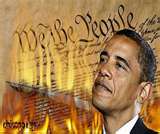
Of Libertines and Idolators: Is America Becoming a Socialist Utopia?

obamaburningconstitutionYesterday, as is my habit, I was perusing over the Drudge Report. Three stories on Drudge caught my eye. I believe that they are a part of a plain…and disturbing pattern.

Please bear with me as I set the table, first. Then, we’ll play “Connect the Dots”.

First, there was the story of a precious little Black child praying. He was not praying to God, nor was he having a conversation with our Savior, Jesus Christ.

Oh no. He was praying to President Barack Hussein Obama.

Barack Obama, thank you for doing everything and all the kind stuff,” the little boy, who identifies himself as Steven, says as he kneels down in typical praying fashion.

“You are good, Barack Obama. You are great and when you get older you will be able to do great things. Love, Steven,” the boy concludes.

Among his sycophantic followers, Obama is is a god. He is “holy”…the object of idolatry…and not to be mocked.  Don’t believe me? Read this story:

The Missouri State Fair on Monday imposed a lifetime ban on a rodeo clown whose depiction of President Barack Obama getting charged by a bull was widely criticized by Democratic and Republican officials alike.

The rodeo clown won’t be allowed to participate or perform at the fair again. Fair officials say they’re also reviewing whether to take any action against the Missouri Rodeo Cowboy Association, the contractor responsible for Saturday’s event.

The entertainment during the bull riding contest featured a clown wearing a mask of Obama with an upside down broomstick attached to his backside. Spectators were asked if they wanted to see “Obama run down by a bull.” Many in the audience responded enthusiastically.

Numerous Missouri officials denounced the act after video and photos were posted online. Some Democratic Missouri lawmakers suggested Monday that there should be financial consequences for the fair.

The fair said in a written statement announcing the clown’s ban that he had engaged in an “unconscionable stunt” that was “inappropriate and not in keeping with the Fair’s standards.” The fair’s press release did not identify the clown.

Now, this last story may not seem like it goes with the others. However, hold tight. I will explain what I am seeing that connects these three stories, after you read this one:

Attorney General Eric H. Holder Jr. announced Monday that low-level, nonviolent drug offenders with no ties to gangs or large-scale drug organizations will no longer be charged with offenses that impose severe mandatory sentences.

The new Justice Department policy is part of a comprehensive prison reform package that Holder unveiled in a speech to the American Bar Association in San Francisco. He also introduced a policy to reduce sentences for elderly, nonviolent inmates and find alternatives to prison for nonviolent criminals.

Justice Department lawyers have worked for months on the proposals, which Holder wants to make the cornerstone of the rest of his tenure.

“We must face the reality that, as it stands, our system is, in too many ways, broken,” Holder said. “And with an outsized, unnecessarily large prison population, we need to ensure that incarceration is used to punish, to deter and to rehabilitate — not merely to warehouse and to forget.”

“A vicious cycle of poverty, criminality and incarceration traps too many Americans and weakens too many communities,” Holder said Monday. (Excerpts of his ­prepared remarks were provided Sunday to The Washington Post.) He added that “many aspects of our criminal justice system may actually exacerbate these problems rather than alleviate them.”

It is clear that “too many Americans go to too many prisons for far too long and for no truly good law enforcement reason,” Holder said. “We cannot simply prosecute or incarcerate our way to becoming a safer nation,” he added later in the speech.

Holder is calling for a change in Justice Department policies to reserve the most severe penalties for drug offenses for serious, high-level or violent drug traffickers. He has directed his 94 U.S. attorneys across the country to develop specific, locally tailored guidelines for determining when federal charges should be filed and when they should not.

Now, let’s play “Connect the Dots”.

The leader of the radical socialist Bolshevik movement that toppled the czarist regime in Russia, in 1917, and head of the first government of the Union of Soviet Socialist Republics (U.S.S.R.), Vladimir Lenin, suffered a stroke in May 1922; a second one, more debilitating, came in March of the following year. This stroke left him mute and ended his political career. When Lenin Died, in Moscow on the evening of January 21, 1924, the Russian people reacted with shock and near-hysterical grief.

The New York Times reported that “it is the general opinion that Lenin’s death will unify and strengthen the Communist Party as nothing else could do. No one who knows them both doubts that Trotsky and Stalin will bury the hatchet over his grave.”

As usual, the New York Times was wrong.Stalin worked quickly to control the situation, encouraging the deification of Lenin, who before his death had called for Stalin s dismissal?while simultaneously working to discredit (and eventually destroy) Trotsky and the rest of his rivals in the Politburo. By 1930, Stalin stood alone at the head of the Soviet state, with all the terrifying machinery Lenin’s revolution had created, at his disposal.

Stalin’s encouragement of the deification Lenin gained him the naive support of the Russian people. Little did they know what they were in for.

Regarding the last story…what better way for Obama to cement himself as the “People’s President”, than to ingratiate himself to those whose “personal pleasure” is of utmost importance to them?

And, what better way to discourage entrepreneurship and work ethic among the populace, setting the stage for the continued advent of a Socialist Utopia?

In conclusion, by playing “Connect the Dots”, with the above stories, one can extrapolate a common thread: All three of them have to do with the direction in which Obama and his Administration wish to take America.

Marx, Lenin, and Stalin would be very proud.

Until He Comes,

KJ

Is America Going to Pot?

ObamapotIs the America we know and love disappearing in a puff of smoke?

Example #1 –

Just over a month after the citizens of Colorado voted overwhelmingly in favor of Amendment 64 to legalize marijuana for recreational use, Democratic Governor John Hickenlooper signed the Executive Order that makes an “official declaration of the vote.”

What does it mean?

“It formalizes the amendment as part of the state Constitution and makes legal the personal use, possession and limited home-growing of marijuana under Colorado law for adults 21 years of age and older,” the Governor’s office wrote in a press release.

That said, the release went on to say that that it is still illegal to buy or sell marijuana or to consume marijuana in public.

Example #2 –

Per a survey taken by Public Policy Polling

Switching now to the topic of marijuana, do you think the use of marijuana should be made legal, or not?

Should be legal, feel strongly 33%

Should be legal, don’t feel strongly 25%

Should not be legal, feel strongly 34%

Should not be legal, don’t feel strongly 5%

Not sure 3%

What do we know about marijuana and it’s effects?

According to the National Institute on Drug Abuse:

Scientists have learned a great deal about how THC acts in the brain to produce its many effects. When someone smokes marijuana, THC rapidly passes from the lungs into the bloodstream, which carries the chemical to the brain and other organs throughout the body.

THC acts upon specific sites in the brain, called cannabinoid receptors, kicking off a series of cellular reactions that ultimately lead to the “high” that users experience when they smoke marijuana. Some brain areas have many cannabinoid receptors; others have few or none. The highest density of cannabinoid receptors are found in parts of the brain that influence pleasure, memory, thinking, concentrating, sensory and time perception, and coordinated movement.

Not surprisingly, marijuana intoxication can cause distorted perceptions, impaired coordination, difficulty with thinking and problem solving, and problems with learning and memory. Research has shown that, in chronic users, marijuana’s adverse impact on learning and memory can last for days or weeks after the acute effects of the drug wear off.2 As a result, someone who smokes marijuana every day may be functioning at a suboptimal intellectual level all of the time.

Research into the effects of long-term cannabis use on the structure of the brain has yielded inconsistent results. It may be that the effects are too subtle for reliable detection by current techniques. A similar challenge arises in studies of the effects of chronic marijuana use on brain function. Brain imaging studies in chronic users tend to show some consistent alterations, but their connection to impaired cognitive functioning is far from clear. This uncertainty may stem from confounding factors such as other drug use, residual drug effects, or withdrawal symptoms in long-term chronic users.

Addictive Potential

Long-term marijuana abuse can lead to addiction; that is, compulsive drug seeking and abuse despite the known harmful effects upon functioning in the context of family, school, work, and recreational activities. Estimates from research suggest that about 9 percent of users become addicted to marijuana; this number increases among those who start young (to about 17 percent) and among daily users (25-50 percent).

Long-term marijuana abusers trying to quit report withdrawal symptoms including: irritability, sleeplessness, decreased appetite, anxiety, and drug craving, all of which can make it difficult to remain abstinent. These symptoms begin within about 1 day following abstinence, peak at 2-3 days, and subside within 1 or 2 weeks following drug cessation.

Marijuana and Mental Health

A number of studies have shown an association between chronic marijuana use and increased rates of anxiety, depression, and schizophrenia. Some of these studies have shown age at first use to be an important risk factor, where early use is a marker of increased vulnerability to later problems. However, at this time, it is not clear whether marijuana use causes mental problems, exacerbates them, or reflects an attempt to self-medicate symptoms already in existence.

Chronic marijuana use, especially in a very young person, may also be a marker of risk for mental illnesses – including addiction – stemming from genetic or environmental vulnerabilities, such as early exposure to stress or violence. Currently, the strongest evidence links marijuana use and schizophrenia and/or related disorders. High doses of marijuana can produce an acute psychotic reaction; in addition, use of the drug may trigger the onset or relapse of schizophrenia in vulnerable individuals.

Just yesterday morning, I was watching the local news when they announced that a fellow I graduated high school with, had escaped from custody, after trying to commit suicide, because the authorities were about to commit him to the looney bin for long-term treatment.

Even back in ’76, this guy had hung out outside the school building in what was affectionately called “the smoke hall”. And, of course, it was well known that he liked to smoke pot.

Even as I type this, I hear thousands of potheads, young and old (picture Tommy Chong), yelling at their monitors, and, among the words I can repeat, are words describing me as a clueless out-of-touch Bible-thumping old man, who doesn’t know what the He@@ he is talking about.

They’re screaming that pot is harmless, non-addictive, and safer than alcohol.

And, they also probably voted for Ron Paul.

…so, their judgement is questionable.

What matters to me, is the fact that no man is an island. No man stands alone. (Hey. That could be a nifty song title. But…I digress.)

And, people struck and killed by a stoned driver, are just as dead as those killed by a drunk driver.

So, stop eating your Cheetos, slackers, and listen tight: Your actions affect others. You are responsible to others. You are not alone in this world.

So, get up out of your bean bag, turn off the TV, move out of Mom’s Basement, and get a job.

Useless, clueless, and stoned is no way to go through life, son.

…Unless, of course, you’re the president.