The Death of Country Music

Hee HawNobody saw him running from sixteenth avenue
They never found the fingerprint or the weapon that was used
But someone killed country music, cut out its heart and soul
They got away with murder down on music row

The almighty dollar and the lust for worldwide fame
Slowly killed tradition and for that someone should hang
They all say not guilty, but the evidence will show
That murder was committed down on music row

For the steel guitars no longer cry and fiddles barely play
But drums and rock ‘n’ roll guitars are mixed up in your face
Old Hank wouldn’t have a chance on today’s radio
Since they committed murder, down on music row

They thought no one would miss it, once it was dead and gone
They said no one would buy them old drinking and cheating songs
Well I’ll still buy ’em
Well there ain’t no justice in it and the hard facts are cold
Murder’s been committed, down on music row

Oh, the steel guitars no longer cry and you can’t hear fiddles play
With drums and rock ‘n roll guitars mixed right up in your face
Why, the hag, he wouldn’t have a chance on today’s radio
Since they committed murder down on music row
Why, they even tell the posse to pack up and go back home
There’s been an awful murder down on music row

“Murder on Music Row”. George Strait/Alan Jackson, 2000

On this Saturday Morning, right across  Stateline Road, from the home of Elvis Presley,Memphis, Tennessee in Northwest Mississippi, I sit here reflecting on Saturday nights, growing up with my Mother and Daddy.

Every family, to this day, have rituals that they observe like clockwork.

Our Saturday Night Ritual was to eat homemade hamburgers, spaghetti, or crockpot beans off of TV trays and watch Hee Haw, the syndicated country music variety show, out of Nashville, which starred Buck Owens, Roy Clark, and a “cast of thousands”.

The snotty folks up in the Northeast Corridor never could figure out what made that “hick show”, that lasted 25 years,  so popular.

After all, it was about traditional American Values, love of God and Country, respecting our American Musical Heritage, and featuring talented performers who wrote songs, sang, played their own instruments, loved and appreciated their fans, and actually behaved like average Americans.

Plus, they had the good grace and common sense to keep their private lives, private.

This week foxnews.com reported that…

The country star opens up about his past, present and future in an interview with Entertainment Tonight’s Nischelle Turner that rivals ABC’s country soap “Nashville” with its real-life drama. Herndon discussed everything from his former drug use, his failed marriages and his current relationship.

“I have an awesome relationship that I’ve been in for a good number of years,” Herndon tells ET in a new sit-down airing Thursday. “[I] love him very much and he loves me.”

Married twice before, Herndon reveals that both of his ex-wives were “absolutely” aware of his sexuality.

“I had a lot of people around me that I trusted at a time and I was like,’Hey, you know this about me but the world doesn’t. So I’m gonna need to call on your services for a little while,'” he confessed. “It was unfortunate that I had to do that, but I felt that’s what I had to do to have my career. Standing on some pretty solid legs today, so I get to tell my truth today.”

The news brings new meaning to the singer’s latest album, “Lies I Told Myself,” which was released in 2013. Today, Herndon reveals that the biggest lie he told himself is “that I couldn’t be gay in country music.”

“I’ve dreamed about being in country music since I was 6 years old,” he said. “It’s my life, it’s what I do, it’s who I am, and I went to great lengths to cover up that fact to be to be a country star.”

Rumors surrounding Herndon’s sexuality first surfaced back in 1995, when an undercover male police officer alleged that the star exposed himself in a park.

“I wish I had really great recall or memory about that,” Herndon said of the allegation. “I think I had been up for like 6 days doing drugs the night and the day was really a huge blur for me.”

Now fully clean and sober, Herndon is looking forward to a future with his partner of five years, joking with ET that he hoped a proposal might follow his big reveal. “God, I’m hoping he asks me right after this interview!” he said.

“I do want children one day, you know,” he added. “I do want to be married one day.”

But for now, Herndon says he’s thrilled to be seeing increasing levels of acceptance in Nashville.

“Traditionally in country music, we don’t see a lot of support for the LGBT community, but that’s changing so much,” he said. “Nashville is changing so much. I mean my goodness… Kacey Musgraves won Song of the Year for [the lyrics] ‘follow your arrow, wherever it points’ and two amazing songwriters that happened to be gay wrote that song.”

Herndon continued, “It gives me a lot of hope that that Nashville is ready for this. I get to be free today. I’m born again today, and I feel like I’m not gonna have any trouble sleeping tonight.”

Herndon’s story inspired fellow country singer Billy Gilman to come out as well.

“It was in that moment that I knew that I’d rather it be from me, than you reading it from somewhere else,” Gilman said in a YouTube video Thursday.

Actually, boys, y’all could have kept your lust for hairy-legged gents to yourselves. America ain’t New York City.

What is happening to country music reflects a lot about the culture we live in.   Artists who actually lived what they sung about like Loretta Lynn, George Jones, Merle Haggard, Tammy Wynette, The Statlers, Jim Ed Brown, Porter Waggoner, Bocephus, Randy Travis, Jeannie C. Riley, and Elvis Presley have been replaced by fashion model wannabes and burned-out rock stars.

Please don’t get me wrong.  There is still a lot of great talent in country music.  Brad Paisley, Alan Jackson, the Zac Brown Band, Toby Keith, Reba McEntire, Martina McBride, Clint Black, Carrie Underwood, and Rascal Flatts, among others, are very talented performers.

However, in our culture of fast lives, fast food, and instant gratification, superficiality sells.  That’s how we got stuck with Barack Hussein Obama (mm mmm mmmm).

It is easier and more profitable for a record company to sell someone who looks good and can sing a little, or release a country music album made by a fading rock star, than it is for them to market someone who is unbelievably talented and writes their own songs, but resembles your next door neighbor.

Remember the Kid Rock, Bruce Springsteen, and Van Morrison country music CD fiascos?  No?  I don’t blame you.  I wouldn’t admit it, either.

Can you imagine Hank Williams, Sr., Patsy Cline, or Buck Owens trying to get a record deal today?

I’m sorry Mr. Williams.  Your vocalization is way too twangy and you drink way too much.  “I Saw The Light”?  What kind of song is that?  A song about redemption?  Get real.  “I’m So Lonesome I Could Cry”?  Who Cares?  You’re just not marketable.

Miss Cline, we can’t use you.  You look like somebody’s next door neighbor.

Mr. Owens, what is the “Bakersfield Sound” that you’re talking about?  That won’t get any airtime in New York City.   “Act Naturally”?  That’s a song?  Next thing you know, you’ll tell me that the Beatles will want to record it.

Now you know why Toby Keith formed his own record label. 

The big recording companies like RCA Nashville and Arista are run like any other business.  Executives are transferred from other cities and other divisions within the company and are judged to be successful by the amount of revenue they generate.  The decision was made several years ago to turn country music into pop music.  Country music started the transition from Kitty Wells to Miranda Lambert and from George Jones to Kid Rock in an effort to claim a bigger share of the CD-buying public.  The disconnect arises when you take a genre that has traditionally sung  about God, America, family, and heartache and try to make it about fashionistas, MTV, and shallow people with situational morality and ethics. 

That dog don’t hunt.

Allow me to close with this video from Alan Jackson and George Strait, of the song featured at the beginning of today’s blog.  As you read earlier, they expressed the situation much more eloquently than I can.

[https://www.youtube.com/watch?v=qgiILl_F7O8]

Until He Comes,

KJ
The Tsunami Hits! Republicans Control Congress!

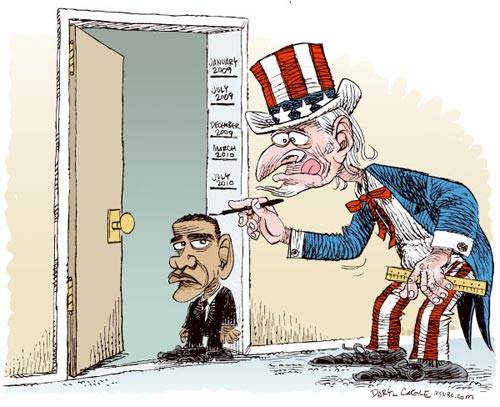
Obama-Shrinks-2Well, it happened.

Americans, in their anger and disgust over the direction which President Barack Hussein Obama, his enablers, and his minions have taken our country, spoke in a loud and clear voice in the Midterm Elections yesterday, giving the Republican Party control of both the House of Representative and the Senate.

The Associated Press reports about the aftermath of this Political Tsunami…

WASHINGTON (AP) — Riding a powerful wave of voter discontent, resurgent Republicans captured control of the Senate and tightened their grip on the House Tuesday night in elections certain to complicate President Barack Obama’s final two years in office.

Republican Mitch McConnell led the way to a new Senate majority, dispatching Democratic challenger Alison Lundergan Grimes in Kentucky after a $78 million campaign of unrelieved negativity. Voters are “hungry for new leadership. They want a reason to be hopeful,” said the man now in line to become majority leader and set the Senate agenda.

Two-term incumbent Mark Pryor of Arkansas was the first Democrat to fall, defeated by freshman Rep. Tom Cotton. Sen. Mark Udall of Colorado was next, defeated by Rep. Cory Gardner. Sen. Kay Hagan also lost, in North Carolina, to Thom Tillis, the speaker of the state House.

Republicans also picked up seats in Iowa, West Virginia, South Dakota and Montana, all states where Democrats retired. They had needed a net gain of six seats to end a Democratic majority in place since 2006.

In the House, with dozens of races uncalled, Republicans had picked up 11 seats that had been in Democratic hands, and given up only one.

A net pickup of 13 would give them more seats in the House than at any time since 1946.

Obama was at the White House as voters remade Congress for the final two years of his tenure — not to his liking. With lawmakers set to convene next week for a postelection session, he invited leaders to a meeting on Friday.

The shift in control of the Senate, coupled with a GOP-led House, probably means a strong GOP assault on budget deficits, additional pressure on Democrats to accept sweeping changes to the health care law that stands as Obama’s signal domestic accomplishment and a bid to reduce federal regulations.

Obama’s ability to win confirmation for lifetime judicial appointments could also suffer, including any Supreme Court vacancies.

Speaker John Boehner, in line for a third term as head of the House, said the new Republican-controlled Congress would vote soon in the new year on the “many common-sense jobs and energy bills that passed the Republican-led House in recent years with bipartisan support but were never even brought to a vote by the outgoing Senate majority.”

Legislation to approve the Keystone XL pipeline from Canada is likely among the disputed issues to be debated.

Said outgoing Senate Majority Leader Harry Reid, a Democrat, ” The message from voters is clear: They want us to work together.”

There were 36 gubernatorial elections on the ballot, and several incumbents struggled against challengers. Tom Wolf captured the Pennsylvania statehouse for the Democrats, defeating Republican Gov. Tom Corbett. Democratic Gov. Pat Quinn lost in Illinois, Obama’s home state. Republican Larry Hogan scored one of the night’s biggest upsets, in Maryland.

How did all this come about?

According to the Washington Post,

…From the outset of the campaign, Republicans had a simple plan: Don’t make mistakes, and make it all about Obama, Obama, Obama. Every new White House crisis would bring a new Republican ad. And every Democratic incumbent would be attacked relentlessly for voting with the president 97 or 98 or 99 percent of the time.

But none of that would work if Republicans did not get the right candidates, a basic tenet that had eluded them in recent elections. This time, party officials pushed bad candidates out, recruited and coached contenders with broad appeal and resuscitated two flailing incumbents, Roberts and Sen. Thad Cochran of Mississippi.
Rival organizations also improved coordination with each other and beefed up their opposition research to wreak havoc on Democrats, while the party closed the gap on data, digital and voter turnout programs.

“We had to recruit candidates, and we had to train them,” said Rob Collins, executive director of the National Republican Senatorial Committee (NRSC). “We had to bring back our incumbents. We had to modernize creaky campaigns. And we had to prevent the mistakes that have plagued our party.”

Democrats began the 2014 campaign with a big disadvantage: They had to defend seats in six deeply Republican states — enough to lose the Senate — and a handful of others in swing states.

Burdened by the climate, Democrats believed they still could win if they localized races and framed each as a choice between two candidates. The strategy worked in 2012. On his office windowsill at the Democratic Senatorial Campaign Committee (DSCC), the group’s executive director, Guy Cecil, displayed a beer mug shaped like a cowboy boot with the name “Heidi” on the side — a reminder of how Democrat Heidi Heitkamp won a Senate seat that year in heavily Republican North Dakota.

Senate Democrats calculated that to win in red states, they also had to alter the midterm electorate.

“There’s basically two Americas — there’s midterm America and there’s presidential-year America,” White House senior adviser Dan Pfeiffer said. “They’re almost apples and oranges. The question was, could Obama voters become Democratic voters?”

Evidently not.

The Democrats never realized that it was too late to separate themselves from their fallen messiah, the “clean and articulate”, unvetted candidate, who, through media manipulation and outrageous propaganda, they foisted on an American public, thanks to America’s Low Information Voters, who desperately wanted to make history, by elected the first Black President (Bubba Clinton, notwithstanding).

Last night, the Democrats paid for their deception and their arrogance, in believing that they could take our country in a direction which the overwhelming majority of Americans do not want to go.

They reaped what they have sewn.

Now, the Republicans have to prove their trustworthiness to all of us who voted them in.

Their actions  will have to reflect our wishes, not their own. They must hold the line against the egregious Executive Orders which will surely be coming from the desk of the Petulant President Pantywaist, since he has lost the ability to get his socialist brand of legislation passed through Congress.

The first one will be a massive Amnesty Order, which White House Officials claim will be put in action by Baracky Claus before Christmas.

If Republicans wish to win the Presidential Election in 2016, they had better pay attention to what the majority of Americans want.

Last night showed what happens  to “public servants” when they only serve special interest groups…and themselves.

Until He Comes,

KJ

Veterans Day 2013

Veterans Day

Veterans Day was formerly known as Armistice Day, and wasoriginally set aside as a U.S. legal holiday to honor the end of World War I, which took place on November 11, 1918. In legislation that was passed in 1938, November 11 was “dedicated to the cause of world peace and to be hereafter celebrated and known as ‘Armistice Day.'” As such, this new legal holiday honored World War I veterans.

In 1954, after World War II and the Korean War, the 83rd U.S. Congress, at the urging of the veterans service organizations, changed the Act of 1938 by striking out the word “Armistice” and inserting the word “Veterans.” With the approval of this legislation on June 1, 1954, Nov. 11 became a day to honor American veterans of all wars.

In 1968, the Uniforms Holiday Bill created three-day weekends for federal employees by celebrating four national holidays on Mondays: Washington’s Birthday, Memorial Day, Veterans Day, and Columbus Day. Under this bill, Veterans Day was moved to the last Monday of October. Many states did not agree with this decision and continued to celebrate the holiday on its original date. The first Veterans Day under the new law was observed with much confusion on Oct. 25, 1971.

Finally on September 20, 1975, President Gerald R. Ford signed a law which returned the annual observance of Veterans Day to its original date of Nov. 11, beginning in 1978. Since then, the Veterans Day holiday has been observed on Nov. 11.

In my research for today’s blog, I came across a speech that explains the significance of this day, far better than I ever could.

On Veterans Day, 1985, at Arlington Cemetery, President Ronald Reagan said the following,

…We are gathered at the National Cemetery, which provides a final resting place for the heroes who have defended our country since the Civil War. This amphitheater, this place for speeches, is more central to this cemetery than it first might seem apparent, for all we can ever do for our heroes is remember them and remember what they did — and memories are transmitted through words.

Sometime back I received in the name of our country the bodies of four marines who had died while on active duty. I said then that there is a special sadness that accompanies the death of a serviceman, for we’re never quite good enough to them-not really; we can’t be, because what they gave us is beyond our powers to repay. And so, when a serviceman dies, it’s a tear in the fabric, a break in the whole, and all we can do is remember.

It is, in a way, an odd thing to honor those who died in defense of our country, in defense of us, in wars far away. The imagination plays a trick. We see these soldiers in our mind as old and wise. We see them as something like the Founding Fathers, grave and gray haired. But most of them were boys when they died, and they gave up two lives — the one they were living and the one they would have lived. When they died, they gave up their chance to be husbands and fathers and grandfathers. They gave up their chance to be revered old men. They gave up everything for our country, for us. And all we can do is remember.

…There’s always someone who is remembering for us. No matter what time of year it is or what time of day, there are always people who come to this cemetery, leave a flag or a flower or a little rock on a headstone. And they stop and bow their heads and communicate what they wished to communicate. They say, “Hello, Johnny,” or “Hello, Bob. We still think of you. You’re still with us. We never got over you, and we pray for you still, and we’ll see you again. We’ll all meet again.” In a way, they represent us, these relatives and friends, and they speak for us as they walk among the headstones and remember. It’s not so hard to summon memory, but it’s hard to recapture meaning.

And the living have a responsibility to remember the conditions that led to the wars in which our heroes died. Perhaps we can start by remembering this: that all of those who died for us and our country were, in one way or another, victims of a peace process that failed; victims of a decision to forget certain things; to forget, for instance, that the surest way to keep a peace going is to stay strong. Weakness, after all, is a temptation — it tempts the pugnacious to assert themselves — but strength is a declaration that cannot be misunderstood. Strength is a condition that declares actions have consequences. Strength is a prudent warning to the belligerent that aggression need not go unanswered.

Peace fails when we forget what we stand for. It fails when we forget that our Republic is based on firm principles, principles that have real meaning, that with them, we are the last, best hope of man on Earth; without them, we’re little more than the crust of a continent. Peace also fails when we forget to bring to the bargaining table God’s first intellectual gift to man: common sense. Common sense gives us a realistic knowledge of human beings and how they think, how they live in the world, what motivates them. Common sense tells us that man has magic in him, but also clay. Common sense can tell the difference between right and wrong. Common sense forgives error, but it always recognizes it to be error first.

We endanger the peace and confuse all issues when we obscure the truth; when we refuse to name an act for what it is; when we refuse to see the obvious and seek safety in Almighty. Peace is only maintained and won by those who have clear eyes and brave minds. Peace is imperiled when we forget to try for agreements and settlements and treaties; when we forget to hold out our hands and strive; when we forget that God gave us talents to use in securing the ends He desires. Peace fails when we forget that agreements, once made, cannot be broken without a price.

Each new day carries within it the potential for breakthroughs, for progress. Each new day bursts with possibilities. And so, hope is realistic and despair a pointless little sin. And peace fails when we forget to pray to the source of all peace and life and happiness. I think sometimes of General Matthew Ridgeway, who, the night before D-day, tossed sleepless on his cot and talked to the Lord and listened for the promise that God made to Joshua: “I will not fail thee, nor forsake thee.”

We’re surrounded today by the dead of our wars. We owe them a debt we can never repay. All we can do is remember them and what they did and why they had to be brave for us. All we can do is try to see that other young men never have to join them. Today, as never before, we must pledge to remember the things that will continue the peace. Today, as never before, we must pray for God’s help in broadening and deepening the peace we enjoy. Let us pray for freedom and justice and a more stable world. And let us make a compact today with the dead, a promise in the words for which General Ridgeway listened, “I will not fail thee, nor forsake thee.”

In memory of those who gave the last full measure of devotion, may our efforts to achieve lasting peace gain strength. And through whatever coincidence or accident of timing, I tell you that a week from now when I am some thousands of miles away, believe me, the memory and the importance of this day will be in the forefront of my mind and in my heart.

Thank you. God bless you all, and God bless America.

Until He Comes,

KJ