
With Freedom Comes Responsibility

americaneagleflagHave you ever thought about what it truly means to be free?

Does “Freedom” mean that you can run naked down the street and then through a playground of young children? Does it mean that you can marry a 9 year old? Does it mean that you can smoke a lid of marijuana, go out and get in your car, have an accident, and maim or kill somebody?

Outside Independence Hall when the Constitutional Convention of 1787 ended, Mrs. Powel of Philadelphia asked Benjamin Franklin, “Well, Doctor, what have we got, a republic or a monarchy?” With no hesitation whatsoever, Franklin responded, “A republic, if you can keep it.”

What did he mean by that? Was he merely speaking of the inner workings of the Federal Government, which he and the Founding Fathers so masterfully designed?

Or, was he talking about this complex matter known as American Freedom?

Ronald Reagan said,

Freedom is never more than one generation away from extinction. We didn’t pass it to our children in the bloodstream. It must be fought for, protected, and handed on for them to do the same.

Was Ronaldus Magnus speaking about our Freedom as a nation? Or, the freedom of the individual?

The answer is yes. Both.

President Reagan knew how fragile this precious thing called freedom is. So did Dr. Franklin.

Dr. Franklin, along with our other Founding Fathers, pledged his life, his fortune, and his sacred honor in pursuit of it.

When he made that now-famous quote to Mrs. Powel, he was expressing his worry that seceding generations, having attained their freedom so easily, might grow lackadaisical and so spoiled by it, that they would squander it through self-indulgence. Franklin was, in fact, so leery of losing this new republic that he said,

Those who would give up essential Liberty, to purchase a little temporary Safety, deserve neither Liberty nor Safety.

He was afraid that Americans would rely and trust those in power over them to the extent that they would surrender their freedom to them.

Sound familiar? Does the phrase “gun control” ring a bell?

I know that it is a phrase which you have no doubt heard before, but, as I write this blog, we are closer to losing this fragile American Freedom, than we have been since my parent’s generation, known as “the Greatest Generation”.

Please allow me to relate to you a story about my Daddy (a Southern colloquialism denoting a male parental unit), an average young man, tossed into a situation beyond his wildest imagination. One of those “fight or flight situations” all the psychiatrists like to theorize about in the Halls of Academia.  However, this was no theory. This situation was as real as it gets:

By the time the sun set on June 6, 1944,more than 9,000 Allied soldiers were dead or wounded, and more than 100,000 had made it ashore, capturing French coastal villages. Within weeks, supplies were being unloaded at Utah and Omaha beachheads at the rate of more than 20,000 tons per day. By June 11, more than 326,000 troops, 55,000 vehicles, and 105,000 tons of supplies had been landed on the beaches. By June 30, the Allies had established a firm foothold in Normandy. Allied forces crossed the River Seine on August 19.

There has never been an exact count of the sacrifices made on D-Day. Although, it is estimated that more than 425,000 Allied and German troops were killed, wounded, or went missing during the battle. 209,000 of those who lost their lives were Allied forces.

Among the young men who stepped off those boats, in a hail of gunfire, was a fellow named Edward, whom everyone called Ned, from the small town of Helena, Arkansas.  Already in his young life, Ned had been forced to drop out of school in the sixth grade, in order to work at the local movie theater to help support his mother, brother, and sister faced with the ravages of the Great Depression.

He was a gentle man who loved to laugh and sing, having recorded several 78 rpm records in the do-it-yourself booths of the day. And now, he found himself, a Master Sergeant in an Army Engineering Unit, stepping off of a boat into the unknown, watching his comrades being mercilessly gunned down around him.

Ned, along with the rest of his unit who survived the initial assault, would go on to assist in the cleaning out of the Concentration Camps, bearing witness to man’s inhumanity to man.

The horrors he saw had a profound effect on Ned.  One that he would keep to himself for the remainder of his life.  While my older sisters and I knew that he served with an Engineering Unit in World War II, we did not know the full extent of his service, until we found his medal, honoring his participation in the Invasion of Normandy, going through his belongings after he passed away on December 29, 1997.

There are a number of Americans nowadays who seem to believe that “Freedom” is merely a personal thing, a state which is unaffected by any unethical, immoral, or irresponsible actions committed by those around them, including family, friends, or strangers. They, in turn, seem oblivious of their responsibility to other Americans, as we all attempt to protect and nurture this fragile thing we call “Freedom”.

Our Legacy of Freedom, bequeathed to us as American citizens, is not  just the blessing of being a free people, but, the responsibility that goes with it, as my Daddy knew all too well…

a responsibility to our family, our friends, our fellow citizens, and the Author of Our Freedom as Americans, Our Creator.

A responsibility that is our charge to keep.

Until He Comes, 

KJ
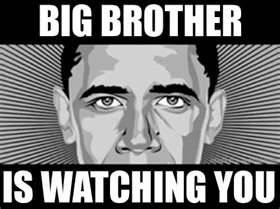
Welcome to the USSA: Now, About That “Right to Privacy”…

obamabigbro Your personal information is no longer personal.

Per Reuters.com:

The Obama administration is drawing up plans to give all U.S. spy agencies full access to a massive database that contains financial data on American citizens and others who bank in the country, according to a Treasury Department document seen by Reuters.

The proposed plan represents a major step by U.S. intelligence agencies to spot and track down terrorist networks and crime syndicates by bringing together financial databanks, criminal records and military intelligence. The plan, which legal experts say is permissible under U.S. law, is nonetheless likely to trigger intense criticism from privacy advocates.

Financial institutions that operate in the United States are required by law to file reports of “suspicious customer activity,” such as large money transfers or unusually structured bank accounts, to Treasury’s Financial Crimes Enforcement Network (FinCEN).

The Federal Bureau of Investigation already has full access to the database. However, intelligence agencies, such as the Central Intelligence Agency and the National Security Agency, currently have to make case-by-case requests for information to FinCEN.

The Treasury plan would give spy agencies the ability to analyze more raw financial data than they have ever had before, helping them look for patterns that could reveal attack plots or criminal schemes.

The planning document, dated March 4, shows that the proposal is still in its early stages of development, and it is not known when implementation might begin.

Financial institutions file more than 15 million “suspicious activity reports” every year, according to Treasury. Banks, for instance, are required to report all personal cash transactions exceeding $10,000, as well as suspected incidents of money laundering, loan fraud, computer hacking or counterfeiting.

“For these reports to be of value in detecting money laundering, they must be accessible to law enforcement, counter-terrorism agencies, financial regulators, and the intelligence community,” said the Treasury planning document.

A Treasury spokesperson said U.S. law permits FinCEN to share information with intelligence agencies to help detect and thwart threats to national security, provided they adhere to safeguards outlined in the Bank Secrecy Act. “Law enforcement and intelligence community members with access to this information are bound by these safeguards,” the spokesperson said in a statement.

Some privacy watchdogs expressed concern about the plan when Reuters outlined it to them.

A move like the FinCEN proposal “raises concerns as to whether people could find their information in a file as a potential terrorist suspect without having the appropriate predicate for that and find themselves potentially falsely accused,” said Sharon Bradford Franklin, senior counsel for the Rule of Law Program at the Constitution Project, a non-profit watchdog group.

Despite these concerns, legal experts emphasize that this sharing of data is permissible under U.S. law. Specifically, banks’ suspicious activity reporting requirements are dictated by a combination of the Bank Secrecy Act and the USA PATRIOT Act, which offer some privacy safeguards.

Speaking of records, are you aware that your medical records are in the process of being digitized?

JudicialWatch.org reports that

In a classic example of how government blows through your tax dollars, billions have been squandered on a faulty electronic medical records system that operates with no oversight and continues receiving big wads of cash from Uncle Sam.

It gets better; by the time it’s all said and done—in about four more years according to government estimates—American taxpayers will have been fleeced $6.6 billion! It’s all part of the Obama Administration’s hostile takeover of the nation’s healthcare system. The idea behind this plan is to switch medical records from paper to digital to create a centralized system that supposedly improves the quality of health care.

The overhaul won’t come cheap and the government is offering hospitals and doctors billions to switch to electronic medical records. The money has come largely from President Obama’s fraud-infested $787 billion stimulus which was supposed to jump start the economy and put Americans back to work. Instead the economy is a disaster as the nation suffers through a staggering $16 trillion (and growing) deficit and unemployment is at record highs.

This has not affected the cash flow to government programs, however. In this case the Centers for Medicare and Medicaid Services (CMS) is the agency that cuts the checks to healthcare providers that agree to switch to electronic records. So far CMS has doled out $3.6 billion to 74,317 medical providers, but the agency doesn’t bother following up to assure the money is appropriately spent. In fact, CMS fails to verify if providers are meeting the required quality goals, according to a federal audit released this week.

Investigators from the Department of Health and Human Services Inspector General warn in their report that the electronic records program is vulnerable to abuse. Furthermore, they say immediate efforts should be made to strengthen oversight and prevent tax dollars from being wasted. This is not an unreasonable request considering doctors receive up to $44,000 and hospitals a minimum of $ 2 million to switch from paper to digital records.

Here is the scary response, included in the HHS watchdog report, from the head of the CMS (Marilyn Tavenner) on the idea of requiring healthcare providers to prove they’re meeting quality requirements before they get U.S. tax dollars. It would be burdensome, Tavenner said, and it would “significantly delay payments.” Spoken like at true government bureaucrat!

Michelle Malkin adds:

Oversight is lax. Cronyism is rife. The job-killing and privacy-undermining consequences have only just begun.

The program was originally sold as a cost-saving measure. In theory, modernizing record-collection is a good idea, and many private health care providers have already made the change. But as with many government “incentive” programs, the EMR bribe is a tax-subsidized, one-size-fits-all mandate. This one pressures health care professionals and hospitals across the country into radically federalizing their patient data and opening up medical information to untold abuse. Penalties kick in for any provider that hasn’t switched over by 2014.

So, what’s it to you? Well, $4 billion has already gone out to 82,535 professionals and 1,474 hospitals, and a total of $6 billion will be doled out by 2016. But the feds’ reckless profligacy, neglect and favoritism have done more harm than good.

Don’t take my word for it. A recent report released by the Department of Health and Human Services Inspector General acknowledged that the incentive system is “vulnerable to paying incentives to professionals and hospitals that do not fully meet” the program’s quality assurance requirements. The federal health bureaucracy “has not implemented strong prepayment safeguards, and its ability to safeguard incentive payments postpayment is also limited,” the IG concluded.

Translation: No one is actually verifying whether the transition from paper to electronic is improving patient outcomes and health services. No one is actually guarding against GIGO (garbage in, garbage out). No one is checking whether recipients of the EMR incentives are receiving money redundantly (e.g., raking in payments when they’ve already converted to electronic records). No one is actually protecting private data from fraud, abuse or exploitation.

Little is being done to recoup ill-gotten payments. In any case, such “pay and chase” policing after the fact is a crummy way to run government in lean times — or in fat times, for that matter.

Allow me to summarize all of this for you. The bottom line is this: The Obama Administration is gathering information about us (The Proletariat) in a manner eerily reminiscent of the old Russian Politboro.

Americans are not going to be able to buy a Big Gulp or have a hangnail removed without the Federal Government knowing about it.

Ted Cruz, Republican Senator from Texas, hit the nail on the head, when he said,

I think President Obama is the most radical president this nation’s ever seen. And in particular, I think he is a true believer in government control of the economy and of our everyday lives. In my judgment, we are facing what I consider to be the epic battle of our generation, quite literally the battle over whether we remain a free market nation.

Hang tough, Americans.

Until He Comes,

KJ