A Yuletide Message Featuring Ben Stein and Tim Tebow

Back in 2005, writer/producer/actor/financial expert/whatever he wants to be Ben Stein wrote the following piece about The War on Christianity and Christmas:

Herewith at this happy time of year, a few confessions from my beating heart:

I have no freaking clue who Nick and Jessica are. I see them on the cover of People and Us constantly when I am buying my dog biscuits and kitty litter. I often ask the checkers at the grocery stores. They never know who Nick and Jessica are either. Who are they? Will it change my life if I know who they are and why they have broken up? Why are they so important? I don’t know who Lindsay Lohan is, either, and I do not care at all about Tom Cruise’s wife.

Am I going to be called before a Senate committee and asked if I am a subversive? Maybe, but I just have no clue who Nick and Jessica are. Is this what it means to be no longer young. It’s not so bad.

Next confession: I am a Jew, and every single one of my ancestors was Jewish. And it does not bother me even a little bit when people call those beautiful lit up, bejeweled trees Christmas trees. I don’t feel threatened. I don’t feel discriminated against. That’s what they are: Christmas trees. It doesn’t bother me a bit when people say, “Merry Christmas” to me. I don’t think they are slighting me or getting ready to put me in a ghetto. In fact, I kind of like it. It shows that we are all brothers and sisters celebrating this happy time of year. It doesn’t bother me at all that there is a manger scene on display at a key intersection near my beach house in Malibu. If people want a creche, it’s just as fine with me as is the Menorah a few hundred yards away.

I don’t like getting pushed around for being a Jew and I don’t think Christians like getting pushed around for being Christians. I think people who believe in God are sick and tired of getting pushed around, period. I have no idea where the concept came from that America is an explicitly atheist country. I can’t find it in the Constitution and I don’t like it being shoved down my throat.

Or maybe I can put it another way: where did the idea come from that we should worship Nick and Jessica and we aren’t allowed to worship God as we understand Him?

I guess that’s a sign that I’m getting old, too. But there are a lot of us who are wondering where Nick and Jessica came from and where the America we knew went to.

Little did Ben Stein know that a young man from the University of Florida would become a focal point, reminding Americans about those values he espoused 6 Christmases ago.

I realize that I’ve written about Denver Broncos starting Quarterback Tim Tebow before, but, especially during this time of the celebration of the first Christmas gift, God’s only begotten son, I believe that spotlighting something extraordinary that this young man did (besides winning a 13-10 game yesterday against the Chicago Bears) is very appropriate:

An 8-year-old cancer patient, Blake Appleton, received a much-needed morale boost recently — a surprise phone call from his long-time hero Tim Tebow of the Denver Broncos.

The call came this month at a particularly grim time for Blake and his family. Blake, a native of Lake Worth, Fla., recently had told his mother that he no longer wants to undergo cancer treatment after being diagnosed with a deadly brain tumor. “Without treatment, he may only have six months,” his mother, Miranda Appleton, told MyFoxOrlando.com.

“We’re in the restroom of all places, and he starts to cry,” she said. “I asked him why he was crying, and he told me, ‘Mommy, I don’t want you to be unhappy with me, but I don’t want to do anymore chemotherapy. I can’t handle it anymore.'”

Blake’s mother told MyFoxOrlando.com, “I don’t have time to cry. It might be a moment I’m missing with him.”

One of the family’s happier moments happened last week, when Tebow, a former Florida Gators star, called Blake in the hospital and sent him a personally signed football.

Saturday, Patton Dodd, writing for the Wall Street Journal, wrote:

Last week, after the Broncos’ victory against Minnesota, Mr. Tebow was asked by a reporter to name something memorable that had been said to him in the wake of the extraordinary win.

“I’ll tell you one thing that happened during the week that I remember,” he said. Mr. Tebow proceeded to talk about spending time with a young leukemia patient from Florida who had just been transferred to hospice care and about how delighted Mr. Tebow was to say the kid’s name on television and to let him know that someone cared.

Mr. Tebow may or may not enjoy long-term success as an NFL quarterback. His current streak will run its course, and the Broncos might well move on to another quarterback, one who is more obviously suited to the pro game.

But win or lose, Tim Tebow will compete hard—and when he’s done, he will thank God and remind all of us that it’s just a game.

And, as we move from quarter to quarter during this game we call life, as Ben Stein and Tim Tebow remind us, it’s important to keep heading toward the end zone and to remember The Reason for the Season.


Battleground Texas: Away in a Manger

As we draw near to Christmas, this weekend will be a maelstrom of activity, as Americans attempt to finish their shopping and struggle to finish putting up their Christmas decorations.

Among those decorations in the overwhelming majority of American homes will be a nativity scene, depicting the birth of Jesus Christ in a lowly manger, a little over 2011 years ago.

Nativity scenes, in both public places and private homes, have been around since right after World War I.  By the time the 1950s rolled around, companies were selling lawn ornaments of non-fading, long-lasting, weather resistant materials telling the nativity story.

By the 1970s, churches and community organizations increasingly included animals in nativity pageants. Since then, automobile-accessible “drive-through” scenes with sheep and donkeys have become popular.

In 2005, President of the United States of America, George W. Bush and his wife, First Lady of the United States, Laura Bush displayed an 18th century Italian presepio in the East Room of the White House, Washington, D.C., United States. The presepio was donated to the White House in the last decades of the 20th century.

On her Christmas Day 2007 television show, Martha Stewart exhibited the nativity scene she sculpted in pottery class at the Alderson Federal Prison Camp in Alderson, West Virginia while serving a 2005 sentence. She remarked, “Even though every inmate was only allowed to do one a month, and I was only there for five months, I begged because I said I was an expert potter—ceramicist actually—and could I please make the entire nativity scene.” She supplemented her nativity figurines on the show with tiny artificial palm trees imported from Germany.

Perhaps the best known nativity scene in America is the Neapolitan Baroque Crèche displayed annually in the Medieval Sculpture Hall of the Metropolitan Museum of Art in New York City. Its backdrop is a 1763 choir screen from the Cathedral of Valladolid and a twenty-foot blue spruce decorated with a host of 18th-century angels. The nativity figures are placed at the tree’s base. The crèche was the gift of Loretta Hines Howard in 1964, and the choir screen was the gift of The William Randolph Hearst Foundation in 1956.

Since it is Christmas, there has to be an Ebeneezer Scrooge,  someone who is too filled with bitterness toward the Almighty and their own miserable lives, to allow others to celebrate the joyous birth of the Christ child.

In 1969, the American Civil Liberties Union (representing three clergymen, an atheist, and a leader of the American Ethical Society), tried to block the construction of a nativity scene on the Ellipse in Washington, D.C. The case continued until September 26, 1973, when the court ruled in favor of the plaintiffs and found the involvement of the Interior Department and the National Park Service in the Pageant of Peace amounted to government support for religion. The court opined that the nativity scene should be dropped from the pageant or the government end its participation in the event in order to avoid “excessive entanglements” between government and religion. In 1973, the nativity scene vanished. Nativity scenes are permitted on public lands in the United States as long as equal time is given to non-religious symbols.

In 1985, the United States Supreme Court ruled in ACLU v. Scarsdale, New York that nativity scenes on public lands violate separation of church and state statutes unless they comply with “The Reindeer Rule”—a regulation calling for equal opportunity for non-religious symbols, such as reindeer.

In 1994, the Christmas in the Park Board of San Jose, California, removed a statue of the infant Jesus from Plaza de Cesar Chavez Park and replaced it with a statue of the plumed Aztec god, Quetzalcoatl, commissioned with US$500,000 of public funds. In response, protestors staged a living nativity scene in the park.

In 2006, a lawsuit was brought against the state of Washington when it permitted a public display of a “holiday” tree and a menorah but not a nativity scene. Because of the lawsuit, the decision was made to permit a nativity scene to be displayed in the rotunda of the state Capitol, in Olympia.

This year is no different.  The Freedom from Religion Foundation, a group of 13,000 atheists from the Great White North, whose mission in life is to stamp out Christianity in public places , and making themselves a bunch of money by filing lawsuits against Christians, are at it again.

Theblaze.com reports that

Christian pastors in Henderson County, Texas, are fighting back against atheists who are demanding that a nativity scene located on a courthouse lawn be taken down.

The group behind the complains, the Wisconsin-based Freedom From Religion Foundation, frequently targets faith and religion projects that are placed on public lands. The group sent a letter to the county that explains how a local resident, who wishes to remain nameless, is offended by the scene.

Here is some of the text from the letter (via Malakoff News):

It is our information and understanding that a large nativity scene is on display at the Henderson County Courthouse and that it is the only seasonal display on the grounds (see photo enclosed). It is unlawful for the County to maintain, erect, or host this nativity scene, thus singling out, showing preference for, and endorsing one religion. The Supreme Court has ruled it is impermissible to place a nativity scene as the sole focus of a display on government property. […]

We request that, as Henderson County Commissioners, you take immediate action to ensure that no religious displays are on city or county property. Please inform us in writing of the steps you are taking to remedy this First Amendment violation so that we may notify our complainant.

“That Christianity was being promoted, endorsed by local government and this made them feel unwelcomed,” said Annie Laurie Gaylor, the co-founder of the Freedom from Religion Foundation. “It sends a message of intimidation and exclusion to non-Christians and non believers this time of year.”

As I have documented in previous posts, this group of bitter 8 per centers  erroneously believes that their right to exercise their belief system trumps the right of 75% of Americans to display their Christianity in public.

Regarding the public nativity scene, I have a couple of suggestions for the FFRF:

1.  There are three other doors to the courthouse.  Use one of them.

2.  If the public nativity scene offends you…don’t look at it.

Merry Christmas, y’all!

American “Superpowers” Activate!

Last night, after a day spent shopping for bargains, my bride brought home three movies from Redbox which we had been wanting to watch.  As I was laying in bed this morning, with the garlic and herb-injected leftover turkey attempting to make a comeback, I thought about the most important characteristics of the three heroes of those movies.

In The Zookeeper:

Beloved zookeeper Griffin Keyes (Kevin James) decides to quit his job to dive into the dating pool, and finds that his animal friends have been harboring an incredible secret in this comedy from director Frank Coraci (The Wedding Singer, Click). Griffin is a single guy who loves his job at the Franklin Park Zoo. He has a special bond with the animals, yet he can’t help but feel lonely each night when he returns to an empty house. Eventually deciding that a more prestigious job may be the key to finding a new girlfriend, Griffin prepares to turn in his walking papers and reinvent himself. But when word gets out to the animals that Griffin will soon be leaving, they realize the only way to keep him around is to reveal they have the gift of the gab. Perhaps with a little dating advice from his friends in the animal kingdom, this lonely zookeeper will manage to meet the girl of his dreams without losing the job he loves. Rosario Dawson co-stars in a comedy featuring the voices of Sylvester Stallone, Adam Sandler, Cher, and Nick Nolte.

Griffin’s greatest “suerpower” was his great big heart.  That still, small voice within, which exhibited itself in his compassion for both the people and the animals in his life.  Americans see that same compassion in the selfless service of Americans in our Armed Forces, from our “Weekend Warriors” to our troops in combat throughout the world.

In Green Lantern:

A test pilot embraces his destiny as a cosmic superhero in Casino Royale director Martin Campbell’s adaptation of the popular DC Comics series. Ever since he saw his fearless father perish in a tragic aviation mishap, all Hal Jordan (Ryan Reynolds) could think about was flying — it was the only thing the brash, cocky, and irresponsible test pilot ever truly excelled at. Little did he realize he was destined for something much bigger. Somewhere out in space, a powerful force of evil known as Parallax is spreading fear and destruction; the only hope for defeating Parallax is the Green Lantern Corps, a group of intergalactic warriors powered by the force of will. When legendary Green Lantern Abin Sur (Temuera Morrison) is sent hurtling toward planet Earth after a deadly encounter with Parallax, his ring chooses Hal to continue the fight. The ring spirits our hero away to the Green Lantern’s home planet of Oa for training. The first human ever to receive the honor of becoming a Green Lantern, Hal is viewed with scorn by the league’s leader, Sinestro (Mark Strong), who trains him alongside the hulking Kilowog (voice of Michael Clarke Duncan). Later, on planet Earth, frail scientist Hector Hammond (Peter Sarsgaard) becomes infected with Parallax’s evil while performing an autopsy on Abin Sur, and uses his newfound powers to stake claim on Carol Ferris (Blake Lively), Hal’s lifelong friend and fellow test pilot. When Hal learns that Parallax plans to consume all life on Earth to gain the energy needed to conquer Oa, he begins looking inward for the courage to defeat the malevolent force and embrace his destiny as a super-powered peacekeeper. ~ Jason Buchanan, Rovi

Green Lantern’s greatest superpower was his indomitable will to succeed and to be the best he could be.  He, like America’s Armed Forces, possessed a will which manifested itself as courage.  This courage, utilized in the never-ending fight of Good versus Evil  allowed him, even as it allows our Best and Brightest, to face seemingly insurmountable odds, and emerge triumphant.

In Captain America:

Meek U.S. Army soldier Steve Rogers (Chris Evans) takes part in an experimental military program that infuses him with super-human powers, and uses his newfound strength to battle the villainous Red Skull (Hugo Weaving) in this comic-book adventure from director Joe Johnston (The Wolfman, The Rocketeer). Tommy Lee Jones, Neal McDonough, and Stanley Tucci co-star in a film written by Christopher Markus and Stephen McFeeley (who previously collaborated on The Chronicles of Narnia: The Lion, the Witch, and the Wardrobe).

Captain America’s “superpower” is that of representing the “little guy”, the average American who keeps getting beaten up by the bullying vicissitudes of life, and yet says, “C’mon, is that all ya got?”  I could do this all night.”  It’s that indomitable American Spirit which led our young men to step off into the unknown on Normandy Beach on D-Day, that same American Spirit which won World War II.

These movies, at least to me, are allegories for the best qualities of the average American:

1.  Americans are compassionate.  We have given more, and done more for our neighbors than any other country on God’s Green Earth.

2.  Americans possess an indomitable will.  From William Bradford and his pilgrims, to the late Christopher Reeve, to the precious children fighting for their lives at St. Jude Children’s Research Hospital in my hometown.  When Americans put their minds to it, we can accomplish anything.

3.  What is it about us as a people?  What is the American Spirit?  I believe that, for average Americans like myself, it’s the way we were raised.  It’s our Christian Faith.  It’s our heritage.  It’s our unflagging determination to make a better life for our families.  And, yes, it’s our thankfulness for the God-given (not community-given) privilege of being born in the greatest country on Earth.

These are our American “superpowers.”

Americans are exceptional.  Period.

Obama Leaves Out the Intended Recipient of America’s Thanksgiving

Yesterday, the 44th President of these United States, Barack Hussein Obama, combined his weekly radio address with a very special Thanksgiving message, which he politicized into a lesson on socialist ideology:

As Americans, each of us has our own list of things and people to be thankful for. But there are some blessings we all share.

We’re especially grateful for the men and women who defend our country overseas. To all the service members eating Thanksgiving dinner far from your families: the American people are thinking of you today. And when you come home, we intend to make sure that we serve you as well as you’re serving America.

We’re also grateful for the Americans who are taking time out of their holiday to serve in soup kitchens and shelters, making sure their neighbors have a hot meal and a place to stay. This sense of mutual responsibility – the idea that I am my brother’s keeper; that I am my sister’s keeper – has always been a part of what makes our country special. And it’s one of the reasons the Thanksgiving tradition has endured.

The very first Thanksgiving was a celebration of community during a time of great hardship, and we have followed that example ever since. Even when the fate of our union was far from certain – during a Civil War, two World Wars, a Great Depression – Americans drew strength from each other. They had faith that tomorrow would be better than today.

We’re grateful that they did. As we gather around the table, we pause to remember the pilgrims, pioneers, and patriots who helped make this country what it is. They faced impossible odds, and yet somehow, they persevered. Today, it’s our turn.

I know that for many of you, this Thanksgiving is more difficult than most. But no matter how tough things are right now, we still give thanks for that most American of blessings, the chance to determine our own destiny. The problems we face didn’t develop overnight, and we won’t solve them overnight. But we will solve them. All it takes is for each of us to do our part.

With all the partisanship and gridlock here in Washington, it’s easy to wonder if such unity is really possible. But think about what’s happening at this very moment: Americans from all walks of life are coming together as one people, grateful for the blessings of family, community, and country.

If we keep that spirit alive, if we support each other, and look out for each other, and remember that we’re all in this together, then I know that we too will overcome the challenges of our time.

So today, I’m thankful to serve as your President and Commander-and-Chief. I’m thankful that my daughters get to grow up in this great country of ours. And I’m thankful for the chance to do my part, as together, we make tomorrow better than today.

Let’s study that first Thanksgiving, shall we, Mr. President?

The etymology of the word is obvious.  Thanks, as in showing appreciation for what Someone has done for you.  Giving, as in expressing that Thanks to The One who was responsible for whatever was done in your behalf.

According to progress.org, a webpage devoted to William Bradford, Governor of Plymouth Plantation:

The history of the colony was chronicled by Governor William Bradford in his book, Of Plimouth Plantation, available at many libraries. Bradford relates how the Pilgrims set up a communist system in which they owned the land in common and would also share the harvests in common. By 1623, it became clear this system was not working out well. The men were not eager to work in the fields, since if they worked hard, they would have to share their produce with everyone else. The colonists faced another year of poor harvests. They held a meeting to decide what to do.

As Governor Bradford describes it, “At last after much debate of things, the governor gave way that they should set corn everyman for his own particular… That had very good success for it made all hands very industrious, so much [more] corn was planted than otherwise would have been”. The Pilgrims changed their economic system from communism to geoism; the land was still owned in common and could not be sold or inherited, but each family was allotted a portion, and they could keep whatever they grew. The governor “assigned to every family a parcel of land, according to the proportion of their number for that end.”

Bradford wrote that their experience taught them that communism, meaning sharing all the production, was vain and a failure:

“The experience that has had in this common course and condition, tried sundrie years, and that amongst Godly and sober men, may well evince the Vanities of the conceit of Plato’s and other ancients, applauded by some of later times; that the taking away of propertie, and bringing into commone wealth, would make them happy and flourishing, as if they were wiser than God.”

Their new geoist [capitalistic] economic system was a great success. It looked like they would have an abundant harvest this time. But then, during the summer, the rains stopped, threatening the crops. The Pilgrims held a “Day of Humiliation” and prayer. The rains came and the harvest was saved. It is logical to surmise that the Pilgrims saw this as a was a sign that God blessed their new economic system, because Governor Bradford proclaimed November 29, 1623, as a Day of Thanksgiving.

Mr. President, America’s blessings come not from “community”.  They come from our Creator.

If you have any questions, please reference The Declaration of Independence, which says:

We hold these truths to be self-evident, that all men are created equal, that they are endowed by their Creator [not their government and not their community] with certain unalienable Rights, that among these are Life, Liberty and the pursuit of Happiness.

Or, perhaps you could recall one of the sermons from Reverend Jeremiah Wright which you sat through during those 20 years you attended Trinity Church.  Certainly, he mentioned the Creator a time or two.

Didn’t he?

Giving Thanks for American Exceptionalism

What is it that makes Americans exceptional? Is it simply a matter of the blessing of an American birth?

No, if that were the case you could consider the Communist slackers of the OWS movement “exceptional”.  No, it’s way more than the privilege of being born a nephew of our Uncle Sam.

For example…

A Suffolk University School of Law adjunct professor who expressed “disgust” over the school’s handling of a fellow faculty member’s military-bashing email two weeks ago shot back yesterday with a letter of resignation submitted to the dean from his military post in Kabul, Afghanistan.

U.S. Army Reserves Major Robert J. Roughsedge, who spent eight years as an adjunct Suffolk Law professor, resigned in a letter to Dean Camille Nelson over Suffolk Law Professor Michael Avery’s five-paragraph email to colleagues stating that it was “shameful” for students at the school to send care packages to soldiers who “have gone overseas to kill other human beings.”

Roughsedge called in from Kabul to Michael Graham’s afternoon drive-time show on WTKK 96.9 FM from Kabul to explain his decision to resign. Though Suffolk has continued to hold a care package drive and accepted Avery’s view as a dissenting opinion that reflects academic freedom, Roughsedge said, “I do not want to provide them cover from what they really are.” He added that he did take “crap” from fellow soldiers for his affiliation with the law school.

In his resignation letter, read over the air by Graham, Roughsedge wrote, “To Professor Avery, I am simply a killer. …Taking action against Professor Avery would in no way threaten academic freedom at Suffolk any more than firing a professor who reveals membership in the Ku Klux Klan.”

Roughsedge, who has served almost a year in Afghanistan, formerly taught a course in counter terrorism at the law school. Avery has declined to comment. Greg Gatlin, spokesman for Suffolk University, said, “Robert Roughsedge has taught classes at Suffolk University Law School as an adjunct and certainly has a right to express his point of view. As we have said, Suffolk University has a proud history, which continues very actively today, of supporting military servicemen and women and veterans. Student veterans have expressed strong support for the university in recent days and have joined the university in calling for support from members of our Suffolk community in the ongoing drive to provide care packages for military men and women serving overseas.”

Is it possible, even now, in this jaded post-President Lightbringer, self-absorbed culture that we live in, for one American to make a difference?

Most decidedly.

Tim Tebow is presently the starting quarterback for the NFL’s Denver Broncos.

A star at the University of Florida, Tebow was given almost no chance at all to make it in the NFL.  Critics said that “his game” just was not suited to the pro game.

The Broncos are 4 – 1 with Tebow starting.

Now Tebow is catching flack from critics who complain that he’s talking too much about his personal relationship with Jesus Christ.

Note to the critics:  Personally, I prefer my grandson pattern himself after a successful professional football player and outstanding young man who writes John 3:16 in his eye black, instead of  a bunch of coddled, useless mom’s basement-dwelling neophyte Communists who think that they’re “taking it to The Man” by trashing City Parks, defecating on city streets, and threatening to “Occupy Black Friday”.

Another great American expressed his thankfulness concerning God and America, when he announced this holiday in 1789:

Whereas it is the duty of all Nations to acknowledge the providence of almighty God, to obey his will, to be grateful for his benefits, and humbly to implore his protection and favor – and Whereas both Houses of Congress have by their joint Committee requested me “to recommend to the People of the United States a day of public thanksgiving and prayer to be observed by acknowledging with grateful hearts the many signal favors of Almighty God, especially by affording them an opportunity peaceably to establish a form of government for their safety and happiness.”

Now therefore I do recommend and assign Thursday the 26th day of November next to be devoted by the People of these States to the service of that great and glorious Being, who is the beneficent Author of all the good that was, that is, or that will be – That we may then all unite in rendering unto him our sincere and humble thanks – for his kind care and protection of the People of this country previous to their becoming a Nation – for the signal and manifold mercies, and the favorable interpositions of his providence, which we experienced in the course and conclusion of the late war –for the great degree of tranquillity, union, and plenty, which we have since enjoyed – for the peaceable and rational manner in which we have been enabled to establish constitutions of government for our safety and happiness, and particularly the national One now lately instituted, for the civil and religious liberty with which we are blessed, and the means we have of acquiring and diffusing useful knowledge; and in general for all the great and various favors which he hath been pleased to confer upon us.

And also that we may then unite in most humbly offering our prayers and supplications to the great Lord and Ruler of Nations and beseech him to pardon our national and other transgressions – to enable us all, whether in public or private stations, to perform our several and relative duties properly and punctually – to render our national government a blessing to all the People, by constantly being a government of wise, just, and constitutional laws, discreetly and faithfully executed and obeyed – to protect and guide all Sovereigns and Nations (especially such as have shewn kindness unto us) and to bless them with good government, peace, and concord – To promote the knowledge and practice of true religion and virtue, and the increase of science among them and Us – and generally to grant unto all mankind such a degree of temporal prosperity as he alone knows to be best.

Given under my hand at the City of New York the third day of October in the year of our Lord 1789. – United States President George Washington.

This Thanksgiving Day 2011, I’m thankful for Americans who are still making a difference.  Americans who still love God and country, and stand on principle with their feet planted on a Solid Rock, and not on shifting sands.

They are the reason we remain the greatest country on Earth.

Happy Thanksgiving!

Mississippi’s Proposition 26: A Question of Personhood

This coming Tuesday, here in Mississippi, a State Amendment will come up for a vote which has sounded off alarm bells across country, reminiscent of the call to battle aboard a nuclear submarine you might see in a movie:

AHHHOOOOOOOGAAAAHHHHHH! BATTTLE STATIONS!!!  DIVE!!! DIVE!!!

Liberal rags across the country have announced the unmitigated horror of the Amendment in their own unbaised way:

Many doctors and women’s health advocates say the proposals would cause a dangerous intrusion of criminal law into medical care, jeopardizing women’s rights and even their lives. – The New York Times

This pernicious Mississippi proposal, based on religious extremism and ignorance of human anatomy and biology, is not just about abortion. It would allow religious interference with all medical care involving the female reproductive system. The anti-abortion movement has never been just about abortion. It has always been about the desire of certain religions to control women’s bodies and lives. Proposition 26 strips away the pretense—which all anti-abortion groups try to maintain—that ordinary birth control, practiced by Americans of all faiths, would not also be affected by declaring the “personhood” of every embryo. The leaders of these groups are well aware that most Americans, including those who oppose abortion, regard birth control in quite a different and positive light. – The Washington Post, “On Faith” Blog, written by an atheist

And, believe it or not, we actually have Liberals in Mississippi, too….even after Shep Smith moved to New York.

The travesty of Proposition 26 is that, with a modicum of intelligence, it could have served its purpose and withstood some degree of legal scrutiny.

If the amendment, which will not be subject to any modifications by the Legislature or courts, had outlawed second and third trimester abortions, many intelligent, moderate pro-lifers would be enthusiastically supportive.

Instead, amendment supporters have asked that well-reasoned group to support a fairy tale, a fantasy – that a two-cell organism is a life.

Well-educated and street-smart people will not buy into that, no matter how much their opponents threaten their salvation.

And the legal implications are absurd. Even the majority Republican U.S. Supreme Court will pummel the constitutionality of this bill and embarrass us, costing Mississippi millions in legal fees. – The Jackson Clarion – Ledger

Imagine a law declaring that upon becoming pregnant a woman loses her right to bodily integrity, life and liberty. Such a law has been proposed here in Mississippi, a so-called “ultimate human life amendment” to the state constitution, declaring that the term ‘person’ includes every human being from the moment of fertilization, cloning or the functional equivalent thereof.”

While proponents of this measure argue that their intent is to “protect women and children,” this amendment will be devastating to pregnant women and dangerous for both maternal and fetal health.

Constitutional law ensures that people – including pregnant women – have the right to make their own health-care decisions. Yet, it is clear that if fertilized eggs, embryos and fetuses are treated as if they are separate legal persons, pregnant women could lose these constitutionally protected rights.

The same legal theory that Proposition 26 would make the law in Mississippi has been used across the country to justify the arrests of pregnant women, removal of their children and orders forcing them to undergo surgery they opposed. – The Hattiesburg American

What?  No dogs and cats living together?

What exactly does Amendment 26 say?

Personhoodmississippi.com breaks it down for us:

Amendment 26 – The Mississippi Personhood Amendment– is a citizens initiative to amend the Mississippi Constitution to define personhood as beginning at fertilization or “the functional equivalent thereof.” Its purpose is to protect all life, regardless of age, health, function, physical or mental dependency, or method of reproduction. The entire proposed Amendment is as follows:

Be it Enacted by the People of the State of Mississippi: SECTION 1. Article III of the constitution of the state of Mississippi is hereby amended BY THE ADDITION OF A NEW SECTION TO READ: Section 33. Person defined. As used in this Article III of the state constitution, “The term ‘person’ or ‘persons’ shall include every human being from the moment of fertilization, cloning or the functional equivalent thereof.” This initiative shall not require any additional revenue for implementation.

(NOTE: Please understand that the inclusion of the word cloning in the proposed Amendment does not in any way condone cloning. There will be an entire section on the web siteposted soon explaining why this wording is necessary and answering any questions.)

We the people of Mississippi were required to collect and certify 89,285 certified signatures from registered voters (equally divided throughout the state of Mississippi). We far exceeded this requirement – collecting well over 130,000 and having over 106,000 certified.

Now, in November of 2011, we have the opportunity to vote on the question. If the majortiy of the people voting in vote YES on Amendment 26, abortion will be outlawed in our state; cloning and other forms of medical cannibalism will be effectively stopped; and a challenge will be set up to Roe v Wade.

And, for the “experts”, who have made a living off of claiming that the life growing in a woman’s womb is not a human being, this would be the beginning of the end of their lucrative careers.


The Separation of Church and State: Real or Not Real?

As I sit here on a Sunday morning, getting ready for Church, I find myself wondering what kind of a country we’re going to leave my grandson Robert.

Robert turns 4 years old today, and my family’s coming over for cake and ice cream this afternoon.

Every Sunday morning, Robert’s in Sunday School, whether he’s with us, or his other set of grandparents.  However, it is not his Sunday morning activities that concern me.

It’s whether he’ll be able to express his Christianity in public the rest of the week.

As I have been writing about the last two days, and in my Battleground series of posts, there are those who would pigeonhole and constrain Christian Americans from expressing our faith in  public, under the false assertions of prejudice, hurt feelings, and, hold on for it…”The Separation of Church and State”.

Have you ever wondered where the expression “separation of church and state” came from?

David Barton, writing at wallbuilders.com, presents the following explanation:

In 1947, in the case Everson v. Board of Education, the Supreme Court declared, “The First Amendment has erected a wall between church and state. That wall must be kept high and impregnable. We could not approve the slightest breach.” The “separation of church and state” phrase which they invoked, and which has today become so familiar, was taken from an exchange of letters between President Thomas Jefferson and the Baptist Association of Danbury, Connecticut, shortly after Jefferson became President.

…Jefferson had committed himself as President to pursuing the purpose of the First Amendment: preventing the “establishment of a particular form of Christianity” by the Episcopalians, Congregationalists, or any other denomination.

Since this was Jefferson’s view concerning religious expression, in his short and polite reply to the Danbury Baptists on January 1, 1802, he assured them that they need not fear; that the free exercise of religion would never be interfered with by the federal government. As he explained:

Gentlemen, – The affectionate sentiments of esteem and approbation which you are so good as to express towards me on behalf of the Danbury Baptist Association give me the highest satisfaction. . . . Believing with you that religion is a matter which lies solely between man and his God; that he owes account to none other for his faith or his worship; that the legislative powers of government reach actions only and not opinions, I contemplate with sovereign reverence that act of the whole American people which declared that their legislature should “make no law respecting an establishment of religion or prohibiting the free exercise thereof,” thus building a wall of separation between Church and State. Adhering to this expression of the supreme will of the nation in behalf of the rights of conscience, I shall see with sincere satisfaction the progress of those sentiments which tend to restore to man all his natural rights, convinced he has no natural right in opposition to his social duties. I reciprocate your kind prayers for the protection and blessing of the common Father and Creator of man, and tender you for yourselves and your religious association assurances of my high respect and esteem.

Jefferson’s reference to “natural rights” invoked an important legal phrase which was part of the rhetoric of that day and which reaffirmed his belief that religious liberties were inalienable rights. While the phrase “natural rights” communicated much to people then, to most citizens today those words mean little.

By definition, “natural rights” included “that which the Books of the Law and the Gospel do contain.” That is, “natural rights” incorporated what God Himself had guaranteed to man in the Scriptures. Thus, when Jefferson assured the Baptists that by following their “natural rights” they would violate no social duty, he was affirming to them that the free exercise of religion was their inalienable God-given right and therefore was protected from federal regulation or interference.

So clearly did Jefferson understand the Source of America’s inalienable rights that he even doubted whether America could survive if we ever lost that knowledge. He queried:

And can the liberties of a nation be thought secure if we have lost the only firm basis, a conviction in the minds of the people that these liberties are the gift of God? That they are not to be violated but with His wrath?

Jefferson believed that God, not government, was the Author and Source of our rights and that the government, therefore, was to be prevented from interference with those rights. Very simply, the “fence” of the Webster letter and the “wall” of the Danbury letter were not to limit religious activities in public; rather they were to limit the power of the government to prohibit or interfere with those expressions.

Now, as I sit back and wait for the inevitable wailing and gnashing of teeth, allow me to leave you with this thought:

Our laws and our institutions must necessarily be based upon and embody the teachings of the Redeemer of mankind. It is impossible that it should be otherwise. In this sense and to this extent, our civilizations and our institutions are emphatically Christian.

— Richmond v. Moore, (Illinois Supreme Court, 1883)

Jefferson, Atheists, and False Assertions

I love our country.

I cherish the memory of those who have fought and died to keep us free.

I write with reverence of our Founding Fathers, men of faith, who, in turn,  wrote:

We hold these truths to be self-evident, that all men are created equal, that they are endowed by their Creator with certain unalienable Rights, that among these are Life, Liberty and the pursuit of Happiness.

…and, evidently, the right to make a total jackass out of one’s self.

Jon Cassidy, writing for the Orange County Register, reported on 10/26/11, that:

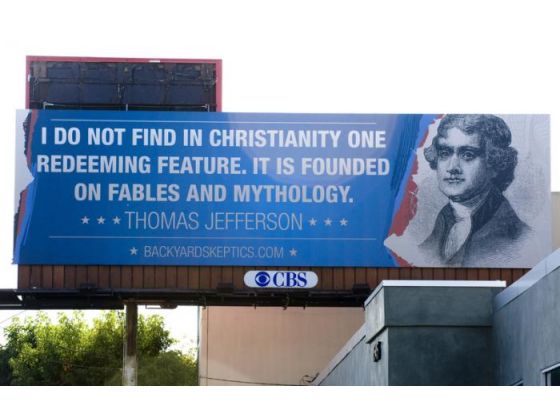
A group of atheists called Backyard Skeptics is planning to unveil a billboard at 1545 Newport Blvd., Wednesday afternoon with a quote from Thomas Jefferson bashing Christianity.

The quote reads, “I do not find in Christianity one redeeming feature. It is founded on fables and mythology.”

There’s one problem: There’s no evidence Jefferson ever said it. The Jefferson Library Collection at Monticello lists it on a page of spurious Jefferson quotes.

Bruce Gleason, whose group paid for this and other recent atheism billboards that have gone up in O.C. in recent months, said Wednesday he wasn’t sure about the origin of the quote.

He agreed that Monticello was an authoritative source.

“You’re absolutely right,” he said. “I should have done the research before I put my billboard up.”

The quote on the billboard is an abridged version of a quote that first appeared in a 1906 book called “Six Historic Americans,” by John E. Remsburg, who attributed it to a “Letter to Dr. Woods.”

It reads: “I have recently been examining all the known superstitions of the world, and do not find in our particular superstition (Christianity) one redeeming feature. They are all alike, founded upon fables and mythologies.”

The Jefferson Library knows of no letter to a Dr. Woods ever written by Jefferson, or of any appearance of the phrase anywhere in his writings.

For some misguided reason, atheists have latched on to Thomas Jefferson as a poster boy for their faith.

Perhaps it’s because Jefferson was such a brilliant man and a prolific, thoughtful writer, that atheists simply misunderstand what he wrote about being a Christian:

The doctrines of Jesus are simple, and tend all to the happiness of man.

The practice of morality being necessary for the well being of society, He [God] has taken care to impress its precepts so indelibly on our hearts that they shall not be effaced by the subtleties of our brain. We all agree in the obligation of the moral principles of Jesus and nowhere will they be found delivered in greater purity than in His discourses.

I am a Christian in the only sense in which He wished anyone to be: sincerely attached to His doctrines in preference to all others.

I am a real Christian – that is to say, a disciple of the doctrines of Jesus Christ.

Seems pretty straightforward and easy to understand to me.

Or, perhaps is that “Separation of Church and State Thingy” that atheists, especially the bitter individuals at the Freedom From Religion Foundation, always bring up as their reason for trying to erase Christianity from American life.

David Barton answered that assertion quite nicely, when he wrote on wallbuilders.com that:

Jefferson penned that phrase to reassure the Danbury (CT) Baptist Association that because of separation of church and state, the government would never interfere with their public religious expressions. For the next 150 years, federal courts followed Jefferson’s intent and attached his separation metaphor to the Free Expression Clause of the First Amendment, thus consistently upholding public religious expressions. However, in 1947, the Supreme Court reversed itself and began applying the phrase to the Establishment Clause instead, thus causing federal courts to remove rather than preserve public religious expressions.

The proof is abundant that this was not Jefferson’s intent. For example, two days after Jefferson wrote his separation letter, he attended worship services in the U. S. Capitol where he heard the Rev. John Leland preach a sermon. (As President of the Senate, Jefferson had personally approved the use of the Capitol Building for Sunday worship services.) The many diaries of Members of Congress during that time confirm that during Jefferson’s eight years, he faithfully attended church services in the Capitol. In fact, he even ordered the Marine Band to play the worship services there. Jefferson also authorized weekly worship services at the War Department and the Treasury Building.

And on December 23, 1803, Jefferson’s administration negotiated – and the Senate ratified – a treaty with the Kaskaskia Indians that stated “the United States will give annually for seven years one hundred dollars for the support of a priest” to minister to the Indians (i.e., federal funds for Christian evangelism!) Jefferson also signed presidential documents, closing them with the appellation, “In the Year of our Lord Christ.” There are many similar surprising facts about Jefferson that are fully documented historically, but that have been ignored for the past 50 years.

So would religious conservatives and Thomas Jefferson really be on opposite sides of the church/state issue? Probably, for I doubt that conservatives would agree with using federal dollars for evangelization.

Well, gosh.  That blows that argument out of the water, doesn’t it?

Golly, Eight Per Centers.  You’ve built your whole Jeffersonian Fan Club around a false assertion.

…That’s not your only one.

Battleground Alabama: Same FFRF. Same Bitter, Broken Record.

In previous “Battleground” articles, I wrote of how the Freedom From Religion Foundation, a 13,000 member, bitter, atheist organization from Wisconsin, had traveled down to Dixie in their quest to remove Christianity from the American landscape.

They’re still here.

Pesky little rodents, aren’t they?

Per foxnews.com:

An Alabama school district has been accused of allowing prayers that invoke the name of Jesus during high school football games, according to a complaint filed by a national atheist organization.

The Freedom From Religion Foundation said the Lauderdale County school district has violated the First Amendment by allowing the prayers at Brooks High School.

School superintendent Bill Valentine confirmed to Fox News that he had received the complaint.

“We’ve referred that complaint to our attorney and we are in the process of reviewing it,” he said.

The complaint was lodged by a single resident who objected to the student-led prayer before high school football games played on school property.

The Times Daily newspaper identified the complainant as Jeremy Green. In an email to the newspaper, Green said he was taking a stand for the so-called “separation of church and state in an effort to protect the constitutional rights of the non-religious.”

“It is not the job of the public school system to endorse religion,” he wrote.

Valentine said that to his knowledge, no one has ever lodged a complaint with the school system about the prayers.

The Freedom from Religion Foundation filed a similar complaint against a school in Arab, Ala. That school decided to end pregame prayers and instead offer a moment of silence.

Valentine said they haven’t made any decision about prayers for Friday night’s football game.

He said the complaint has generated lots of telephone calls – mostly in support of keeping the prayers. He added that most callers have been understanding and “seem to appreciate the quandary we find ourselves in.”

Lauderdale County has about 8,600 students enrolled in public schools and Valentine said the community has a very active religious community.

Among those is David McKelvey, pastor of the nearby First Baptist Church, Killen. He discussed the controversy during his Sunday sermon.

“It’s very sad,” McKelvey told Fox News. “I would think that any other prayer from another religion would not receive this kind of negativity.”

According to David Horowitz’s discoverthenetworks.org:

The Foundation is led by its co-presidents, Dan Barker and his wife, Annie Laurie Gaylor. Barker was a Christian preacher for 19 years before renouncing his faith in 1984. Gaylor, who earned a journalism degree from the University of Wisconsin-Madison in 1980, co-founded FFRC with her mother and the late John Sontarck in 1978. She is author of the books Woe to the Women: The Bible Tells Me So (1981), and Betrayal of Trust: Clergy Abuse of Children (1988). She also edited the 1997 anthology Women Without Superstition: No Gods, No Masters. Today she edits FFRF’s newspaper, Freethought Today, which is published ten times annually.

In April of 2010, Judge Barbara Crabb (a Clinton appointee), responding to a lawsuit filed by the FFRF, ruled that the National Day of Prayer, scheduled for May 6th of that year, was unconstitutional.    Crabb wrote in her ruling (excerpt):

It goes beyond mere “acknowledgment” of religion because its sole purpose is to encourage all citizens to engage in prayer, an inherently religious exercise that serves no secular function in this context. In this instance, the government has taken sides on a matter that must be left to individual conscience

One might argue that the National Day of Prayer does not violate the establishment clause because it does not endorse any one religion. Unfortunately, that does not cure the problem. Although adherents of many religions “turn to God in prayer,” not all of them do.

Further, the statute seems to contemplate a specifically Christian form of prayer with its reference to “churches” but no other places of worship and the limitation in the 1952 version of the statute that the National Day of Prayer may not be on a Sunday.

This year, on the National Day of Prayer, May 5th, Jay Sekolow, Lead Counsel for the American Center for Law and Justice, wrote the following:

Just last month [April 2011], a federal appeals court overturned a decision by a federal district court in Wisconsin that declared the National Day of Prayer presidential proclamation unconstitutional. A proclamation like this one issued by President Obama for this year’s event.

As you’ll recall, a decision issued by the U.S. Court of Appeals for the Seventh Circuit, the Court’s Chief Judge Frank Easterbrook rejected an argument by FFRF that they could bring a federal lawsuit because the National Day of Prayer made them feel excluded and unwelcome. Echoing an argument made by the ACLJ in our amicus brief, the court concluded: “Hurt feelings differ from legal injury,” and all plaintiffs ultimately allege is “disagreement with the President’s action.” The decision is posted here. Our amicus brief, in which we represented nearly 70 members of Congress, is posted here.

The appeals court correctly concluded that FFRF does not have the right to silence the speech they don’t agree with and that the organization lacked legal standing to challenge the National Day of Prayer.

While this decision represents a victory for this time-honored tradition, FFRF has already said it plans to appeal that decision.

And, as you also know, that FFRF is currently challenging the constitutionality of the phrase ‘under God’ in the Pledge of Allegiance. FFRF is asking the U.S. Supreme Court to take a case out of New Hampshire and overturn a lower court decision upholding the constitutionality of the Pledge.

So, FFRF wants to get rid of the National Day of Prayer and the Pledge of Allegiance with the phrase ‘under God.’

This is absurd. These challenges not only are legally flawed, but clog our court systems and represent a waste of judicial resources.

We’re standing up for the National Day of Prayer and the Pledge. We will file briefs backing the National Day of Prayer and the Pledge of Allegiance as these flawed challenges and appeals continue.

While Jay does, rightfully, toot his own horn a little bit, the important thing is, that Judge’s ruling was overturned.

Average Americans are fighting back.

As President Ronald Wilson Reagan said:

Freedom prospers when religion is vibrant and the rule of law under God is acknowledged.

If we ever forget that we are One Nation Under God, then we will be a nation gone under.

Battleground Hollywood: Tinseltown and Christian Americans

I was listening to American Family Radio yesterday.  One of their hosts was on, stating the obvious fact that American Christianity has been under attack during the present Administration.

He and a Congressman from Houston had been talking about last summer’s dust-up at the 3rd largest Veterans Cemetary in America, where the VA had attempted to ban  Christian Services there and all mention of Christ.

Here is a report from foxnews.com about the controversy, posted 6/30/11:

Veterans in Houston say the Department of Veterans Affairs is consistently censoring their prayers by banning them from saying the words “God” and “Jesus” during funeral services at Houston National Cemetery.

Three organizations — the Veterans of Foreign Wars, The American Legion and the National Memorial Ladies — allege that the cemetery’s director and other government officials have created “religious hostility” at the cemetery and are violating the First Amendment. According to court documents filed this week in federal court, the cemetery’s director, Arleen Ocasio, has banned saying “God” at funerals and requires prayers be submitted in advance for government approval, MyFoxHouston.com reports.

“People are doing things out there that I feel like they shouldn’t be,” Vietnam veteran Jim Rodgers told the website.

The Department of Veterans Affairs said in a statement that it “respects every veteran and their family’s right to burial service that honors their faith tradition.” The department employs nearly 1,000 chaplains who preside over religious burials, according to the statement.

The matter was settled quietly, and Christian Services were once again allowed at Houston National Cemetary.

Some of my most popular blogs recently have been about the fight going on in this God-given land between a vocal minority of non-believers who seem to want to make everyone as miserable as they are, and Christian Americans, who are fighting back.

And the battle is even taking place in the American Movie Industry.

Hollywood Reporter.com  recently ran the following story:

Before the filmmakers for Sherwood Pictures shot the first frame of Courageous, they prayed. It’s right there in the press materials. They did the same thing with Sherwood’s previous theatrical releases, Facing the Giants in 2006 and Fireproof in 2008. None of these Christian-themed movies is up to Hollywood production standards, though by one metric — box office compared to budget — they’re some of the most profitable films in modern history.

While Iron Man 2 and Thor earned three times their production budgets, Giants was made for $100,000 and took in $10.2 million domestically, 102 times its budget. Fireproof cost $500,000 but earned $33.5 million, a multiple of 67 on its budget, and Courageous, made for $2 million, earned eight times that in its first 10 days. It bowed No. 4 at the box office with$9.1 million from 1,161 theaters.

It seems Sherwood — a company few in Hollywood have even heard of — has discovered the secret for making films on a shoestring that people will line up to see in theaters. Maybe it’s all that praying.

Sherwood Pictures is “the moviemaking ministry” of Sherwood Baptist Church in Albany, Ga., which spans 130 acres. While it serves 3,000 congregants from a dozen nations, its message — “passion for Christ and compassion for all” — reaches millions more through TV and radio broadcasts and its film entity, which launched in 2003 with Flywheel, a movie produced for $20,000 that sold 350,000 DVDs. Since then, Sherwood has struck distribution and marketing deals with two units of Sony Pictures: Affirm Films and Provident Films.

Sherwood’s films are similarly themed. Courageous is about cops who fear they might fail as fathers without help from Christ. With Fireproof, which starred Kirk Cameron, it was men seeking help to become better husbands, and with Giants and Flywheel, it was men seeking help in their professional lives. The movies have progressed from amateurish to critical successes.

However, as Al Jolson said in the first Talkie:

Waitaminute…waitaminute…you ain’t seen nothing…yet!:

With half a dozen film projects derived from classic Bible stories in development, it would seem that Hollywood has (amen!) found God. Not since the 1950s, when Paramount and Cecil B. de Mille trotted out a handful of Old Testament tales, has there been so much Good Book on the books. Paramount and New Regency are building the big-budget Noah with Black Swan director Darren Aronofsky; Relativity has Goliath in the works with director Scott Derrickson; Warner Bros. has its controversial Judah Maccabee/Hannukkah movie with Mel Gibson producing (that film is competing with another Maccabee project); Steven Spielberg is considering directing Gods and Kings, a Moses story; and an adaptation of John Milton’s Paradise Lost starring Bradley Cooper as Lucifer is aiming for a January shoot. It’s a veritable flood.

“’What are those things that have huge pre-awareness that are huge spectacles that you can exploit our contemporary filmmaking abilities to do even bigger?’” says Goliath producer Wyck Godfrey, who saw comic-book, video-game and fairy-tale cycles running their course. “We’ve spent our entire lives hearing sports analogies of David versus Goliath. Well, before every David and Goliath story there was David and Goliath. That’s how I sold it.”

What a concept.  Family-friendly movies, based on the Old Testament, aimed at attracting the 75%  majority of Americans who proclaim Christ as their Savior.

Why, next thing you’ll be telling me is that a well-known Hollywood actor will produce a movie about the Life, Crucifixion, and Resurrection of Jesus Christ, which will stay in release for 156 days, and bring in a worldwide gross of $611, 899,420.

Oh, wait…