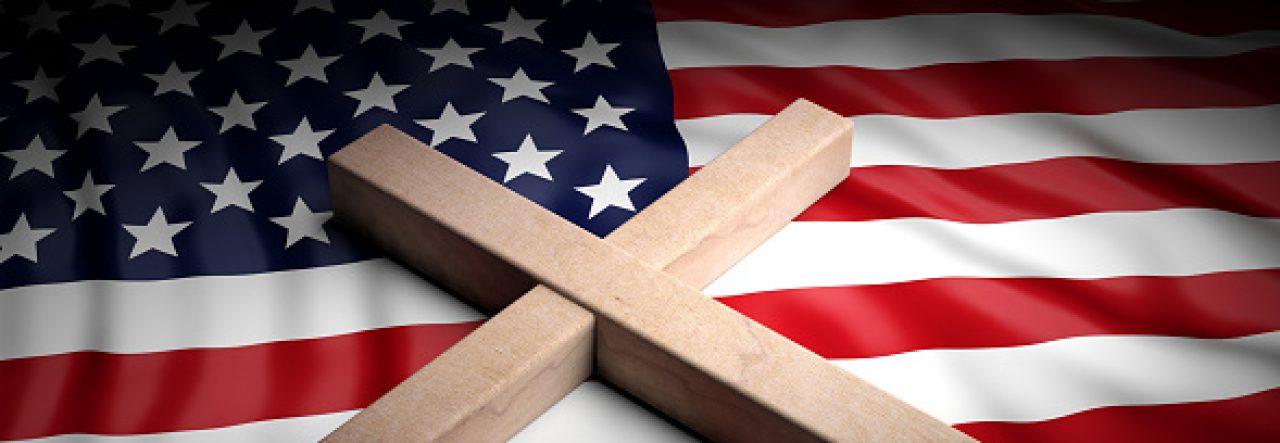
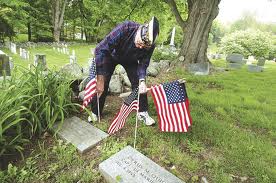
Memorial Day 2012: Honor Them All

Today is a day of solemn remembrance, during which we honor our fallen heroes.  An unwatched cable news host, Chris Hayes, on an unwatchable cable news channel, MSNBC, has a problem with calling these brave men and women “heroes”:

Thinking today and observing Memorial Day, that’ll be happening tomorrow. Just talked with Lt. Col. Steve Burke [sic, actually Beck], who was a casualty officer with the Marines and had to tell people [inaudible]. Um, I, I, ah, back sorry, um, I think it’s interesting because I think it is very difficult to talk about the war dead and the fallen without invoking valor, without invoking the words “heroes.” Um, and, ah, ah, why do I feel so comfortable [sic] about the word “hero”? I feel comfortable, ah, uncomfortable, about the word because it seems to me that it is so rhetorically proximate to justifications for more war. Um, and, I don’t want to obviously desecrate or disrespect memory of anyone that’s fallen, and obviously there are individual circumstances in which there is genuine, tremendous heroism: hail of gunfire, rescuing fellow soldiers and things like that. But it seems to me that we marshal this word in a way that is problematic. But maybe I’m wrong about that.

Maybe?  Just shuddup, you ungrateful idiot.

Memorial Day, originally called Decoration Day, is a day of remembrance for those who have died in our nation’s service. There are many stories as to its actual beginnings, with over two dozen cities and towns laying claim to being the birthplace of Memorial Day. There is also evidence that organized women’s groups in the South were decorating graves before the end of the Civil War: a hymn published in 1867, “Kneel Where Our Loves are Sleeping” by Nella L. Sweet carried the dedication “To The Ladies of the South who are Decorating the Graves of the Confederate Dead” (Source: Duke University’s Historic American Sheet Music, 1850-1920). While Waterloo N.Y. was officially declared the birthplace of Memorial Day by President Lyndon Johnson in May 1966, it’s difficult to prove conclusively the origins of the day. It is more likely that it had many separate beginnings; each of those towns and every planned or spontaneous gathering of people to honor the war dead in the 1860’s tapped into the general human need to honor our dead, each contributed honorably to the growing movement that culminated in Gen Logan giving his official proclamation in 1868. It is not important who was the very first, what is important is that Memorial Day was established. Memorial Day is not about division. It is about reconciliation; it is about coming together to honor those who gave their all.

Memorial Day was officially proclaimed on 5 May 1868 by General John Logan, national commander of the Grand Army of the Republic, in his General Order No. 11, and was first observed on 30 May 1868, when flowers were placed on the graves of Union and Confederate soldiers at Arlington National Cemetery. The first state to officially recognize the holiday was New York in 1873. By 1890 it was recognized by all of the northern states. The South refused to acknowledge the day, honoring their dead on separate days until after World War I (when the holiday changed from honoring just those who died fighting in the Civil War to honoring Americans who died fighting in any war). It is now celebrated in almost every State on the last Monday in May (passed by Congress with the National Holiday Act of 1971 (P.L. 90 – 363) to ensure a three day weekend for Federal holidays), though several southern states have an additional separate day for honoring the Confederate war dead: January 19 in Texas, April 26 in Alabama, Florida, Georgia, and Mississippi; May 10 in South Carolina; and June 3 (Jefferson Davis’ birthday) in Louisiana and Tennessee.

Traditional observance of Memorial day has diminished over the years. Many Americans nowadays have forgotten the meaning and traditions of Memorial Day. At many cemeteries, the graves of the fallen are increasingly ignored, neglected. Most people no longer remember the proper flag etiquette for the day. While there are towns and cities that still hold Memorial Day parades, many have not held a parade in decades. Some people think the day is for honoring any and all dead, and not just those fallen in service to our country.

There are a few notable exceptions. Since the late 50’s on the Thursday before Memorial Day, the 1,200 soldiers of the 3d U.S. Infantry place small American flags at each of the more than 260,000 gravestones at Arlington National Cemetery. They then patrol 24 hours a day during the weekend to ensure that each flag remains standing. In 1951, the Boy Scouts and Cub Scouts of St. Louis began placing flags on the 150,000 graves at Jefferson Barracks National Cemetery as an annual Good Turn, a practice that continues to this day. More recently, beginning in 1998, on the Saturday before the observed day for Memorial Day, the Boys Scouts and Girl Scouts place a candle at each of approximately 15,300 grave sites of soldiers buried at Fredericksburg and Spotsylvania National Military Park on Marye’s Heights (the Luminaria Program). And in 2004, Washington D.C. held its first Memorial Day parade in over 60 years.

To help re-educate and remind Americans of the true meaning of Memorial Day, the “National Moment of Remembrance” resolution was passed on Dec 2000 which asks that at 3 p.m. local time, for all Americans “To voluntarily and informally observe in their own way a Moment of remembrance and respect, pausing from whatever they are doing for a moment of silence or listening to ‘Taps.”

For a member of the Main Stream Media to disrepect the fallen in this way, is beyond the pale and unforgivable.

But, unfortunately, not surprising, at all.

Liberals actually do believe in sacrifice…as long as they’re not the ones doing the sacrificing.
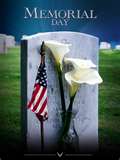
I was raised by members of the Greatest Generation.  It is today that we pause to remember their sacrifices at home and abroad.  Not only theirs, but the sacrifices made by our Brightest and Best, and their families, yesterday, today, and tomorrow.

May God bless them all and may He hold them in the hollow of His hand.

What Part of “Freedom of Religion” Does Obama Not Understand?

William Peter Blatty, accomplished author (The Exorcist) is calling Georgetown University out.

Why?

The 1950 Georgetown University Graduate is tired of the secularization of the University, which includes a recent visit by HHS Secretary Kathleen Sibelius, Obamacare contributor and pro-abortion advocate.

On May 5, 2012, in a speech to American bishops, Pope Benedict XVI called on America’s Catholic universities to reaffirm their Catholic identity. The Pope noted the failure of many Catholic universities to comply with Blessed John Paul II’s apostolic constitution Ex corde Ecclesiae. The Pope said that preservation of a university’s Catholic identity “entails much more than the teaching of religion or the mere presence of a chaplaincy on campus.”

For 21 years now. Georgetown University has refused to comply with Ex corde Ecclesiaie (“From The Heart of the Church”), and, therefore, with canon law. And, it seems as if every month GU gives another scandal to the faithful! The most recent is Georgetown’s obtuse invitation to Secretary Sebelius to be a commencement speaker.

Each of these scandals is proof of Georgetown’s non-compliance with Ex corde Ecclesiae and canon law. They are each inconsistent with a Catholic identity, and we all know it. A university in solidarity with the Church would not do these prideful things that do so much harm to our communion.

Georgetown is being dishonest. Together, we need to end that! In very recent years, Georgetown has even created the impression that its Jesuit tradition can stand apart from its Catholic identity. I am told that in on-campus debates, students will divide over favoring either Jesuit or Catholic! After eight years of Jesuit education, – when Jesuits and their reputation were one and the same – I shudder at this deception. The great Jesuit theologian Avery Dulles anticipated and admonished his fellow Jesuit educators over this fomented confusion: “To be Jesuit is merely to be more intensely Catholic,” he said. Of course.

Many believe that to make Georgetown truly Catholic is to turn back the clock hands and somehow limit its very nature as a university, as if the notion of “Catholic” and “university” are new to each other, or inherently at odds. On the contrary, to make Georgetown “Catholic” is to move the clock forward; it is to make the University better than it now is! Of course, there are always those who are afraid of change, – who lack vision. They may need to step aside.

John Paul II exhorted us all to preserve for the Church the highest places of culture – our universities. Generations of alumni have long been seduced to “go along” by dinners, medals, and board seats (I accepted my John Carroll Medal too). We have all been negligent for too long: the laity, the clergy, and the bishops as well.

Blatty is not alone in his righteous indignation over the anti-life Healthcare Monster being imposed upon us by the Obama Administration and their Congressional sycophants.

Foxnews.com reports that:

Some of the most influential Catholic institutions in the country filed suit against the Obama administration Monday over the so-called contraception mandate, in one of the biggest coordinated legal challenges to the rule to date.

Claiming their “fundamental rights hang in the balance,” a total of 43 plaintiffs filed a dozen separate federal lawsuits challenging the constitutionality of the requirement. Among the organizations filing were the University of Notre Dame, the Archdiocese of New York and The Catholic University of America.

The groups are objecting to the requirement from the federal health care overhaul that employers provide access to contraceptive care. The Obama administration several months ago softened its position on the mandate, but some religious organizations complained the administration did not go far enough to ensure the rule would not compel them to violate their religious beliefs.

A statement from the University of Notre Dame said the requirement would still call on religious-affiliated groups to “facilitate” coverage “for services that violate the teachings of the Catholic Church.”

“The federal mandate requires Notre Dame and similar religious organizations to provide in their insurance plans abortion-inducing drugs, contraceptives and sterilization procedures, which are contrary to Catholic teaching,” the statement said.

Rev. John Jenkins, the president of Notre Dame, said in a message to the campus that the filing “is about the freedom of a religious organization to live its mission, and its significance goes well beyond any debate about contraceptives.”

The contraception rule does include an exemption for religious organizations — but that exemption does not cover many religious-affiliated organizations like schools and charities. Complaints about the narrowly tailored exemption prompted a stand-off between the Obama administration and religious groups earlier this year. As a compromise, the administration said insurers — and not the religious-affiliated organizations themselves — could be required to offer contraceptive coverage directly.

But many organizations were not satisfied with the plan. John Garvey, president of Catholic University, said in a statement Monday that “such a revision would not solve our moral dilemma.” He argued that the cost of contraceptive coverage would still be “rolled into the cost” of a university insurance policy.

“In the end the university, its employees and its students will be forced to pay for the prescriptions and services we find objectionable,” he said.

University of Notre Dame Law Prof. Richard Garnett said in a statement that the mandate could affect a range of religious institutions, including “schools, health care providers and social welfare agencies.”

On a separate track, officials at a Florida Catholic university decided Monday to drop student health care coverage, becoming the second school this month to make that call. The decision at Ave Maria University was based in part on objections to the contraception rule, but also on projected increased premium costs tied to new rules in the federal health care overhaul.

While I am not Catholic, as a Christian American Conservative, I applaud the stand made by these People of Faith.

For those of you who, like the president, do not understand, the phrase is “Freedom of Religion”.

Not “Freedom from Religion”.

The Harps Eternal

Sacred music has played a part in my life as long as I can remember.  My father used to sing hymns to me as he was making my breakfast when I was a child, having sang all of his life.  Both of my sisters took piano lessons, and music always rang through the house in one form or another.

When I was 19, the music director at my church approached me.  She said,

Your father has a beautiful voice.  I’ll bet you can sing, too.

That began a 30 year musical journey which has led me from singing at a Methodist Church in Midtown Memphis, Tennessee to singing on the York, England Grand Hotel staircase, and has included singing sacred music ranging from Bill Gaither’s “Because He Lives” to Faure’s Requiem in Latin. I’ve sung in 40-voice choirs, in Southern Gospel Quartets, on Contemporary Praise Teams, and have had the privilege of leading the singing in church services.

Yesterday, at the young age of 53, I experienced something musically that I’ve never experienced before:

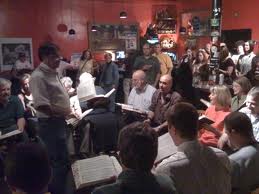
I participated in a 5-hour Sacred Harp singing.

What’s “Sacred Harp”?  I’m glad you asked.

Per the official website, fasola.org:

Sacred Harp is a uniquely American tradition that brings communities together to sing four-part hymns and anthems. It is a proudly inclusive and democratic part of our shared cultural heritage.

Participants are not concerned with re-creating or re-enacting historical events. Our tradition is a living, breathing, ongoing practice passed directly to us by generations of singers, many gone on before and many still living.

All events welcome beginners and newcomers, with no musical experience or religious affiliation required — in fact, the tradition was born from colonial “singing schools” whose purpose was to teach beginners to sing and our methods continue to reflect this goal. Though Sacred Harp is not affiliated with any denomination, it is a deeply spiritual experience for all involved, and functions as a religious observance for many singers.

Sacred Harp “singings” are not performances. There are no rehearsals and no separate seats for an audience. Every singing is a unique and self-sufficient event with a different group of assembled participants. The singers sit in a hollow square formation with one voice part on each side, all facing inwards so we can see and hear each other. However, visitors are always welcome to sit anywhere in the room and participate as listeners.

Why is it called “Sacred Harp”?

Technically, our style of singing is “shape note singing” because the musical notation uses note heads in 4 distinct shapes to aid in sight-reading, but it is often called “Sacred Harp” singing because the books that most singers use today are called “The Sacred Harp,” with the most prominent of these being the 1991 Denson edition. The term “sacred harp” refers to the human voice — that is, the musical instrument you were given at birth.

In 1844, The Sacred Harp was just one of more than 100 oblong hymn books published in the U.S. It has been continuously updated ever since. Along with other hymn books from the era, a handful of which are also still published and used, its repertoire of over 500 4-part a cappella hymns, odes, and anthems is part of the foundation of our vibrant oral tradition. There are dozens of living composers still actively writing new tunes within the traditional styles and shape note format. Other shape note books still in use today include Christian Harmony (using a 7-shape notation), New Harp of Columbia, plus several others, including some entirely new collections such as Northern Harmony.

So, you ask, what are “shape notes”?

The four shape note system used in the Sacred Harp came into being during a whirlwind of American invention. Nothing and no institution was above diddling. This particular shape system was but part of an endless tinkering with music notation that 18th and 19th century Americans indulged in. Little and Smith with the Easy Instructor invented and patented of the four shape note system, but it was but the latest in a long line of experimental music notations.

Spirituals in the Southern Uplands

This notation reform which combined music notation with solmization practice ignited the oblong shaped note tunebook golden era (1801 – Civil War). Books such as Repository of Sacred Music, Kentucky Harmony, Southern Harmony, Sacred Harp, Hesperian Harp, and Social Harp were just some of the dozens produced during this era.

Then came the ominous cloud of the “Better Music Movement.” With this movement came the do re mi fa sol la ti do solmization system which had long replaced the simpler fasola system in Europe among the musically literate. In the urban north the victory of Mason and his ilk was complete with the eradication from the churches and communities of such scourges as the “patent” notes and the “crude music” of composers such as William Billings.

The south was far more resilient in preserving their ways. But even here the long arm of this movement was felt, and thus the seven shaped note system was born. With the exception of the editors of a handful of books Southern shaped note tune compilers largerly accepted the belief that the seven syllable (“one for each note”) solmization was superior to the old fashioned fasola approach. Chief among those leading the charge to this trough was “singing Billy Walker” (compiler of the four shape Southern Harmony) with his Christian Harmony. Although a variety of seven shape notations were invented, the emerging standard was created by Jesse Aiken.

Through his personal presence and intimidation tactics he gradually bludgeoned music publishers into agreements acknowledging his notation standard. Other notable books published in this format were Harp of Columbia (and the New Harp of Columbia), Harmonia Sacra.

During the era of late 19th century and the first few decades of the 20th century legions of seven shaped small books were published in southern book mills. The music published in these books were mostly gospel and revival tunes. The people singing this music had a raging thirst for the new and according to GP Jackson, it was not uncommon for singers at a seven shape singing convention to show up and sing out of a book just published and never before seen by any of the singers. With the coming of modernity to the rural south this vigorous flood of music publishing dwindled, and currently there exists only a few seven shaped tune books still in publication.

For those of you who think that I possibly have lost what little mind I have left, I can only answer your concerns with an explanation that you may or may not understand.

I currently attend a contemporary church.  I am being filled spiritually as I never have been before.

However, I have also been feeling a gentle, but firm tugging at my soul for a while now.  As if a strong, but gentle hand is leading me back to use a sacred gift that was given to me a long time ago.

The experience which I had yesterday, was like the re-opening of a special birthday gift, long forgotten.

And, I want to experience that feeling, again.

Anti-Bullying “Savagery”

Did you know that the Obama Administration has a defacto “Anti-Bullying Czar”?  No, it isn’t any of the wrestlers from the WWE, which has its own “Be A Star” Anti-Bullying Campaign.

It is syndicated writer Dan Savage, author of a syndicated sex-advice column titled “Savage Love”.

The column appears weekly in several dozen newspapers, mainly free newspapers in the US and Canada, but also newspapers in Europe and Asia. It started in 1991 with the first issue of the Seattle weekly newspaper The Stranger.

Since October 2006, Savage has also recorded the “Savage Lovecast”, a weekly podcast version of the column, featuring telephone advice sessions. Podcasts are released every Tuesday.

The openly gay author uses the column as a forum for his strong opinions that reject conservative views on love, sex, and family. He generally encourages advice-seekers to pursue their fetishes, so long as activities are legal, consensual, safe, and respectful. The tone of the column is humorous, and Savage does not shy away from using profanity.

…For the first six years of the column, Savage had his readers address him with “Hey faggot”, as a comment on previous efforts to recapture offensive words.

This weekend, Savage more than proved my often-stated observation that

Those among us (Liberals) who claim to be the most tolerant are actually the least tolerant of all.

Citizenlink.com broke the story:

A group of high school journalism students attending a conference called “Journalism on the Edge” in Seattle over the weekend felt they were pushed over the edge by syndicated sex advice columnist Dan Savage.

Savage, the creator of the two-year-old It Gets Better Project, which encourages teens struggling with same-sex attractions to embrace homosexuality, was invited to give a keynote address last Friday at the JEA/NSPA National High School Journalism Convention.

Students were expecting him to talk about bullying. But they also got an earful about birth control, sex, and Savage’s opinions on the Bible.

A 17-year-old from California who was attending with half a dozen other students from her high school yearbook staff, was one of several students to walk out in the middle of Savage’s speech.

“The first thing he told the audience was, ‘I hope you’re all using birth control!’ ” she recalled. Then “he said there are people using the Bible as an excuse for gay bullying, because it says in Leviticus and Romans that being gay is wrong. Right after that, he said we can ignore all the ‘B.S.’ in the Bible.

“I was thinking, ‘This is not going a good direction at all,’ Then he started going off about the Bible. He said somehow the Bible was pro-slavery. I’m really shy. I’m not really someone to, like, stir up anything. But all of a sudden I just blurted out, ‘That’s bull!’ ”

As she and several other students walked out of the auditorium, Savage noticed them leaving and called them “pansies.”

Though recordings of the keynote speech are unavailable, Savage has made similar comments in the past, which can be found on YouTube. Among them:

“Most people that you wind up arguing with about religion and homosexuality have not ever read the Bible without their, you know, moron glasses on.”

“If you believe it is the divinely inspired word of God, if you believe in the literal truth of the Bible, I challenge you to read the first five (expletive) pages. There are two creation myths in Genesis.”

“We ignore the (expletive) in the Bible about race, about slavery, and we’re going to have to get there for homosexuality.”

The student’s father is a public school teacher. Though he said Savage’s comments were inappropriate, he thinks the organizers of the conference are ultimately responsible.

“I’m well-versed in the rules of the game, the captive-audience ethic,” he said. “You have a bunch of kids. They’re required to go to school. They don’t have the option of walking out on you as a teacher, so you guard your speech.

“If Dan Savage was a teacher, they’d suspend him without pay for this behavior,” he added. “He didn’t take account of who his audience was. If he was doing this with a bunch of college journalism kids, that would be a different story — that’s more rough and tumble. How many of the kids who didn’t walk out felt backed into a corner? To me, that’s bullying behavior. It has all the symptoms, as far as I’m concerned.”

In a related story from 9/29/2010, abcnews.go.com posted that

At a backyard town hall in Albuquerque, NM, Tuesday, President Obama was asked “Why are you a Christian?” The question, from teacher’s assistant Elizabeth A. Murphy, 42, was one of three “hot topics” she raised with the president.

“I’m a Christian by choice,” the president said. “My family didn’t — frankly, they weren’t folks who went to church every week. And my mother was one of the most spiritual people I knew, but she didn’t raise me in the church.”

The president said he “came to my Christian faith later in life and it was because the precepts of Jesus Christ spoke to me in terms of the kind of life that I would want to lead — being my brothers’ and sisters’ keeper, treating others as they would treat me. And I think also understanding that Jesus Christ dying for my sins spoke to the humility we all have to have as human beings, that we’re sinful and we’re flawed and we make mistakes, and that we achieve salvation through the grace of God. But what we can do, as flawed as we are, is still see God in other people and do our best to help them find their own grace.”

The president said “that’s what I strive to do. That’s what I pray to do every day. I think my public service is part of that effort to express my Christian faith.”

By endorsing vulgar, anti-christian heathens like Dan Savage, Mr. President?

Ted Nugent and Franklin Graham Have Something in Common?

Legendary Rocker “The Motor City Madman” Ted Nugent, and Evangelist Rev. Franklin Graham, son of the great Reverend Billy Graham, have something in common.  The administration does not want them near our “Best and Brightest”.

Per Foxnews.com:

The U.S. Army has nixed Ted Nugent from the lineup at a Fort Knox concert scheduled for late June, after the outspoken rocker made controversial remarks about President Obama.

The decision comes after Nugent met with Secret Service officials Thursday — the Service said at the time the issue had been “resolved.”

But the Army went on to cancel Nugent’s performance set for June 23 at the Fort Knox annual summer concert.

“Co-headliners REO Speedwagon and Styx remain scheduled to perform,” a statement on the Fort Knox Facebook page said. “However, after learning of opening act Ted Nugent’s recent public comments about the president of the United States, Fort Knox leadership decided to cancel his performance on the installation.”

Organizers are offering refunds, though the statement said they may find a replacement for Nugent’s act.

Nugent, who recently endorsed GOP presidential candidate Mitt Romney, said during a recent National Rifle Association convention that the Obama administration was “vile,” “evil” and “America-hating.”

He also said that if the president is re-elected, “I will either be dead or in jail by this time next year.”

Nugent later said his remarks were not a call to violence.

Obama and his minions have a habit of “banning” those who say something that they don’t like, from speaking to the troops.  Remember this from The Washington Post of April 22, 2010?

The Army has withdrawn an invitation to evangelist Franklin Graham to speak at a special Pentagon prayer service next month because of his controversial views on Islam, said Col. Thomas Collins, spokesman for the U.S. Army.

Colins said Graham’s remarks were “not appropriate. We’re an all-inclusive military. We honor all faiths. … Our message to our service and civilian work force is about the need for diversity and appreciation of all faiths.”

Graham issued this statement: “I regret that the Army felt it was necessary to rescind their invitation to the National Day of Prayer Task Force to participate in the Pentagon’s special prayer service. I want to express my strong support for the United States military and all our troops. I will continue to pray that God will give them guidance, wisdom and protection as they serve this great country.”

The Military Religious Freedom Foundation objected to Graham’s scheduled appearance at the prayer event, largely because of his past remarks about Islam as an evil religion. “Lady liberty is smiling today,” said Weinstein, MRFF president, who sent a letter to Defense Secretary Robert Gates, objecting to Graham’s scheduled appearance. Weinstein said the invitation offended Muslim employees at the Pentagon and would endanger American troops by stirring up Muslim extremists.

Weinstein said the foundation’s DC attorney, Victor Glasberg, was planning today to go to court to seek a restraining order against the entire prayer event as unconstitutional. Last week, a federal judge in Wisconsin ruled that National Day of Prayer is unconstitutional. “We congratulate the Pentagon for making the right decision, but it’s a shame that it had to be made under duress.” Weinstein said the Pentagon plans to replace Graham with “a more inclusive” interfaith figure.

Graham, son of evangelist Billy Graham, was invited to speak at the event by the Colorado-based National Day of Prayer Task Force, which works with the Pentagon chaplain’s office on the prayer event. The task force organizes Christian events for the National Day of Prayer. Graham is president and CEO of both Samaritan’s Purse, a Christian international relief organization in Boone, N.C., and the Billy Graham Evangelistic Association in Charlotte.

After the 2001 terrorist attacks on the United States, Graham said Islam “is a very evil and wicked religion.” In a later op-ed piece in The Wall Street Journal, Graham wrote that he did not believe Muslims were evil because of their faith, but “as a minister …. I believe it is my responsibility to speak out against the terrible deeds that are committed as a result of Islamic teaching.”

Last month, in a video interview with On Faith’s Sally Quinn, Graha, repeated some of those remarks, but also said “I am not on a crusade against Muslims. I love the Muslim people . . . I want them to know that they don’t have to die in a car bomb, don’t have to die in some kind of holy war to be accepted by God. But it’s through faith in Jesus Christ and Christ alone.”

The MRFF claims to represent 17,000 members of the armed forces — 96 percent of whom are Protestant or Catholic. “Those who hate us really hate us today,” said Weinstein. “But those who love us really love us.”

Collins said the National Day of Prayer event at the Pentagon “will continue as scheduled under the administration of the office of the Pentagon Chaplain.”

It’s no secret that the 44th President of these United States is thin-skinned.  In fact, it’s become the stuff of legend.  As we head toward the General Election this November 6th, it could very well be his Achilles’ Heel.

Now, it’s up to Mitt Romney to take advantage of it.

Charles “Chuck” Colson: From Administrator to Evangelist

The Watergate Scandal was a dark point in the history of the American Presidency. But it was a momentary darkness, which led to a lifetime of life-saving ministry.

On 17th June 1972, 5 men were arrested for breaking into the headquarters of the Democratic National Committee. Initially, it was assumed that it was just a simple burglary that went wrong. However, when investigations started, it was found out that the men had entered the office to repair bugs that they had installed into the office nearly a week earlier.

On further investigations, it was found out that the so-called burglars were some how connected to the White House and were given the task to spy on the Democrats. One of the “burglars” arrested was named Jim McCord Jr. He was the security officer for Richard Nixon’s Committee to Reelect the President. Even a diary was found which had the contact number of E Howard Hunt, who was an intelligence agent and a member of the White House plumbers, which was a secret team of agents working at the behest of the White House. The investigators went on to figure out that the E Howard Hunt along G Gordon Liddy were the brains behind the first break in. Soon it was found that there were many agents responsible for spying on the Democrats. A check meant for Richard Nixon’s reelection campaign was traced to the bank account of one of the burglars. This led the investigators to conclude that the campaign funds were being used to fund these illegal activities. However, even at this stage, it did not stop Richard Nixon, a Republican, to win the US president election.

James McCord sent a letter to the trial judge naming other people who were part of this conspiracy. With more and more evidence being unearthed, it was soon clear that Richard Nixon was personally involved in the scandal along with several members from his administration. It was also discovered that many of the conversations regarding the conspiracy took place in the Oval Office and these conversations were taped. Initially, Nixon denied the presence of the tapes, but due to US Supreme Court order, he was forced to hand over the tapes containing the damning conversations. However, some important conversations from these tapes were missing.

The US Congress was forced to begin the process of impeachment against Richard Nixon. However, before the culmination of the process, Nixon resigned on 9th August 1974. While Nixon himself did not serve any prison time, many of his aides were found guilty by the Grand Jury.

One of the men who helped to plan the break-in was Charles “Chuck” Colson.

Charles Wendell Colson was born in Boston in October, 1931. After graduating from Brown University Colson joined the U.S. Marine Corps (1953-55). This was followed by the post of Assistant to the Assistant Secretary of the Navy (1955–56).

Colson was a member of the Republican Party and in 1956 he became Administration Assistant to Senator Leverett Saltonstall. In 1961 Colson became a partner in the Gadsby and Hannah Law Firm.

In 1969 Colson was appointed to the White House staff as Counsel to President Richard Nixon. Colson also began involved in the activities of the Committee to Re-Elect the President (CREEP). On 20th March, 1971, at a meeting of CREEP it was agreed to spend $250,000 “intelligence gathering” operation against the Democratic Party.

Colson and John Ehrlichman appointed E. Howard Hunt as a member of the White House Special Investigations Unit. On 15th May Arthur Bremer attempted to assassinate George Wallace. As a result Colson ordered Hunt to break into Bremer’s apartment to see if he could find any information that the Democratic Party was involved in the assassination. However, some have claimed that Hunt’s role was to remove incriminating documents from Bremer’s home.

…In 1974, Colson entered a plea of guilty to Watergate-related charges. He also pleaded guilty to obstruction of justice in the Daniel Ellsberg case. He was given a one-to-three year sentence. However, he only served seven months at Alabama’s Maxwell Prison.

In 1976, Colson founded Prison Fellowship Ministries, which has become the world’s largest outreach to prisoners, ex-prisoners, crime victims, and their families. Colson has visited prisons throughout the US and the world and has built a movement working with more than 40,000 prison ministry volunteers, with ministries in 100 countries. Colson became highly critical of the prison system and in 1983 he established Justice Fellowship, a faith-based criminal justice reform group.

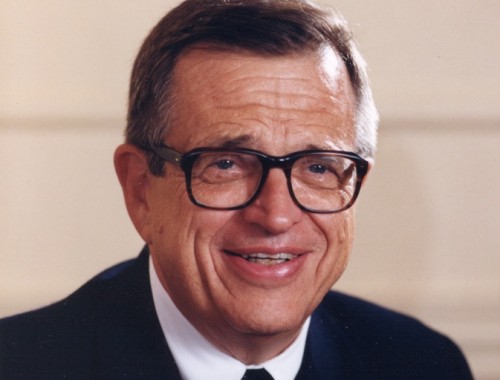
Chuck Colson passed away yesterday.

Chuckcolson.org has posted the following tribute:

Evangelical Christianity lost one of its most eloquent and influential voices today with the death of Charles W. “Chuck” Colson. The Prison Fellowship and Colson Center for Christian Worldview founder died at 3:12 p.m. on Saturday from complications resulting from a brain hemorrhage. Colson was 80.

A Watergate figure who emerged from the country’s worst political scandal, a vocal Christian leader and a champion for prison ministry, Colson spent the last years of his life in the dual role of leading Prison Fellowship, the world’s largest outreach to prisoners, ex-prisoners and their families, and the Colson Center, a teaching and training center focused on Christian worldview thought and application.

Colson was speaking at a Colson Center conference when he was overcome by dizziness. Quickly surrounded by friends and staff, Colson was sent to the Fairfax Inova Hospital in Fairfax, Virginia. On March 31, he underwent two hours of surgery to remove a pool of clotted blood on the surface of his brain. At times, Chuck showed encouraging indicators of a possible recovery, but his health took a decided turn, and he went to be with the Lord. His wife, Patty, and the family were with him in the last moments before he entered eternity.

Revered by his friends and supporters, Colson won the respect of those who disagreed with his religious and political views thanks to his tireless work on behalf of prisoners, ex-prisoners, and their families. Colson maintained that the greatest joy in life for him was to see those “living monuments” to God’s grace: Prisoners transformed by the love of Jesus Christ. And thanks to the work of Colson and Prison Fellowship volunteers across the country, there are thousands of those living monuments among us today.

A remarkable man.  A remarkable life.  A merciful, redeeming God.

An Interruption in Programming

Dear Friends and “Family”:

I will be off the grid for about a week or so.  Wednesday night, the Generation XY kids above our apartment decided to cook fried chicken and neglected to watch it cook, resulting in a grease fire.  Our ground-floor apartment was flooded by their sprinkler system, resulting in us being relocated (by the grace of God) to live for a while in a Corporate Unit at another apartment complex, owned by the corporation who owns ours.

Your prayers are welcome and appreciated.  It could have been a lot worse. Until I return, here is a recent post, to remind you of what I’m about.

God is Good.  All the time.

WHAT IS A CHRISTIAN AMERICAN CONSERVATIVE?

I have been asked to define what it means to be a Christian American Conservative.  After all, that’s how I identify myself and that is what it says on the top of this blog, since I began this exercise in ranting and raving in April of 2010.

Let’s perform a dissection, shall we?

First word:  Christian – A follower of Jesus Christ.

I was raised as a Christian by my parents and accepted Christ as my personal Savior many years ago.

Here are some interesting things about Christianity to consider, written by Dr. Ray Pritchard and posted on christianity.com:

1) The name “Christian” was not invented by early Christians. It was a name given to them by others.
2) Christians called themselves by different names—disciples, believers, brethren, saints, the elect, etc.
3) The term apparently had a negative meaning in the beginning: “those belonging to the Christ party.”
4) It was a term of contempt or derision.
5) We can get a flavor for it if we take the word “Christ” and keep that pronunciation. You “Christ-ians.”
6) It literally means “Christ-followers.”
7) Over time a derogatory term became a positive designation.
8) Occasionally you will hear someone spit the term out in the same way it was used in the beginning. “You Christians think you’re the only ones going to heaven.”
9) There was a sense of suffering and reproach attached to the word in the New Testament.

In working my way toward an answer to “What is a Christian?” I decided to check out the dictionary. I found these two definitions:

1. One who professes belief in Jesus as Christ or follows the religion based on the life and teachings of Jesus. 2. One who lives according to the teachings of Jesus.”

That’s actually quite helpful because it gives some content to the word. To be a Christian means that you . . .

Believe Something
Follow Something
Live Something
A Fully Devoted Follower To borrow a contemporary phrase, we could simply say that a Christian is a “fully devoted follower of Jesus.” As I think about that, two insights come to mind.

1) It doesn’t happen by accident. You are not “born” a Christian nor are you a Christian because of your family heritage. Being a Christian is not like being Irish. You aren’t a Christian simply because you were born into a Christian family.
2) It requires conversion of the heart. By using the term “conversion,” I simply mean what Jesus meant when he said that to be his disciple meant to deny yourself, take up your cross and follow him (Luke 9:23). The heart itself must be changed so that you become a follower of the Lord.

Second word: American – A citizen of the United States of America.

Stephen M. Warchawsky, wrote the following in an article for americanthinker.org:

So what, then, does it mean to be an American? I suspect that most of us believe, like Supreme Court Justice Potter Stewart in describing pornography, that we “know it when we see it.” For example, John Wayne, Amelia Earhart, and Bill Cosby definitely are Americans. The day laborers standing on the street corner probably are not. But how do we put this inner understanding into words? It’s not easy. Unlike most other nations on Earth, the American nation is not strictly defined in terms of race or ethnicity or ancestry or religion. George Washington may be the Father of Our Country (in my opinion, the greatest American who ever lived), but there have been in the past, and are today, many millions of patriotic, hardworking, upstanding Americans who are not Caucasian, or Christian, or of Western European ancestry. Yet they are undeniably as American as you or I (by the way, I am Jewish of predominantly Eastern European ancestry). Any definition of “American” that excludes such folks — let alone one that excludes me! — cannot be right.

Consequently, it is just not good enough to say, as some immigration restrictionists do, that this is a “white-majority, Western country.” Yes, it is. But so are, for example, Ireland and Sweden and Portugal. Clearly, this level of abstraction does not take us very far towards understanding what it means to be “an American.” Nor is it all that helpful to say that this is an English-speaking, predominately Christian country. While I think these features get us closer to the answer, there are millions of English-speaking (and non-English-speaking) Christians in the world who are not Americans, and millions of non-Christians who are. Certainly, these fundamental historical characteristics are important elements in determining who we are as a nation. Like other restrictionists, I am opposed to public policies that seek, by design or by default, to significantly alter the nation’s “demographic profile.” Still, it must be recognized that demography alone does not, and cannot, explain what it means to be an American.

So where does that leave us? I think the answer to our question, ultimately, must be found in the realms of ideology and culture. What distinguishes the United States from other nations, and what unites the disparate peoples who make up our country, are our unique political, economic, and social values, beliefs, and institutions. Not race, or religion, or ancestry.

Third word: Conservative -A person who holds to traditional values and attitudes.

J. Matt Barber wrote in the Washington Times that

Ronald Reagan often spoke of a “three-legged stool” that undergirds true conservatism. The legs are represented by a strong defense, strong free-market economic policies and strong social values. For the stool to remain upright, it must be supported by all three legs. If you snap off even one leg, the stool collapses under its own weight.

A Republican, for instance, who is conservative on social and national defense issues but liberal on fiscal issues is not a Reagan conservative. He is a quasi-conservative socialist.

A Republican who is conservative on fiscal and social issues but liberal on national defense issues is not a Reagan conservative. He is a quasi-conservative dove.

By the same token, a Republican who is conservative on fiscal and national defense issues but liberal on social issues – such as abortion, so-called gay rights or the Second Amendment – is not a Reagan conservative. He is a socio-liberal libertarian.

Put another way: A Republican who is one part William F. Buckley Jr., one part Oliver North and one part Rachel Maddow is no true conservative. He is – well, I’m not exactly sure what he is, but it ain’t pretty.

Even the Brits understand what American Conservatism is.

Per blogs.telegraph.co.uk:

Conservatism is thriving in America today because liberty, freedom and individual responsibility are at the heart of its ideology, one that rejects the foolish notion that government knows best. And its strength owes a great debt to the conviction and ideals of Ronald Reagan, who always believed that America’s best days are ahead of her, and for whom the notion of decline was unacceptable. As the Gipper famously put it, in a speech to the Conservative Political Action Conference in 1988:

Those who underestimate the conservative movement are the same people who always underestimate the American people.

In conclusion, I, a Christian American Conservative, am a follower of Jesus Christ and a citizen of the United States of America (by the Grace of God), who holds to traditional values and attitudes.

I pray that you, the reader, are able to glean that from my blogs.  Because, as Matthew 6:21 tells us:

For where your treasure is, there your heart will be also.

May God bless you and yours,

KJ

He is Risen!

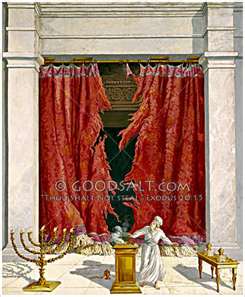
Wow. It’s really been amazing around here since they crucified Jesus. Did you feel that earthquake? The veil of the temple was torn in half! And did you hear? A bunch of people that had died years ago, were seen walking around the city! But that’s not all. Don’t tell me you haven’t heard?

Listen to this: He has risen! He arose from the dead and was seen by several people. It’s true! I know it sounds unbelievable. I can scarcely take it in myself. Mary Magdalene and Mary, James and Salome’s mother, went to the tomb to perform the anointing of His body and it wasn’t there! On top of that, there was this young guy there, dressed in a white robe. They said he must have been 9 feet tall. He said, “You are seeking Jesus of Nazareth. Why do you seek the living among the dead? He is not here. See the place where you laid him.” So they went and told the disciples. But you know how Peter is. He just had to go run up there and see for himself.

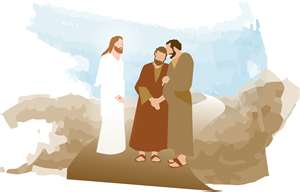
Jesus even approached two of them on the road to Emmaus. They didn’t recognize him. He even broke bread with them that night. They realized who He was and He disappeared! They ran to tell the disciples and as they were telling them, Jesus appeared right in front of them! They were all starting to panic. Jesus said, “Peace to you.” But they couldn’t believe it was him, especially Thomas. So he had him touch him in the hole in his hand where they drove the nail and where the spear pierced his side.

Jesus ate with them and performed other signs and miracles in front of them and they understood scripture as never before. He also came to them at the Sea of Tiberius. Peter took the disciples fishing and they weren’t catching anything. Jesus told them from the bank to cast the net down on the right side. They did, and they could hardly bring it in the boat! When they got back to land, Jesus already had a fire going and some fish and bread ready to eat. He asked Peter three times if he loved Him, and each time He told him “Feed my sheep’. Hey, isn’t that the same number of times Peter Denied Him?

Anyway, He taught them many things before He left. They watched as He was taken straight up into heaven. Can you imagine?

The disciples are making plans now to go out and starting spreading the Good News about Jesus’ Resurrection. They are talking about going out in pairs. Man. Nothing is ever going to be the same again.

“For God so loved the word, that he gave his only begotten son, that whosoever believeth in him should not perish, but have everlasting life.” – John 3:16

I originally wrote and published the above post on Easter, April 4th, 2010.

As you read this post today:

33% of the world’s population are  Christian.

The top 3 countries with the largest national Christian populations are :

USA – 224,457,000 (85%)

Brazil – 139,000,000 (93%)

Mexico – 86,120,000 (99%)

There are approximately 38,000 Christian denominations in the world. This statistic takes into consideration cultural distinctions of denominations in different countries.

Today, in the United States of America, about 78% (244, 140,000) of adults identify themselves as Christian. In comparison, the next largest religions in America are Islam and Judaism. Combined they represent only about one to two percent of the United States population.

There are more than 1500 different Christian faith groups in America.

All this and more, because of the sacrifice of the Son of God.
Within the editorial, Jesus, the Perfect Man, published on Christmas Day 1912, C.P.J. Mooney, Editor of the Memphis Commercial Appeal, wrote the following excerpt:

After the experience of 2,000 years no man can find a flaw in the governmental system outlined by Jesus.

Czar and kaiser, president and Socialist, give to its complete merit their admiration.

No man today, no matter whether he follows the doctrine of Mill, Marx or George as to property, can find a false principle in Jesus’ theory of property.

In the duty of a man to his fellow no sociologist has ever approximated the perfection of the doctrine laid down by Jesus in His Sermon on the Mount.

Not all the investigations of chemists, not all the discoveries of explorers, not all the experiences of rulers, not all the historical facts that go to make up the sum of human knowledge on this day in 1912 are in contradiction to one word uttered or one principle laid down by Jesus.

The human experiences of 2,000 years show that Jesus never made a mistake. Jesus never uttered a doctrine that was true at that time and then became obsolete.

Jesus spoke the truth, and the truth is eternal.

History has no record of any other man leading a perfect life or doing everything in logical order. Jesus is the only person whose every action and whose every utterance strike a true note in the heart and mind of every man born of woman. He never said a foolish thing, never did a foolish act and never dissembled.

No poet, no dreamer, no philosopher loved humanity with all the love that Jesus bore toward all men.

WHO, THEN, was Jesus?

He could not have been merely a man, for there never was a man who had two consecutive thoughts absolute in truthful perfection.

Jesus must have been what Christendom proclaims Him to be — a divine being — or He could not have been what He was. No mind but an infinite mind could have left behind those things which Jesus gave the world as a heritage.

He is risen indeed!

Romney and Those Darned Christians

On March 27th, 2012, gallup.com released the following lists of the 10 Most Religious and Least Religious states in America. Most Religious States, Based on % Very Religious, 2011 Least Religious States, Based on % Very Religious, 2011

As of the writing of this blog, Mitt Romney has come in First Place in the following states’ Republican Primaries: Alaska, Arizona, Florida, Hawaii, Idaho, Illinois, Maine, Massachusetts, Michigan, Nevada, New Hampshire, Ohio, Vermont, Virginia, Washington, Wyoming.

The only state that Romney will possibly win among the Most Religious List is Utah.  Excuse me for being politically incorrect, but, the only reason he will carry that state, is the fact that he is a Mormon. (Yeah, I said it.)

The Pew Research Center released some interesting information last month.

A poll by the Pew Research Center’s Forum on Religion and Public Life has found that nearly 60% of Romney supporters believe that churches should step back from political and social issues, while 60% of Santorum supporters believe churches should play a more active role. These sentiments were echoed by another sharp divide found between the candidates’ supporters regarding their views on whether there’s too little expression of religious faith by political leaders. For Romney’s camp, there’s little concern, with 24% agreeing that there’s not enough religious discourse. But 55% of Santorum supporters see a deficit in religious speech by politicians. As for the nation on a whole, the poll unearthed another interesting trend. The largest number of Americans in the poll’s 10-year history believe there is too much expression of religious faith by politicians. In 2010, the last national election year, 37% said there was too little expression compared to 29% saying there was too much. Now, the numbers are nearly reversed, at 30% and 38% respectively. Democrats were found to be nearly twice as likely as Republicans to say there’s too much talk of religion by politicians, 46% to 24%. Among white evangelicals, Santorum’s most prominent base of supporters, only 14% thought politicians focused on religion too much. As such, it comes as no surprise that 54% see the Republican Party as being friendly toward religion, compared to 35% for Democrats. The largest divides in the poll were on President Obama’s perceived friendliness to religion. A majority of Republicans, 52%, categorize him as unfriendly, compared to 5% of Democrats, while 15% of Republicans see him as friendly, compared to 59% percent of Democrats. The poll was conducted between March 7-11 with 1,503 individual interviews and has a sampling error of 3 percentage points.

If I’m interpreting this poll correctly, both the majority of Romney supporters and the Majority of Democrats have an aversion to religious values playing a part in the governance of our country. With 78% of Americans, per Gallup, identifying themselves as Christians, this could be a problem for Romney, if he continues on to the nomination.

But, is it his Mormonism or his flip-flipping Political Ideology that has alienated the Conservative Base of the Republican Party?

TheBlaze.com reported the following on March21st:

Following a win in the Illinois GOP primary Tuesday and a key endorsement from former Florida Gov. Jeb Bush, Mitt Romney’s top adviser Eric Fehrnstrom appeared on CNN where he answered questions concerning whether his candidate had gone “so far right” in the primary campaign.

“Well, I think you hit a reset button for the fall campaign,” Fehrnstrom said. “Everything changes. It’s almost like an Etch a Sketch. You can kind of shake it up and we start all over again.”

Fehrnstrom’s answer is likely to rehash concerns from many critics within the conservative base and general electorate who have long alleged that Romney is a “flip-flopper“ and has ”no core values.”

The campaign of Romney’s strongest rival Rick Santorum has immediately pounced on the gaffe.

“We all knew Mitt Romney didn’t have any core convictions, but we appreciate his staff going on national television to affirm that point for anyone who had any doubts,” Santorum’s National Communications Director Hogan Gidley said in a statement.

“With the two year anniversary of the signing of ObamaCare upon us, can voters really believe that the man who urged the President to use his healthcare plan in Massachusetts as a model would really repealObamaCare? Or is that promise just something they would ‘shake up and restart’ with when Romney hits the general election.”

If you have spent any time at all on Conservative Blogs during the Republican Nomination Process, you have seen Mitt Supporters label Christians, especially Evangelicals, as narrow-minded bigots, if they express any concern of the political ideology of Mitt Romney.  These “fans” stand at the ready to identify genuine concerns as anti-Mormon bigotry, where there is none.

The simple fact of the matter is, as Rush Limbaugh himself stated on February 2nd:

There is a Republican primary going on right now, and who votes in a Republican primary?  Starts with a C.  Conservatives.  There are elements of conservatism that are fundamental.  And we conservatives, we have radar.  We know when somebody isn’t.

Additionally, if the Romney supporters knew their Christianity, they would be familiar with the gift of discernment.

What is a Christian American Conservative?

I have been asked to define what it means to be a Christian American Conservative.  After all, that’s how I identify myself and that is what it says on the top of this blog, since I began this exercise in ranting and raving in April of 2010.

Let’s perform a dissection, shall we?

First word:  Christian – A follower of Jesus Christ.

I was raised as a Christian by my parents and accepted Christ as my personal Savior many years ago.

Here are some interesting things about Christianity to consider, written by Dr. Ray Pritchard and posted on christianity.com:

1) The name “Christian” was not invented by early Christians. It was a name given to them by others.
2) Christians called themselves by different names—disciples, believers, brethren, saints, the elect, etc.
3) The term apparently had a negative meaning in the beginning: “those belonging to the Christ party.”
4) It was a term of contempt or derision.
5) We can get a flavor for it if we take the word “Christ” and keep that pronunciation. You “Christ-ians.”
6) It literally means “Christ-followers.”
7) Over time a derogatory term became a positive designation.
8) Occasionally you will hear someone spit the term out in the same way it was used in the beginning. “You Christians think you’re the only ones going to heaven.”
9) There was a sense of suffering and reproach attached to the word in the New Testament.

In working my way toward an answer to “What is a Christian?” I decided to check out the dictionary. I found these two definitions:

1. One who professes belief in Jesus as Christ or follows the religion based on the life and teachings of Jesus. 2. One who lives according to the teachings of Jesus.”

That’s actually quite helpful because it gives some content to the word. To be a Christian means that you . . .

Believe Something
Follow Something
Live Something
A Fully Devoted Follower To borrow a contemporary phrase, we could simply say that a Christian is a “fully devoted follower of Jesus.” As I think about that, two insights come to mind.

1) It doesn’t happen by accident. You are not “born” a Christian nor are you a Christian because of your family heritage. Being a Christian is not like being Irish. You aren’t a Christian simply because you were born into a Christian family.
2) It requires conversion of the heart. By using the term “conversion,” I simply mean what Jesus meant when he said that to be his disciple meant to deny yourself, take up your cross and follow him (Luke 9:23). The heart itself must be changed so that you become a follower of the Lord.

Second word: American – A citizen of the United States of America.

Stephen M. Warchawsky, wrote the following in an article for americanthinker.org:

So what, then, does it mean to be an American? I suspect that most of us believe, like Supreme Court Justice Potter Stewart in describing pornography, that we “know it when we see it.” For example, John Wayne, Amelia Earhart, and Bill Cosby definitely are Americans. The day laborers standing on the street corner probably are not. But how do we put this inner understanding into words? It’s not easy. Unlike most other nations on Earth, the American nation is not strictly defined in terms of race or ethnicity or ancestry or religion. George Washington may be the Father of Our Country (in my opinion, the greatest American who ever lived), but there have been in the past, and are today, many millions of patriotic, hardworking, upstanding Americans who are not Caucasian, or Christian, or of Western European ancestry. Yet they are undeniably as American as you or I (by the way, I am Jewish of predominantly Eastern European ancestry). Any definition of “American” that excludes such folks — let alone one that excludes me! — cannot be right.

Consequently, it is just not good enough to say, as some immigration restrictionists do, that this is a “white-majority, Western country.” Yes, it is. But so are, for example, Ireland and Sweden and Portugal. Clearly, this level of abstraction does not take us very far towards understanding what it means to be “an American.” Nor is it all that helpful to say that this is an English-speaking, predominately Christian country. While I think these features get us closer to the answer, there are millions of English-speaking (and non-English-speaking) Christians in the world who are not Americans, and millions of non-Christians who are. Certainly, these fundamental historical characteristics are important elements in determining who we are as a nation. Like other restrictionists, I am opposed to public policies that seek, by design or by default, to significantly alter the nation’s “demographic profile.” Still, it must be recognized that demography alone does not, and cannot, explain what it means to be an American.

So where does that leave us? I think the answer to our question, ultimately, must be found in the realms of ideology and culture. What distinguishes the United States from other nations, and what unites the disparate peoples who make up our country, are our unique political, economic, and social values, beliefs, and institutions. Not race, or religion, or ancestry.

Third word: Conservative -A person who holds to traditional values and attitudes.

J. Matt Barber wrote in the Washington Times that

Ronald Reagan often spoke of a “three-legged stool” that undergirds true conservatism. The legs are represented by a strong defense, strong free-market economic policies and strong social values. For the stool to remain upright, it must be supported by all three legs. If you snap off even one leg, the stool collapses under its own weight.

A Republican, for instance, who is conservative on social and national defense issues but liberal on fiscal issues is not a Reagan conservative. He is a quasi-conservative socialist.

A Republican who is conservative on fiscal and social issues but liberal on national defense issues is not a Reagan conservative. He is a quasi-conservative dove.

By the same token, a Republican who is conservative on fiscal and national defense issues but liberal on social issues – such as abortion, so-called gay rights or the Second Amendment – is not a Reagan conservative. He is a socio-liberal libertarian.

Put another way: A Republican who is one part William F. Buckley Jr., one part Oliver North and one part Rachel Maddow is no true conservative. He is – well, I’m not exactly sure what he is, but it ain’t pretty.

Even the Brits understand what American Conservatism is.

Per blogs.telegraph.co.uk:

Conservatism is thriving in America today because liberty, freedom and individual responsibility are at the heart of its ideology, one that rejects the foolish notion that government knows best. And its strength owes a great debt to the conviction and ideals of Ronald Reagan, who always believed that America’s best days are ahead of her, and for whom the notion of decline was unacceptable. As the Gipper famously put it, in a speech to the Conservative Political Action Conference in 1988:

Those who underestimate the conservative movement are the same people who always underestimate the American people.

In conclusion, I, a Christian American Conservative, am a follower of Jesus Christ and a citizen of the United States of America (by the Grace of God), who holds to traditional values and attitudes.

I pray that you, the reader, are able to glean that from my blogs.  Because, as Matthew 6:21 tells us:

For where your treasure is, there your heart will be also.

May God bless you and yours,

KJ