
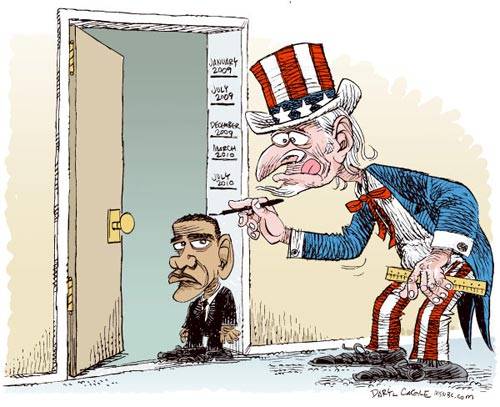
 Back in January , President Karzai of Afghanistan and U.S. President Barack Hussein Obama (mm mmm mmmm) had a meeting, where it was decided to speed up America’ s military withdrawal from that war-torn nation. The two presidents seem to have gotten along famously.
Well…that honeymoon’s over.
Bloomberg.com reports that
Defense Secretary Chuck Hagel was greeted on his first visit to Afghanistan since taking office by suicide bombs, threats and Afghan President Hamid Karzai’s accusation that the U.S. is colluding with the Taliban.
As Hagel prepared to leave a U.S. military compound in Kabul on March 9, a Taliban suicide bomber blew himself up outside the Ministry of Defense, and another suicide bomb detonated in Khost province. Yesterday, Karzai said that those attacks, which together killed 19 people, aided U.S. goals. A joint Hagel-Karzai press conference at the presidential palace was canceled for what Pentagon officials said were security reasons.
While the Taliban said the attacks were aimed at sending a message to Hagel that the insurgents remain a powerful force, Karzai said in a speech yesterday that the U.S. is holding peace talks with the radical Islamists and the bombs were in the “service of America.”
“On the surface and to this outside observer, it appears that Karzai has gone way off the reservation, perhaps more so than he has in the past,” said David Maxwell, a retired U.S. Army colonel who’s associate director of the Center for Security Studies at Georgetown University’s School of Foreign Service. “I cannot see how we could work with such an apparently delusional leader much longer, but unfortunately I do not know if we have any other good options.”
Karzai’s allegations and the suicide attacks gave the new defense secretary, who took office March 1, a close-up view of the military and political obstacles the Obama administration faces as it tries to extricate the U.S. from a war it’s been waging for more than 11 years, train Afghan forces to take over the fight, root out official corruption, curb opium trafficking, and develop the Afghan economy.
President Barack Obama has ordered the withdrawal of 34,000 of about 68,000 U.S. troops in Afghanistan by February. Former Defense Secretary Leon Panetta said last month that the drawdown will occur in stages, with the force dropping to 50,000 by November, after the summer fighting season, and then to 34,000 by February. More troops will come home after Afghan elections planned for early 2014, Panetta said.
“When you spend 48 hours in Afghanistan or any part of the world that’s still dangerous, you again recognize the complications that exist every day in these parts of the world,” Hagel, a combat veteran of Vietnam, told reporters at a U.S. military base after he met with Karzai yesterday. Asked about Karzai’s accusation that the U.S. was colluding with the Taliban, Hagel said he “spoke clearly and directly” to Karzai on the matter. Hagel didn’t elaborate.
Earlier yesterday, Marine Corps General Joseph Dunford, head of the North Atlantic Treaty Organization’s International Security Assistance Force, said the Afghan president’s comments were “categorically false.”
Perhaps, Karzai is a just a wee bit torqued over all the unmanned drones flying over his country:
With debate intensifying in the United States over the use of drone aircraft, the U.S. military said on Sunday that it had removed data about air strikes carried out by unmanned planes in Afghanistan from its monthly air power summaries.
U.S. Central Command, which oversees the Afghanistan war, said in a statement the data had been removed because it was “disproportionately focused” on the use of weapons by the remotely piloted aircraft as it was published only when strikes were carried out – which happened during only 3 percent of sorties. Most missions were for reconnaissance, it said.
U.S. President Barack Obama’s administration has increasingly used drones to target against al Qaeda-linked militants overseas.
Civilian casualties from drone strikes have raised ethical concerns and angered local populations, creating tension between the United States and Pakistan and Afghanistan.
Some U.S. lawmakers have also questioned the legality of targeted killings and whether drones would allow the killing of American citizens inside the United States.
The debate was intensified by Obama’s decision to nominate his chief counter-terrorism adviser John Brennan, an architect of the drone campaign, as the new director of the CIA.
The Air Force Times said air force chiefs had started posting the drone strikes data last October in an attempt to provide more detail on the use of drones in Afghanistan.
The newspaper said the statistics were provided for November through January, but the February summary released on March 7 had a blank spot where the drone data had previously been listed.
“A variety of multi-role platforms provide ground commanders in Afghanistan with close air support capabilities, and it was determined that presenting the weapons release data as a whole better reflects the air power provided” in Afghanistan, Central Command said in its statement.
“Protecting civilians remains at the very core of AFCENT’s (Air Force Central Command’s) mission,” it said. “The use of all AFCENT aerial weapons are tightly restricted, meticulously planned, carefully supervised and coordinated, and applied by only qualified and authorized personnel.”
The statement said the decision to stop reporting the drone strikes was taken with the International Security Assistance Force – the NATO-led coalition in Afghanistan.
Brennan was sworn into office on Friday following a protracted confirmation battle that saw Senator Rand Paul attempt to block a vote on the nomination with a technical manoeuvre called a filibuster, in which he tried to prevent a vote by talking continuously.
Paul held the Senate floor for more than 12 hours while talking mainly about drones, expressing concern that Obama’s administration might use the aircraft to target U.S. citizens on home soil.
Back in 2009, Joseph S. Nye, Jr. , wrote the following in an article for ForeignPolicy.com:
In her confirmation hearings, U.S. Secretary of State Hillary Clinton said, “America cannot solve the most pressing problems on our own, and the world cannot solve them without America. . . . We must use what has been called ‘smart power,’ the full range of tools at our disposal.” Since then, editorial pages and blogs have been full of references to “smart power.” But what does it mean?
“Smart power” is a term I developed in 2003 to counter the misperception that soft power alone can produce effective foreign policy. Power is one’s ability to affect the behavior of others to get what one wants. There are three basic ways to do this: coercion, payment, and attraction. Hard power is the use of coercion and payment. Soft power is the ability to obtain preferred outcomes through attraction. If a state can set the agenda for others or shape their preferences, it can save a lot on carrots and sticks. But rarely can it totally replace either. Thus the need for smart strategies that combine the tools of both hard and soft power.
Judging by their appeasement of our enemies, and their total naivete (at least, I hope it’s just naivete) of the Muslim World, Obama and his State Department have Nye’s “Smart Power” down pat. The only problem is, the only things those barbarians understand are strength of will and brute force. Therefore using unmanned drones, instead of traditional Armed Forces, only solidifies their opinion of Obama as a wimp.
Therefore, Karzai and his friends in the Muslim Brotherhood, are not impressed.
God protect us.
Until He Comes,
KJ
 Kingsjester's Blog
Like you said KJ….GOD protect us.
LikeLike
Naivete? Nope…
LikeLike