
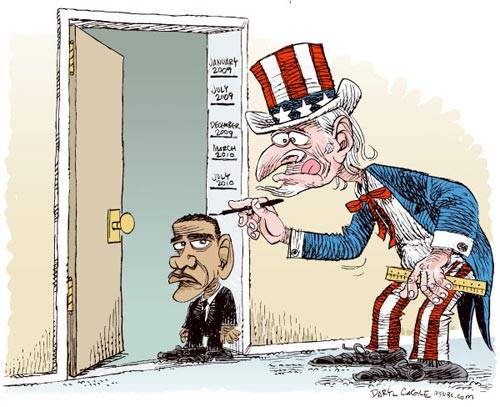
 On January 25th, 2011, during his annual State of the Union Address, the 44th President of these United States, Barack Hussein Obama, read aloud, before a Joint Session of Congress, a packed gallery, and a national television audience, the following:
We are poised for progress. Two years after the worst recession most of us have ever known, the stock market has come roaring back. Corporate profits are up. The economy is growing again.
But we have never measured progress by these yardsticks alone. We measure progress by the success of our people. By the jobs they can find and the quality of life those jobs offer. By the prospects of a small business owner who dreams of turning a good idea into a thriving enterprise. By the opportunities for a better life that we pass on to our children.
That’s the project the American people want us to work on. Together.
We did that in December. Thanks to the tax cuts we passed, Americans’ paychecks are a little bigger today. Every business can write off the full cost of new investments that they make this year. And these steps, taken by Democrats and Republicans, will grow the economy and add to the more than one million private sector jobs created last year.
But we have to do more. These steps we’ve taken over the last two years may have broken the back of this recession, but to win the future, we’ll need to take on challenges that have been decades in the making.
Many people watching tonight can probably remember a time when finding a good job meant showing up at a nearby factory or a business downtown. You didn’t always need a degree, and your competition was pretty much limited to your neighbors. If you worked hard, chances are you’d have a job for life, with a decent paycheck and good benefits and the occasional promotion. Maybe you’d even have the pride of seeing your kids work at the same company.
That world has changed. And for many, the change has been painful. I’ve seen it in the shuttered windows of once booming factories, and the vacant storefronts on once busy Main Streets. I’ve heard it in the frustrations of Americans who’ve seen their paychecks dwindle or their jobs disappear -– proud men and women who feel like the rules have been changed in the middle of the game.
Meanwhile, in the real world, the United States Census Bureau, earlier this month, released a study that showed one of the most profound effects of “The Lightbringer’s” Economic Policies.
There are a lot of Americans financially holding on for dear life. The Bureau’s report showed that 51 million people are struggling, with incomes less than 50 percent above the poverty line. That number is actually 76 percent higher than the previous official account, published in September. This means that 100 million people, one in three Americans, are living either in poverty or just above it.
The Census Bureau is shocked. Shocked, I tell you.
“These numbers are higher than we anticipated,” said Trudi J. Renwick, the bureau’s chief poverty statistician. “There are more people struggling than the official numbers show.”
Outside the bureau, skeptics of the new measure warned that the phrase “near poor” — a common term, but not one the government officially uses — may suggest more hardship than most families in this income level experience. A family of four can fall into this range, adjusted for regional living costs, with an income of up to $25,500 in rural North Dakota or $51,000 in Silicon Valley.
But most economists called the new measure better than the old, and many said the findings, while disturbing, comported with what was previously known about stagnant wages.
“It’s very consistent with everything we’ve been hearing in the last few years about families’ struggle, earnings not keeping up for the bottom half,” said Sheila Zedlewski, a researcher at the Urban Institute, a nonpartisan economic and social research group.
Patched together a half-century ago, the official poverty measure has long been seen as flawed. It ignores hundreds of billions the needy receive in food stamps, tax credits and other programs, and the similarly large sums paid in taxes, medical care and work expenses. The new method, called the Supplemental Poverty Measure, counts all those factors and adjusts for differences in the cost of living, which the official measure ignores.
The results scrambled the picture of poverty in many surprising ways. The measure shows less severe destitution, but a bit more overall poverty; fewer poor children, but more poor people over 65.
Of the 51 million who appear near poor under the fuller measure, nearly 20 percent were lifted up from poverty by benefits the official count overlooks. But more than half were pushed down from higher income levels: more than eight million by taxes, six million by medical expenses, and four million by work expenses like transportation and child care.
Demographically, they look more like “The Brady Bunch” than “The Wire.” Half live in households headed by a married couple; 49 percent live in the suburbs. Nearly half are non-Hispanic white, 18 percent are black and 26 percent are Latino.
Perhaps the most surprising finding is that 28 percent work full-time, year round. “These estimates defy the stereotypes of low-income families,” Ms. Renwick said.
As of Sunday, November 20, 2011, the American people polled by gallup.com, held the following opinions:
Obama Job Approval 43%
Economic Conditions Excellent/Good 9%
Poor 50%
Economic Outlook Getting Better 22%
Getting Worse 73%
Economic Confidence -46%
On January 21, 2009 President Barack Hussein Obama spoke the following words during his Inauguration:
For everywhere we look, there is work to be done. The state of our economy calls for action, bold and swift. And we will act, not only to create new jobs, but to lay a new foundation for growth. We will build the roads and bridges, the electric grids and digital lines that feed our commerce and bind us together. We’ll restore science to its rightful place, and wield technology’s wonders to raise health care’s quality and lower its cost. We will harness the sun and the winds and the soil to fuel our cars and run our factories. And we will transform our schools and colleges and universities to meet the demands of a new age. All this we can do. All this we will do.
We’re still waiting, Mr. President...for one more year.
 Kingsjester's Blog
obaka is nothing but an empty suit, with nicely creased pants
LikeLike
Evidently those tax cuts didn’t do much good.. much like the Bush cuts of 2001, which only brought us this crisis in the first place.
LikeLike
So the Democratic Congress who have been in power since 2007 and the failed Economic Policies of Obama had nothing to do with it at all?
What color is the unicorn in your backyard?
LikeLike
You’re not very well informed, are you?…
LikeLike
wow, who gave him 9%?
LikeLike