 Growing up as an All-American boy, there were certain foods that were staples around our house: foods like Aunt Jemima Pancake Mix and Uncle Ben’s Rice and, if my older sisters didn’t grab them first, Little Debbie Oatmeal Cakes.
Like me, I’m sure some of you grew up as a child, thinking these kindly characters were real people.
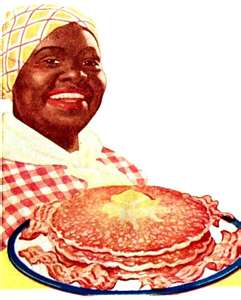 Aunt Jemima actually was…and made personal appearances!
According to food reference.com:
Chris L. Rutt and Charles G. Underwood purchased the Pearl Milling Company in 1889, and came up with the novel idea of creating a ready-mixed pancake flour. Rutt named it for a catchy tune called ‘Aunt Jemima’ which he had recently heard in a vaudeville show.
Rutt and Underwood went broke in 1890, and sold the formula for Aunt Jemima Pancake Mix to the R.T. Davis Milling Company. Davis looked for a woman to represent the product, and hired an African American woman named Nancy Green (Nov 17, 1834 – September 23, 1923) from Chicago, Illinois.
At the 1893 Colombian Exposition in Chicago, Davis made an all-out effort to promote the new pancake mix, and built the world’s largest flour barrel. ‘Aunt Jemima’ (Nancy Green) demonstrated how to use the new mix, and the exhibit was so popular, police had to control the crowds at the Aunt Jemima booth. Nancy Green was awarded a medal and proclaimed ‘Pancake Queen’ by the Fair officials. Soon signed to a lifetime contract by Davis, Green was a hit all across the country, as she toured demonstrating the new Aunt Jemima Pancake Mix, and by 1910 it was available nationally.
She played the part of Aunt Jemima until her death on September 24, 1923 (she died in a car accident).
Aunt Jemima Mills were purchased in 1925 by the Quaker Oats Company of Chicago.
 Uncle Ben? Not so much.
In the 1910s, the German-British scientist Eric(h) Huzenlaub (1899–1964) invented a form of parboiling designed to retain more of the nutrients in rice, now known as the Huzenlaub Process. It involves first vacuum drying of the whole grain, then steaming, and finally vacuum drying and husking. Besides increasing rice’s nutritional value[citation needed], it also made it resistant to weevils and reduced cooking time.
In 1942, Huzenlaub partnered with a Houston food broker, Gordon L. Harwell, forming Converted Rice, Inc., which sold its entire output to the U.S. Armed Forces.[2] In 1944, with additional financing from the Defense Plant Corporation and an investment by Forrest Mars, Sr., it built a second large plant. Not long afterwards, Mars bought out the founders and merged the company into his Food Manufacturers, Inc..
When white South Carolina planters were unable to make their rice crops thrive, “slaves from West Africa’s rice region tutored planters in growing the crop.”
Uncle Ben’s products carry the image of an elderly African-American man dressed in a bow tie, said to have been the visage of a Chicago maitre d’hotel named Frank Brown. According to Mars, Uncle Ben was an African-American rice grower known for the quality of his rice. Gordon L. Harwell, an entrepreneur who had supplied rice to the armed forces in World War II, chose the name Uncle Ben’s as a means to expand his marketing efforts to the general public.
In March 2007, Uncle Ben’s image was “promoted” to the “chairman of the board” by a new advertising campaign designed to distance the brand from its iconography depicting a domestic servant.
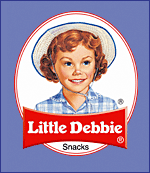 Finally, what about Little Debbie: was she a real person? You betcha!
According to the folks who should know at littledebbie.com:
In 1960, McKee Foods founder O.D. McKee was trying to come up with a catchy name for their new family-pack cartons of snack cakes. Packaging supplier Bob Mosher suggested using a family member’s name. Thinking of what could be a good fit for the brand, O.D. arrived at the name of his 4-year-old granddaughter Debbie. Inspired by a photo of Debbie in play clothes and her favorite straw hat, he decided to use the name Little Debbie® and the image of her on the logo. Not until the first cartons were being printed did Debbie’s parents, Ellsworth and Sharon McKee, discover that their daughter was the namesake of the new brand.
The first family-pack was produced in August of that year and consisted of the original snack cake, the Oatmeal Creme Pie. Family-packs were one of the first multiple-item baked goods available with individually wrapped products. The cost per carton was only 49 cents. By combining a quality product with outstanding value, Little Debbie® quickly became a member of America’s households. After its initial introduction, more than 14 million cakes were sold within 10 months. While the Oatmeal Creme Pie was the original Little Debbie® snack cake, there were 14 different varieties by 1964 including the ever-popular Nutty Bars® Wafer Bars and Swiss Cake Roll.
So, there you have it. Brand names for foods that became American icons. Now, if you’ll excuse me, gentle reader, I’ll take my leave. I’m hungry.
 Kingsjester's Blog
Thanks for the history lesson into Americana, KJ. Good stuff.
LikeLike
Thanks KJ, that was an informative read and welcome respite from political fodder.
LikeLike
Like you KJ…..I think I am going to chow down on one of those icons right now. Syrup anyone?
LikeLike
I’ve got some Johnny Fair syrup!!!
LikeLike
I’ll go political here. How many endeavors like this had to be sold to big business in order to be able to survive up against government interventions?
Sorry folks. I just can’t help myself 😉
LikeLike
In my family, “Little Debbie” means oatmeal cream cookies…everything else is known by it’s own name…
🙂
LikeLike