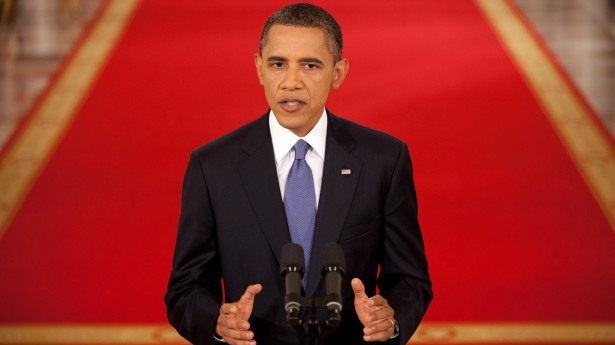
 Last night, President Barack Hussein Obama (mm mmm mmmm) formally addressed the American people for the sixth time since he ascended to the throne of the Regime. He announced a withdrawal of American Troops in Afghanistan, which he euphemistically referred to as drawdown, to be completed by 2014.
He began his address with his usual Don’t blame me, I inherited this mess approach:
By the time I took office, the war in Afghanistan had entered its seventh year. But Al Qaeda’s leaders had escaped into Pakistan and were plotting new attacks, while the Taliban had regrouped and gone on the offensive. Without a new strategy and decisive action, our military commanders warned that we could face a resurgent Al Qaeda, and a Taliban taking over large parts of Afghanistan.
By the way, don’t try to count the number of I’s in this speech. I lost count.
For this reason, in one of the most difficult decisions that I’ve made as President, I ordered an additional 30,000 American troops into Afghanistan. When I announced this surge at West Point, we set clear objectives: to refocus on Al Qaeda; reverse the Taliban’s momentum; and train Afghan Security Forces to defend their own country. I also made it clear that our commitment would not be open-ended, and that we would begin to drawdown our forces this July.
Tonight, I can tell you that we are fulfilling that commitment. Thanks to our men and women in uniform, our civilian personnel, and our many coalition partners, we are meeting our goals. As a result, starting next month, we will be able to remove 10,000 of our troops from Afghanistan by the end of this year, and we will bring home a total of 33,000 troops by next summer, fully recovering the surge I announced at West Point. After this initial reduction, our troops will continue coming home at a steady pace as Afghan Security forces move into the lead. Our mission will change from combat to support. By 2014, this process of transition will be complete, and the Afghan people will be responsible for their own security.
We are starting this drawdown from a position of strength. Al Qaeda is under more pressure than at any time since 9/11. Together with the Pakistanis, we have taken out more than half of Al Qaeda’s leadership. And thanks to our intelligence professionals and Special Forces, we killed Usama bin Laden, the only leader that Al Qaeda had ever known. This was a victory for all who have served since 9/11. One soldier summed it up well. “The message,” he said, “is we don’t forget. You will be held accountable, no matter how long it takes.”
Here comes the part of the speech that piqued my interest. Evidently, our CIC actually is naive enough to believe that we can negotiate with the Taliban:
We do know that peace cannot come to a land that has known so much war without a political settlement. So as we strengthen the Afghan government and Security Forces, America will join initiatives that reconcile the Afghan people, including the Taliban. Our position on these talks is clear: they must be led by the Afghan government, and those who want to be a part of a peaceful Afghanistan must break from Al Qaeda, abandon violence, and abide by the Afghan Constitution. But, in part because of our military effort, we have reason to believe that progress can be made.
The goal that we seek is achievable, and can be expressed simply: no safe-haven from which Al Qaeda or its affiliates can launch attacks against our homeland, or our allies. We will not try to make Afghanistan a perfect place. We will not police its streets or patrol its mountains indefinitely. That is the responsibility of the Afghan government, which must step up its ability to protect its people; and move from an economy shaped by war to one that can sustain a lasting peace. What we can do, and will do, is build a partnership with the Afghan people that endures – one that ensures that we will be able to continue targeting terrorists and supporting a sovereign Afghan government.
What happens after the last American Troops pull out of Afghanistan? Well, just like the last guy at the Sports Bar, we get stuck with the check.
It is estimated that the yearly bill for the US to sustain the Afghan security forces, after we withdraw, will be $6bn to $8bn a year, a figure that has caused a massive political freak-out in Washington and among those in charge of NATO’s end of the deal.
However, we don’t have to worry about the Afghan regime collapsing. Even after we give the keys to the Afghan Government at the end of 2014, there will still be a significant foreign military presence.
Which countries will make up that force, where it will be based, and who will control it, is currently the subject of negotiations between the Afghan and US governments.
Considering who is presently in charge of our end of the negotiations, we’re destined to get the raw end of the deal.
 Kingsjester's Blog
nice summary KJ….
LikeLike
” This was a victory for all who have served since 9/11. One soldier summed it up well. “The message,” he said, “is we don’t forget.”” ….. until the next election. Unfortunatey.
If Bush had given the same speech, I wouldn’t feel so bad, because we could assume that Bush had the best interests of America in his heart, but with 0bummer, we can only expect that he is not saying what he hopes the outcome will be.
LikeLike
“Evidently, our CIC actually is naive enough to believe that we can negotiate with the Taliban…” Ever the clueless one…And he is in charge of the read phone? *Shudders at the thought….
LikeLike
Well, at least the Buddha statutues can’t be blown up again…The backdrop of the pic looks more like a East European/USSR setting than the WH…
LikeLike