 Tonight, at 7:00 p.m. Central, Americans will have the honor and privilege of, once again, viewing the President of our country, Barack Hussein Obama, as he comes into our living rooms, against the advice of the Pentagon, to announce the withdrawal of up to 30,000 troops from Afghanistan by November next year, just in time for the US presidential election.
Obama is making the withdrawal despite warnings from his military commanders that recent security gains are fragile, at best. The Pentagon is telling the CIC that he should keep troop numbers high until 2013.
American and British commanders in Kabul have privately expressed concern that the White House is now being driven by political rather than military imperatives, and they are puzzled by this.
Welcome to Smart Power, y’all!
One of the British commanders told guardian.co.uk:
This is not something we feel entirely comfortable with.
The American people do not, either, mate.
Tonight’s nationally televised address, will be the sixth that Obama has given since his ascension to the throne of the Regime. Obama’s speechifying is intended to mark the beginning of the end of American military deployment in Afghanistan, now sitting at- almost 100,000 troops.
The White House confirmed that the withdrawal will be “significant”.
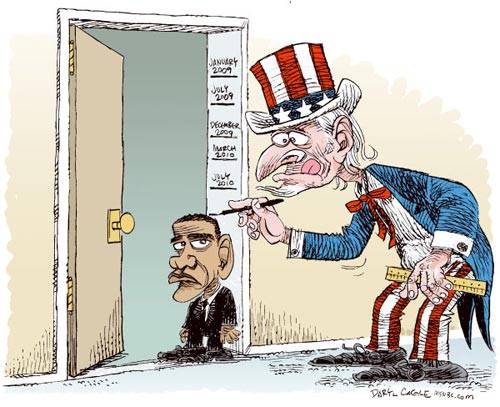
Obama realizes that he must re-energize his Liberal base, while appealing to the so-called Independents (Moderates). What better way to do that than to pull out of a war that has lasted 10 years and cost 1,522 lives?
Obama’s problem is the fact that NATO commanders, led by General David Petraeus, have explicitly told him what the risks are of withdrawing too many troops too soon, and they have also warned Obama there has been no advantage gained from taking out Osama bin Laden.
Maybe not. But it sure did make Americans feel good. But, I digress…
The military commanders had urged him to keep the bulk of the extra 30,000 troops he committed to the “surge” until the end of 2012 in place in Afghanistan, in order that a drawdown can begin in 2013. That would allow the military another couple of years to attack Taliban strongholds and target insurgent leaders.
It goes without saying that there are a lot of reservations in the Congress about the war in Afghanistan and our level of commitment. There are concerns among the American people who are tired of a decade of war.
Per an Associated Press-GfK poll published last month, 80 percent of Americans approve of Obama’s decision to begin withdrawal of combat troops in July and end U.S. combat operations in Afghanistan by 2014. Just 15 percent disapprove.
However, according to rasmussenreports.com:
A new Rasmussen Reports national telephone survey finds that only 31% of Likely U.S. Voters think it is at least somewhat likely that the United States will remove its remaining 50,000 troops from Iraq by the end of this year as scheduled, and that includes just three percent (3%) who say it’s Very Likely. Sixty-five percent (65%) believe a full troop withdrawal from Iraq by year’s end is unlikely, with 21% who say it’s Not At All Likely.
Forty-six percent (46%) of voters say if the Iraqi government formally requests troops to stay, the United States should leave some there after the end of the year. Thirty-three percent (33%) disagree, but 21% are not sure.
So what is a Hahvahd-educated, Socialist Progressive POTUS, desperately trying to hold onto the most prestigious job in the world, supposed to do?
Unfortunately for Afghanistan and the rest of the Free World, Obama’s passion toward prosecuting the War on Terror is evidently taking second place to his re-election campaign.
In the Obama White House, Political expediency wins out over National Defense.


“In the Obama White House, Political expediency wins out over National Defense.”
THIS….excellent post KJ
LikeLike
The difference between this withdrawal and our withdrawal from Viet Nam is that at least we didn’t have any troops left in Nam to get slaughtered during the Communist resurgence. Of course, millions of Vietnamese were slaughtered.
We won’t be so lucky this time, I’m afraid.
LikeLike
Barry’s got to have something to crow about to his base when he hits his continuous campaign trail.
LikeLike
My liver isn’t going to make it…
LikeLike
Lady…mine either. God help those of our troops and the Afghan civilians left behind…
LikeLike
The US has cajoled and bribed other Nations to provide troops and materials to the effort in Afghanistan. Now, after a surge of US manpower and resulting gains in area held, we are the ones that our coalition partners are going to cajole and bribe to stay and stay in sufficient numbers to matter…
LikeLike