
 This Sunday will complete 90 days since President Barack Hussein Obama (mm mmm mmmm) told Congress that he had sent U.S. troops to Libya, in what his bureaucrats labeled a Kinetic Military Action, in order to help enforce a no-fly zone over Libya, designed to protect the rebels fighting Col. Moammar Gadhafi’s government.
Yesterday, House Speaker John A. Boehner warned President Obama that, unless he seeks authorization from Congress for the ongoing military action in Libya, he will be in violation of the War Powers Resolution.
 Boehner sent an official letter to Obama yesterday afternoon demanding that the president provide a clear justification by Friday for sending our troops to Libya.
The letter reads:
The Constitution requires the president to ‘take care that the laws be faithfully executed,’ and one of those laws is the War Powers Resolution, which requires an approving action by Congress or withdrawal within 90 days from the notification of a military operation.
The House of Representatives passed a nonbinding resolution two weeks ago, urging Obama to provide detailed information on our actions in Libya. At the time, Boehner hinted that Congress might cut off funding for the deployment if the administration didn’t comply.
The time for the Obama White House to comply with the nonbinding resolution runs out on Friday.
According to Obama and his Administration, they have already complied with the law by alerting Congress to the initial deployment, and, through their testimony at more than 10 hearings and providing 30 follow-up briefings about the pace and extent of U.S. troops’ commitment.
The catch is, the administration has never sought approval from Congress.
White House National Security Council spokesman Tommy Vietor said Tuesday evening:
We are in the final stages of preparing extensive information for the House and Senate that will address a whole host of issues about our ongoing efforts in Libya.
He added that the White House will also present its legal analysis of the War Powers Resolution.
What is the War Powers Resolution?
In 1970 the House of Representatives passed by a vote of 289 to 39 a bill recognizing that the president “in certain extraordinary and emergency circumstances has the authority to defend the United States and its citizens without specific prior authorization by the Congress.” Instead of trying to define the precise conditions under which presidents may use military force, the House preferred to rely on procedural safeguards. The bill required the president, “whenever feasible,” to consult with Congress before sending American forces into armed conflict. He was also to report (1) the circumstances necessitating the action; (2) the constitutional, legislative, and treaty provisions authorizing the action, together with his reasons for not seeking specific prior congressional authorization; and (3) the estimated scope of activities. The Senate did not act on this measure.
…Senators, regarding the House bill as too favorable to presidential power, decided to spell out the conditions under which presidents could act alone without Congress. Armed force could be used in three situations:
To repel an armed attack on the United States, or its territories and possessions, to retaliate in the event of such an attack, and to prevent the direct and imminent threat of such an attack.
To repel an armed attack against U.S. armed forces located outside the United States, or its territories and possessions, and prevent the direct and imminent threat of such an attack.
To rescue endangered American citizens and nationals in foreign countries or at sea.
The two houses settled on a compromise measure. Instead of the 120-day House limit and the thirty-day Senate limit, the final bill allowed the president to use military force for up to sixty days, with an additional thirty days to permit disengagement. The bill directed the president “in every possible instance” to consult with lawmakers, and required the president to report to Congress within forty-eight hours. At any time during military operations, Congress could pass a concurrent resolution directing that U.S. troops be removed.
Here is an excerpt from the final bill:
Sec. 2. (a) It is the purpose of this joint resolution to fulfill the intent of the framers of the Constitution of the United States and insure that the collective judgment of both the Congress and the president will apply to the introduction of United States Armed Forces into hostilities, or into situations where imminent involvement in hostilities is clearly indicated by the circumstances, and to the continued use of such forces in hostilities or in such situations.
(b) Under article I, section 8, of the Constitution, it is specifically provided that the Congress shall have the power to make all laws necessary and proper for carrying into execution, not only its own powers but also all other powers vested by the Constitution in the Government of the United States, or in any department or officer thereof.
(c) The constitutional powers of the president as Commander-in-Chief to introduce United States Armed Forces into hostilities, or into situations where imminent involvement in hostilities is clearly indicated by the circumstances, are exercised only pursuant to (1) a declaration of war, (2) specific statutory authorization, or (3) a national emergency created by attack upon the United States, its territories or possessions, or its armed forces.e Constitution gives Congress the power to declare war, but makes the president commander-in-chief. Those dual roles have caused tension throughout the nation’s history.
The resolution is due to be considered in the Foreign Relations Committee on Thursday.
To this point in America’s history, Congress has been unwilling to challenge America’s CIC, the president, with legislative restrictions, limiting an undeclared war.
Additionally, courts will not back Congress up in such a matter unless our representatives have exercised the powers available to them.
Because of this malaise of responsibility by Congress, presidents have been able to initiate and conduct wars whenever and wherever they like.
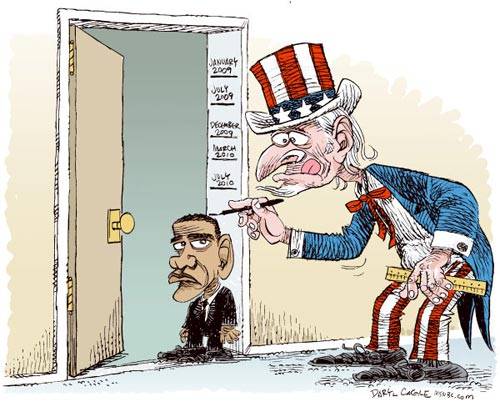 That’s fine and dandy, if you have someone of character and integrity sitting in the Oval Office. Unfortunately…
In this case, our leadership must return to our Founders’ system of checks and balances, which is set up to facilitate each branch’s ability to fight off Constitutional violations from other branches, with the power to initiate war securely vested in Congress.
This president is launching Drone Attacks in Yemen, even as I write this post. That’s our fourth theater of war, under a man whose bureaucrats renamed Terrorist Acts, Man-caused Disasters.
Please excuse me if I don’t feel comfortable in his ability to effectively prosecute a war.
 Kingsjester's Blog
Well said, KJ.
It is a sad fact that for decades, Congress has been busy handing over its power & authority to others.
This must stop.
And while we’re at it, how about the states start assuming their dutiful responsibility again in protecting their sovereignty?
LikeLike
Man-caused-disaster powers act?
LikeLike
excellent KJ…
nevermind the outrage by nan and harry if W didn’t get approval before iraq and afghanistan….
hypocrites!
LikeLike
This should make for interesting conversation during their golf outing…
An outing that could render moot using the obamanation’s MANY golf outings against hm during the ’12 campaign…
LikeLike