
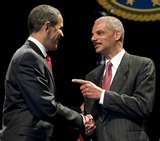
 The United States Department of Justice, a federal executive department established in 1870, has decided, under the administration of President Barack Hussein Obama (peace be unto him) and Attorney General Eric Holder, that the perceived civil rights of Terrorists and people who are living in our country illegally, are more important than the wishes of the American citizens who they are supposed to be protecting and serving, to the point of attempting to destroy American Sovereignty.
KJ, you’re off your meds again, aren’t you? Not hardly.
 Example #1 – The judge in the first civilian trial of a Guantanamo Bay detainee has barred the prosecution’s star witness Wednesday from testifying. This action will forever cripple the government’s effort to build criminal cases with evidence obtained through harsh CIA interrogations overseas.
According to U.S. District Judge Lewis A. Kaplan, the witness could not take the stand because investigators learned of his existence through coercive questioning of the defendant, terrorism suspect Ahmed Khalfan Ghailani, pictured here, at a secret CIA camp.
In explaining his ruling, Kaplan wrote:
The court has not reached this conclusion lightly. It is acutely aware of the perilous nature of the world in which we live. But the Constitution is the rock upon which our nation rests. We must follow it not when it is convenient, but when fear and danger beckon in a different direction.
The ruling stunned federal prosecutors, who asked for an immediate delay in the case while they decide whether to appeal. It also re-energized the debate over whether terrorism suspects captured overseas should be prosecuted in civilian courts and whether the American justice system is up to the task.
Ummm…call it a snap judgement…but I’d have to say…NO.
In spite of the judge’s ruling, Attorney General Eric Holder (whose former law firm defended Islamic Terrorists) said at a Washington news conference that he remains confident the Justice Department can successfully prosecute Ghailani in civilian court. Of course.
The smackdown by the judge came during the final selection of jurors in the case against Ghailani, a Tanzanian charged in the 1998 bombing of two U.S. embassies in Africa. The twin attacks killed 224 people, including a dozen Americans.
The man who was supposed to be the government’s star witness, Hussein Abebe, said he sold explosives to Ghailani that were used in the bombing. But defense lawyers said prosecutors never would have learned about Abebe if Ghailani had not divulged his identity while undergoing harsh interrogations at a secret overseas CIA camp in 2004.
Former Army judge advocate and now a civilian attorney,Michael Farkas, said the ruling shows why those backing military tribunals for Guantanamo detainees contend that “civilian criminal courts are no place for war criminals.” He said the military rules of evidence do not give defendants some of the protections they are afforded in the civilian justice system.
Per Farkas:
In a military tribunal, this witness would not have been precluded.
Ghailani was brought to New York for trial in 2009, as covertly as possible. The subject of where to try Guantanamo Bay detainees got the attention of the American people when AG Holder announced last November that the 9/11 Islamic Terrorist mastermind Khalid Sheikh Mohammed and four others would be tried blocks from where the World Trade Center stood. Holder later parsed his words, saying that he was reconsidering.
Ghailani is accused of being a bomb-maker, document forger and aide to Osama bin Laden. He is charged with conspiring in the 1998 bombings in Tanzania and Kenya.
Prosecutors had repeatedly said that Abebe’s testimony was vital to their case.
Judge Lewis shot a big hole in the DOJ’s plans by ruling that Abebe was identified and located as a “close and direct result of statements made by Ghailani” while in CIA custody. He noted the government had decided not to contest the details of Ghailani’s treatment while in CIA custody and had told the judge to assume that everything Ghailani said while in CIA custody was coerced.
Though many of the details about his treatment have been kept secret, the defense divulged during a pretrial hearing that he was subjected to enhanced interrogation techniques for 14 hours over five days. After the Sept. 11, 2001, attacks, the CIA used 10 harsh methods, including waterboarding, a form of simulated drowning, against select detainees.
That’s better treatment that the Americans murdered on 9/11/01 received.
The judge previously rejected a defense request to throw out the charges because of Ghailani’s treatment at the hands of the CIA.
 Example #2 – Yesterday, Arizona Governor Jan Brewer filed a motion stating her opposition to foreign countries’ participation in the U.S. Department of Justice’s challenge to SB 1070 at the Ninth Circuit Court of Appeals and requesting the court’s permission to respond to their brief.
Mexico and 10 other foreign governments have asked the court to participate in the appeal by filing an amicus brief supporting the U.S. Department of Justice against the State of Arizona in the defense of SB 1070. Mexico is joined by Argentina, Bolivia, Brazil, Costa Rica, Ecuador, El Salvador, Nicaragua, Paraguay, Peru, and Chile in opposing SB 1070 and enforcement measures that have been a part of U.S. federal law for decades.
What is an amicus brief?
Literally, friend of the court. A person with strong interest in or views on the subject matter of an action, but not a party to the action, may petition the court for permission to file a brief, ostensibly on behalf of a party but actually to suggest a rationale consistent with its own views. Such amicus curiae briefs are commonly filed in appeals concerning matters of a broad public interest; e.g., civil rights cases. They may be filed by private persons or the government. In appeals to the U.S. courts of appeals, an amicus brief may be filed only if accompanied by written consent of all parties, or by leave of court granted on motion or at the request of the court, except that consent or leave shall not be required when the brief is presented by the United States or an officer or agency thereof.
The Arizona Legislature passed SB 1070 in order to insure that Arizona’s law enforcement officers cooperate in the enforcement of federal immigration laws and to adopt state crimes that mirror existing federal laws. These laws were passed by the Arizona Legislature to protect the citizens of Arizona from the federal government’s failure to enforce the immigration laws.
Governor Brewer’s motion asserts that the opinions of foreign governments have no bearing on whether a state law providing for cooperative enforcement of federal immigration law in Arizona complies with the U. S. Constitution. In addition, the foreign government’s brief raises issues that are unsupported by the facts in the record and have little relevance to the issues presented in this preliminary injunction appeal.
Go, Gov. Brewer, go! This great civil servant summarizes thusly:
As do many citizens, I find it incredibly offensive that these foreign governments are using our court system to meddle in a domestic legal dispute and to oppose the rule of law. What’s even more offensive is that this effort has been supported by the U.S. Department of Justice. American sovereignty begins in the U.S. Constitution and at the border. I am confident the Ninth Circuit will do the right thing and recognize foreign interference in U.S. legal proceedings and allow the State of Arizona to respond to their brief.
Sovereigntyis defined as supremacy of authority of rule as exercised by a sovereign or sovereign state (country) or complete independence and self-government. America was established by our Founding Fathers as a sovereign nation, a Republic whose citizenry elect their peers to representative the citizens of this country and protect them from threats, foreign and domestic. So far, this administration and the sycophantic Congress has been an epic failure in the performance of their duties. That is why November 2nd, 2010 is so very important. It is time to start taking our country back.


And people wonder why I think we’re done. We reached the tipping point long ago. Too many people (thanks to government public education) agree with the nonsense we’re having to deal with, here.
LikeLike
It just gets worser and worser
LikeLike
I’m not sure there’s a broom big enough…
LikeLike
what else can we expect out of this administration. nothing good at all
LikeLike