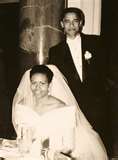
 In the summer of 1988, while still at Harvard, Barack Hussein Obama (mm mmm mmmm) landed a job as an intern in the Chicago office of the influential law firm of Sidley Austin. ( How does a first-year law student get an internship at such a prestigious law firm?) He was dating Michelle Robinson, a young lawyer from a working-class family in the South Shore area of the South Side. She also just happened to be his mentor at the firm. The lovebirds got married in 1990, and settled in the Hyde Park neighborhood on the South Side along the lakefront. Built around the University of Chicago, both black and white affluent families lived among the middle class and the poor. Hyde Park boasts a strong base of independent voters who are committed to political reform, which influenced Obama’s political message.
He worked for seven months in 1992 on a voter registration and education project that helped elect Bill Clinton as president and Carol Moseley Braun as the state’s first African-American female senator.
You may have heard of it: Project Vote. In 2008, Project Vote and ACORN were responsible for a voter registration drive targeting battleground states Obama needed to win the White House.
Though officially non-partisan, the ACORN/Project Vote voter drive focused on groups that they thought would vote Democratic in the presidential contest: African-American, young, Latino and low-income earners. They referred to these groups as “historically underrepresented in elections” in a press release they issued, in an attempt to justify what they were doing.
ACORN/Project Vote operated voter registration drives in 21 states in 2008; including the battlegrounds Colorado, Florida, Michigan (since move to Obama) Minnesota, Missouri, Nevada, New Mexico, North Carolina, Ohio, Pennsylvania and Wisconsin. They were very instrumental in Obama’s victory.
Also in 1992, Scooter went to work for Miner, Barnhill & Galland, a firm specializing in civil rights law and other forms of public advocacy. Working there provided him with the opportunity to make many contacts in the Chicago Political Machine. The longtime fire he had in his gut concerning a political career found inspiration through the changes being made in Chicago by Harold Washington, its black mayor. African-Americans were finally getting the power and control that they hadn’t had before, and Obama decided that politics was the career for him.
Obama started another part-time gig in 1992. Per the University of Chicago:
From 1992 until his election to the U.S. Senate in 2004, Barack Obama served as a professor in the Law School. He was a Lecturer from 1992 to 1996. He was a Senior Lecturer from 1996 to 2004, during which time he taught three courses per year. Senior Lecturers are considered to be members of the Law School faculty and are regarded as professors, although not full-time or tenure-track.
Why didn’t they just call him a Part-time Lecturer?
In 1995 “Bomber” Bill Ayers and his wife Bernadette Dohrn hosted a fund-raiser for Obama prior to Obama’s run for Alice Palmer’s seat in the state Senate and Ayers donated $200 to Obama’s upcoming state Senate campaign.
In 1996 at age 34, he ran for the state Senate in dubious campaign that is barely known of, outside of Chicago. Alice Palmer, the incumbent, had decided to run for Congress and supported Obama as her successor. But after Palmer’s congressional campaign ran into trouble, she changed her mind and decided to run for re-election to the Illinois Senate after all. Obama refused to step aside and the melee ensued. One of Scooter’s volunteers challenged whether Palmer’s nominating petitions were even legal. Obama’s campaign pulled the same chicanery concerning the petitions of other candidates. Palmer dropped out, and the other candidates were disqualified. So, Obama won unopposed in the Democratic primary—guaranteeing his victory in the general election. This was truly an example of Chicago-style politics at it’s finest…or dirtiest.
Around this same time, at a Bill Clinton White House event, philanthropist Walter Annenberg announced that he was making a $500 million grant to cities across the nation to put towards the reform of public schools. Bill Ayers was the head of the Chicago group that, with$49.2 million in hand, formed the Chicago Annenberg Challenge. The launch party in 1995 was attended by the governor of Illinois and the mayor of Chicago, as well as anybody was influential among the Chicago Political Elite. Guess who the first chairman of the Chicago Annenberg Challenge was? You guessed. Obama held the post until 1999. At that time, he stepped down and remained on the board. Bill Ayers worked closely with the Challenge as a leader of the newly formed Chicago School Reform Collaborative.
They also both served on the board of the charitable Woods Fund of Chicago from 1999 to 2002. Just a “guy from the neighborhood”. Huh, Scooter?
Additionally, Scooter served on the board of the Joyce Foundation from 1994 to 2002. This foundation started as the financial back-up plan of a widow whose family had made millions in the lumber industry.
After her death, it was run by philanthropic people who increasingly dedicated their giving to Liberal causes, including gun control, environmentalism and school changes. It has grown over the years until it is now bigger than the TIDES Foundation and actually funds it.
The Joyce Foundation in 2000 and 2001 provided the capital outlay to start the Chicago Climate Exchange. It started trading in 2003, and what it trades is, believe it or not, air.
What a coincidence, that, as president, pushing cap-and-trade is one of his highest priorities, huh?
While he served in the State Senate in Springfield, Illinois, Obama wrote more than 40 columns for his neighborhood Newspaper, The Hyde Park Herald. He also received extensive coverage in the Chicago Defender, an over-one hundred year old newspaper of record serving Chicago’s black community.
Per Howard Kurtz, writing for weeklystandard.com, from an article published August 11-18, 2008:
What they [the newspaper articles] portray is a Barack Obama sharply at variance with the image of the post-racial, post-ideological, bipartisan, culture-war-shunning politician familiar from current media coverage and purveyed by the Obama campaign. As details of Obama’s early political career emerge into the light, his associations with such radical figures as Reverend Jeremiah Wright, Father Michael Pfleger, Reverend James Meeks, Bill Ayers, and Bernardine Dohrn look less like peculiar instances of personal misjudgment and more like intentional political partnerships. At his core, in other words, the politician chronicled here is profoundly race-conscious, exceedingly liberal, free-spending even in the face of looming state budget deficits, and partisan. Elected president, this man would presumably shift the country sharply to the left on all the key issues of the day-culture-war issues included. It’s no wonder Obama has passed over his Springfield years in relative silence.
You’re a prophet, Mr. Kurtz.
Obama remained in the Illinois State Senate until 2004, when he became the Democratic nominee for the United States Senate seat from Illinois. We’ll examine this period of his life tomorrow, as we finish this series.
Sources: usnews.com, suntimes.com, uchicago.edu, michellemalkin.com, pajamasmedia.com, weeklystandard.com
 Kingsjester's Blog
Nice background you have there Barry…..and the rest is history…mmm mmm mmm.
LikeLike
Great post KJ. You are doing a great job with this series.
LikeLike
Thanks KJ. I started to say that I’ve enjoyed this series. heheheh.
I’ll just say that I love the messenger but hate the message.
LikeLike
How interesting that all these philanthropies are political causes in sheep’s clothing. It reminds me of the days when people would collect for the “Widows and Orphans Fund” in Irish pubs in the US. They collected all kinds of money from well-meaning Americans who thought they were helping others in need. It was actually a well-known scam that helped the IRA create more widows and orphans.
LikeLike
Sadly, yes. Kurtz WAS right.
LikeLike
“His associations with such radical figures… look less like peculiar instances of personal misjudgment and more like intentional political partnerships.”
I remember before the 2008 elections how a select group of conservative media types were hammering this fact in day after day and it seemed no one was listening, or maybe no one wanted to believe that such a person could even get as far as being nominated for President. There was so much denial going on at that time…. now look where we are. So sad.
Thank you so much for doing this series and all the research it entails, KJ. It is greatly appreciated.
LikeLike
Good stuff, Maynard…
LikeLike
Pingback: Mayor Rahmbo: The Chicago Way « Kingsjester's Blog
Pingback: Obama Calls Romney a Crook: Glass Houses, Preezy « Kingsjester's Blog