This is the first in a series that I will be doing, from time to time, titled American Influences. These will be people, of all walks of life, who influenced our country and its’ culture through extrordinary talent and/or intelligence. Or they might have just been at the right place at the right time.
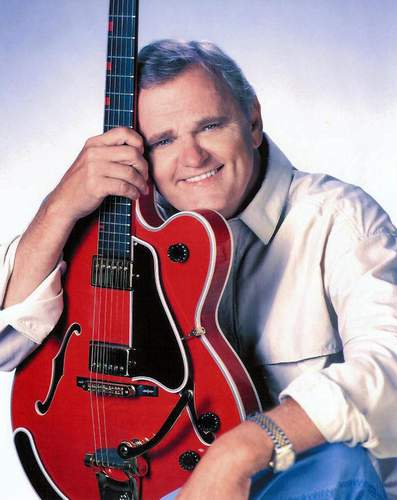 Known forever as “The Guitar Man,” singer-songwriter Jerry Reed became famous not only for a successful career in popular and country music, but also as an actor and as one of the greatest studio session guitar players ever.
Jerry Reed Hubbard was born in Atlanta on March 20, 1937. He was quoted as saying as a small child, while running around strumming his guitar:
I am gonna be a star. I’m gonna go to Nashville and be a star.
Reed’s parents separated four months after his birth, and he and his sister spent seven years in foster homes or orphanages. Reed was reunited with his mother and stepfather in 1944. He was signed by publisher and producer Bill Lowery to cut his first record, “If the Good Lord’s Willing and the Creeks Don’t Rise,” at age 18. He continued releasing both country and rockabilly singles to little notice until rocker Gene Vincent covered his “Crazy Legs” in 1958.
Reed married Priscilla “Prissy” Mitchell in 1959. They had two daughters, Charlotte Elaine “Lottie” Reed Stewart, and Seidina Ann Reed Hinesley, born April 2, 1960. After 2 years of serving in the military, Reed returned to Nashville in 1961 to continue his songwriting career, which had continued to grow while he was in the armed forces thanks to Brenda Lee’s 1960 cover of his “That’s All You Got to Do.” He became a popular session and tour guitarist.
In 1962, he scored some success with the singles “Goodnight Irene” and “Hully Gully Guitar,” which found their way to Chet Atkins, who produced Reed’s 1965 “If I Don’t Live Up to It.” In 1967, he notched his first chart hit with “Guitar Man,” which Elvis Presley soon covered with a little help from Jerry himself:
I was out on the Cumberland River fishing, and I got a call from Felton Jarvis (then Presley’s producer). He said, ‘Elvis is down here. We’ve been trying to cut ‘Guitar Man’ all day long. He wants it to sound like it sounded on your album.’ I finally told him, ‘Well, if you want it to sound like that, you’re going have to get me in there to play guitar, because these guys (you’re using in the studio) are straight pickers. I pick with my fingers and tune that guitar up all weird kind of ways.’
Jarvis hired Reed to play on the session.
I hit that intro, and [Elvis’] face lit up and here we went. Then after he got through that, he cut [my] “U.S. Male” at the same session. I was toppin’ cotton, son.
Reed also played the guitar for Elvis Presley’s “Too Much Monkey Business” (1968), recorded in the same session.
Here is a version of Guitar Man that you have probably never seen before. Hold on to something.
After Presley recorded another of Reed’s songs, “U.S. Male,” the songwriter recorded an Elvis tribute, “Tupelo Mississippi Flash,” which proved to be his first Top 20 hit.
After releasing the 1970 crossover hit “Amos Moses,” a hybrid of rock, country and Cajun styles, Reed teamed with Atkins for the duet LP Me and Jerry. During the 1970 television season, he was a regular on the Glen Campbell Goodtime Hour, and in 1971 he issued his biggest hit, the chart-topper “When You’re Hot, You’re Hot,” which was also the title track of his first solo album. A second collaboration with Atkins, Me and Chet, followed in 1972, as did a series of Top 40 singles, which alternated between frenetic, straightforward country offerings and more pop-flavored, countrypolitan material. A year later, he scored his second No. 1, “Lord, Mr. Ford”.
During this time (1970), he also wrote the following beautiful song, which he performed live on Pop Goes the Country (introduced by a young Ralph Emery):
The legendary Chet Atkins, who frequently produced Reed’s music, remarked that he had to nag Reed into putting instrumental numbers on his own albums, as Reed always considered himself more of a songwriter than a player. Atkins, however, thought Reed was a better fingerstyle player than he himself was; Reed, according to Atkins, helped him work out the fingerpicking for one of Atkins’ biggest hits, “Yakety Axe.” Jerry Reed was one of only four people to have the title of “Certified Guitar Player” (an award only bestowed to those who have completely mastered guitar). He was given this title by Chet Atkins himself.
In the mid-1970s, Reed slowed down in his recording career and got into high gear with his acting career. In 1974, he co-starred with his close friend Burt Reynolds in the film W.W. and the Dixie Dancekings. Even though he continued to record throughout the decade, he was known to more people as a movie star, almost always seen with headliner Reynolds. After 1976’s Gator, Reed appeared in 1978’s High Ballin’ and 1979’s Hot Stuff. He also co-starred in all three of the Smokey and the Bandit films. The first, which came out in 1977, produced the hit, “Eastbound and Down.”
In 1979, he released a record comprised of both vocal and instrumental selections, Half & Hal, followed two years later by Jerry Reed Sings Jim Croce. In 1982, Reed’s career as a singles artist was boosted by the chart-topping novelty hit, “She Got the Goldmine (I Got the Shaft),” followed by “The Bird,” which peaked at No. 2. His last chart hit, “I’m a Slave,” appeared in 1983.
After an unsuccessful 1986 LP, Lookin’ at You, Reed focused on touring until 1992, when he and Atkins reunited for the album Sneakin’ Around before he again returned to the road. Jerry Reed’s last recording was a live album, released in 2005.
Reed died Aug. 31, 2008, at the age of 71 from complications of emphysema.
He left us with a legacy of good-natured humor, movies, song writing, and guitar virtuousity that all came together to make an American Original.
The following video of one of his classics includes a beautiful tribute. Rest in peace, Jerry.
Sources: cmt.com, wikipedia.com, youtube.com
 Kingsjester's Blog
Thanks for the stroll down memory lane, KJ. Jerry Reed was great.
LikeLike
This is great. Thanks KJ!
LikeLike
Thanks KJ … I needed that. What a great tribute and a great reminder for us … “today is mine” … let’s make the most of it!
LikeLike