
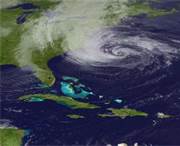
 Besides the Presidential Election, the big news story this week has been Hurricane Sandy.
The New York Daily News reports that
The massive storm that started out as Hurricane Sandy slammed into the East Coast and morphed into a huge and problematic system, killing at least 74 people in the United States. Power outages now stand at more than 5.6 million homes and businesses, down from a peak of 8.5 million.
And if incidents like the following continue to happen, it may take a while to get powers restored…
Angry residents pelted utility crews with eggs as they tried to restore power in Bridgeport, Conn., after the mayor claimed the local power company had “shortchanged” the state’s largest city as it tries to recover from superstorm Sandy.
United Illuminating workers reported eggs and other objects being thrown at them a day after Mayor Bill Finch said the utility was taking care of wealthy suburbs while his constituents suffered. The unrest caused United Illuminating to pull its workers out until the city agreed to provide police protection.
“Citizens began throwing things at the crews,” Michael West, a spokesman for United Illuminating, told FoxNews.com. “It started to get pretty hairy. They did not feel safe.”
West said it started with verbal abuse and escalated.
“It started to get pretty hairy. They did not feel safe.”
– Michael West, spokesman for United Illuminating
“We communicated with the city and said if you don’t provide police support, we can’t have our crews there in harm’s way,” he said.
But, the power companies themselves aren’t helping the situation, either…
A business coordinator at a power company in western Georgia told The Daily Caller Friday afternoon that workers from his electric-utility employer were not permitted to help restore power to New York consumers because they would not join the International Brotherhood of Electrical Workers (IBEW).
The revelation comes on the heels of similar stories TheDC has reported about power crews from Alabama and Florida who volunteered to fix downed power lines after Hurricane Sandy left millions in the Northeastern United States in the dark this week.
“We’re not a large utility, so we were only able to send up two or three crews,” Glenn Cunningham, a business continuity coordinator with Diverse Power in LaGrange, Georgia, said in a phone interview.
Then, there was the matter of Mayor Bloomberg’s insistence on holding the New York Marathon and allocating resources for it that were needed elsewhere:
Mayor Michael Bloomberg and organizers of New York City Marathon cancelled the race Friday amid growing concerns that holding the event would divert resources from cleanup efforts in the wake of superstorm Sandy.
Mr. Bloomberg had said as recently as early Friday afternoon that the marathon, scheduled to start Sunday morning, would go on and serve as a demonstration that the city was recovering from the storm and moving forward.
But other elected officials from around the city said holding it so soon after a major storm would be an insult to hard-hit residents still cleaning up and worried that it would get in the way of recovering from a storm that killed at least 41 people in New York City alone.
“We would not want a cloud to hang over the race or its participants, and so we have decided to cancel it,” Mr. Bloomberg and the organizers said in a joint news release. “We cannot allow a controversy over an athletic event—even one as meaningful as this—to distract attention away from all the critically important work that is being done to recover from the storm and get our city back on track.”
At the Jacob Javits Center, where the pre-marathon expo was being held on Friday, volunteers stopped admitting runners for check-in, although long lines still awaited direction organizers.
Mont McClendon, from Lubbock, Texas, said he was “shocked” to learn that the race had canceled, having found the news via Twitter. “Honestly,” he said, “the reason I came here and felt confident is because the mayor said so.”
The debate over whether to hold the race had grown heated Friday. Asked earlier in the day whether discussions were under way about the viability of the race as public pressure mounts, a spokesman for the group that organizes the race, New York Road Runners Club, had said: “The situation is a fluid one and continues to evolve.”
That statement come just hours after Mr. Bloomberg reasserted his support for holding the race.
Several public officials had said holding the race Sunday could drain resources from the city’s recovery efforts. In addition, the leader of the Police Benevolent Association said the department was stretched too thin to facilitate what he called “essentially a citywide party.”
As horrible as the conditions are in the areas affected by Hurricane Sandy are, I can’t even begin to image what would have happened if another Hurricane the size and power of Katrina would have hit that area.
 According to the Discovery Channel:
Hurricane Katrina was one of the deadliest hurricanes in the history of the United States, killing over 1,800 people.
The confirmed death toll (total of direct and indirect deaths) stood at 1,836, mainly from Louisiana (1,577) and Mississippi (238). However, 705 people remain categorized as missing in Louisiana, so this number is not final. Many of the deaths are indirect. It is almost impossible to determine the exact cause of some of the fatalities.
Katrina was the largest hurricane of its strength to approach the United States in recorded history; its sheer size caused devastation over 100 miles (160 kilometers) from the storm’s center. The storm surge caused major or catastrophic damage along the coastlines of Louisiana, Mississippi and Alabama, including the cities of Mobile, Ala., Biloxi and Gulfport, Miss., and Slidell, La.
Katrina was the 11th named storm, fifth hurricane, third major hurricane and second category 5 hurricane of the 2005 Atlantic hurricane season. It was also the sixth strongest hurricane ever recorded, and the third strongest hurricane to make landfall in the U.S. ever recorded.
New Orleans’ levee failures were found to be primarily the result of system design flaws, combined with the lack of adequate maintenance. According to an investigation by the National Science Foundation, those responsible for the conception, design, construction and maintenance of the region’s flood-control system apparently failed to pay sufficient attention to public safety.
Hurricane Katrina was the costliest hurricane in U.S. history, with $75 billion in estimated damages.
Now, I realize that we’re just a bunch of poor, ignorant red-state rednecks down here in Dixie, but we’ve worked hard and have made a major comeback from the monster known as Katrina.
I feel confidant that the Northeast can do the same…if they don’t let the politicians, the unions, political correctness, and Presidential Photo Ops get in the way.
 Kingsjester's Blog