 When Barack Hussein Obama first ran for the Presidency of the United States in 2008, he claimed that his economic policies would “foster economic growth from the bottom up and not just from the top down.” Obama promised to put in place “an immediate rescue plan for the middle class” and would end the “tired, worn-out, trickle-down ideologies we’ve been seeing for so many years.”
Obama got everything that he wanted in his first two years in the White House, when Democrats had solid control of Congress — a massive stimulus, auto industry bailouts, temporary middle class tax cuts, vast new regulations on businesses and ObamaCare.
But, all of his brilliant Socialist Economic Policies produced the exact opposite of what he’d promised, when, on January 21, 2009, President Barack Hussein Obama spoke the following words during his Inauguration:
For everywhere we look, there is work to be done. The state of our economy calls for action, bold and swift. And we will act, not only to create new jobs, but to lay a new foundation for growth. We will build the roads and bridges, the electric grids and digital lines that feed our commerce and bind us together. We’ll restore science to its rightful place, and wield technology’s wonders to raise health care’s quality and lower its cost. We will harness the sun and the winds and the soil to fuel our cars and run our factories. And we will transform our schools and colleges and universities to meet the demands of a new age. All this we can do. All this we will do.
With less than 50 days (Praise God) left to go in the Reign of King Barack The First, Americans are no longer waiting for “action, bold and swift’ to impact the rotten state of our economy.
That long-awaited action did not come from the Sitting President.
It came from the President-elect.
The New York Times reports that
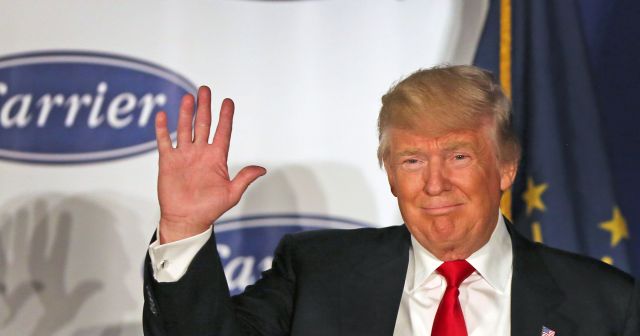
President-elect Donald Trump on Thursday warned that the government would punish companies seeking to move operations overseas with “consequences,” setting the stage for an unusual level of intervention by the White House into private enterprise. Trump’s remarks came as he triumphantly celebrated a decision by the heating and air conditioning company Carrier to reverse its plans to close a furnace plant here and move to Mexico, helping keep 1,100 jobs in Indianapolis. About 800 of those were manufacturing positions that had been scheduled to move south of the border, said a person familiar with the negotiations.
An additional 300 to 600 Carrier positions at that plant, as well as roughly 700 jobs at another facility in the area, will still be cut.
Under the terms of the agreement, which have not been finalized, Carrier would receive a $7 million tax incentive package from the state of Indiana in exchange for making a $16 million investment in the facility — although Trump said Thursday that amount would probably be higher.
In remarks delivered inside the Carrier facility, the president-elect said more companies will decide to stay in the United States because his administration will lower corporate taxes and reduce regulations. He also warned that businesses that decide to go abroad will pay a price through a border tax on imported goods.
“Companies are not going to leave the United States any more without consequences,” Trump declared Thursday. “Not gonna happen. It’s not gonna happen.”
Trump said he decided to intervene after watching a television news report that reminded him that he had vowed during the campaign, “We’re not going to let Carrier leave.”
Trump’s determination to use a mixture of incentives and tariffs to keep jobs from going overseas represents a sharp break with the free-market wing of the Republican Party, including senior congressional leaders. On Thursday, top Republicans offered careful responses to the Carrier deal.
“I think it’s pretty darn good that people are keeping their jobs in Indiana instead of going to Mexico,” said House Speaker Paul D. Ryan (R-Wis.), emphasizing that the party is hoping to pass comprehensive tax changes that would be a boon to all businesses. Ryan has repeatedly criticized President Obama for allegedly trying to pick “winners and losers” in his stimulus package and other economic policies.
The Carrier deal was sharply criticized by some conservatives, who viewed it as government distortion of free markets, as well as liberals, who derided it as corporate welfare.
“I think it sets a pretty bad precedent,” said Dan Ikenson, director of the Herbert A. Stiefel Center for Trade Policy Studies at the Cato Institute, a libertarian think tank. “I don’t think we should be addressing issues like this on an ad hoc basis. It certainly incentivizes companies to make a stink and say: ‘We’re going to leave, too. What are you going to do for me?’ ”
Sen. Bernie Sanders of Vermont, who ran for the Democratic presidential nomination, accused Trump of reversing course on a pledge to punish companies that outsource manufacturing jobs. In the case of Carrier, Trump had said he would force the company to “pay a damn tax” if it closed the plant.
“Instead of a damn tax, the company will be rewarded with a damn tax cut,” Sanders wrote in an op-ed for The Washington Post. “Wow! How’s that for standing up to corporate greed?”
Privately, some business leaders were also unnerved.
“It is uncharted territory for a president-elect to get involved personally in social engineering with a single company,” said an adviser to major corporations, who spoke on the condition of anonymity in order not to anger the incoming administration.
Now that Carrier “is no longer the political piñata,” the adviser added, chief executives “are asking, ‘Who’s next?’ ”
Timothy Bartik, an economist at the nonpartisan W.E. Upjohn Institute for Employment Research in Kalamazoo, Mich., said that vague threats from the president-elect could stymie corporate investment as firms seek to avoid decisions that could draw the ire of the White House.
“What are these consequences? Who’s in charge of them?” Bartik asked.
“One of the worst things for corporate investment is uncertainty,” he added. “You would hope that the government would not add to the uncertainty.”
In Indianapolis, where Carrier has been a staple of the business community since the 1950s, the deal was celebrated.
“Our union at every level, including our local union leadership, fought to keep that plant open,” said Leo Gerard, international president of the United Steelworkers, which represents the factory’s workers.
Gerard said that although it did not endorse Trump, the union supports crucial aspects of the president-elect’s agenda, including preservation of manufacturing jobs, scrapping free-trade deals and spending on infrastructure.
“If this step is any indication of what’s to come, we look forward to working with him,” Gerard said.
Jennifer Volheim, a bartender at Sully’s Bar and Grill, down the street from the factory, said she was “heartbroken” when it was on track to shut down. But, she said, she voted for Trump and knew he would make a difference.
“We knew Trump was on it,” she said. “He’s not even in office yet and he’s saving . . . jobs.”
In fact, by Trump’s own telling on Thursday, he had no plans to intervene in the Carrier case until he watched an evening news segment featuring a worker who expressed confidence that the president-elect would save the Indianapolis plant. He said his campaign vow to save the plant was “a euphemism” for other companies.
Regardless, Trump — known for his tendency to react to TV news reports — said he immediately picked up the phone and called Gregory Hayes, the chief executive of Carrier’s parent company, United Technologies.
“I said, ‘Greg, you gotta help us out here. You gotta do something,’ ” Trump recalled Thursday.
Standing in front of a wall blanketed with Carrier’s blue-and-white logo, Trump lavished praise on the company for its decision, promising that the sales of its air-conditioning units would soar “because of the goodwill you have engendered.”
Experts said no modern president has intervened on behalf of an individual company. Although Obama stepped in to rescue car manufacturers after the 2008 financial crisis and President John F. Kennedy intervened to prevent steel producers from increasing prices, these actions affected entire industries — not decisions at a specific plant, Bartik said.
Jeff Windau, an analyst at the investment firm Edward Jones in St. Louis, said that Trump might not have the “bandwidth” to keep up this kind of dealmaking once in the Oval Office.
“Having a current president-elect focus on a specific company and a specific location — it’s a pretty micro view of the world,” he said.
But Trump said Thursday that he planned to personally call other companies that are contemplating moving operations out of the country, even, as he said, if critics felt such outreach was not “presidential.”
“I think it’s very presidential. And if it’s not presidential, that’s okay because I actually like doing it,” Trump said. “But we’re going to have a lot of phone calls made to companies when they say they’re leaving this country, because they’re not going to leave this country.”
How could saving the jobs of Americans NOT be Presidential?
The prosperous years during the Reagan Presidency marked a period of economic progress for Middle Class Americans. Middle Class Income increased 11 percent after adjustment for inflation, while nearly 20 million new jobs were created.
Those Liberal critics of the 1980s, who argue that the Middle Class shrank in number during those years, are half -right for the wrong reasons. The proportion of Middle Class Americans did indeed decline, but this reflected an upward movement of households into the high income category. Meanwhile, the proportion of Low Income Households declined, as more became middle class. The income growth during the Reagan Presidency increased the size of the pocketbooks of Americans at all income levels.
During Obama’s time in office, America’s major corporations have been hit with punitive measures, including high corporate tax rates and Obamacare, which has caused them to “down-size” their employee rolls and to relocate their call centers to companies like India, which has effected the rest of our economy.
Supply Side or “Trickle-Down” Economics was simply common sense. As I have written before, Capitalism is the engine that drives America’s economy.
When those who actually hire Americans are attacked by an Administration, naturally, those consequences are felt by those in lower economic strati (that’s you and me, boys and girls).
Obama’s “Trickle-Up” Economic Policy has been a miserable failure.
Because, as Lady Margaret Thatcher once said,
The problem with Socialism is that eventually you run out of other people’s money.
President-elect Trump, unlike the present occupant of the White House, wants Americans to prosper and make (and keep) our own money.
And, to quote Peter Noone (Herman’s Hermits),
Now, ain’t that just a little bit better?
Until He Comes,
KJ
 Kingsjester's Blog