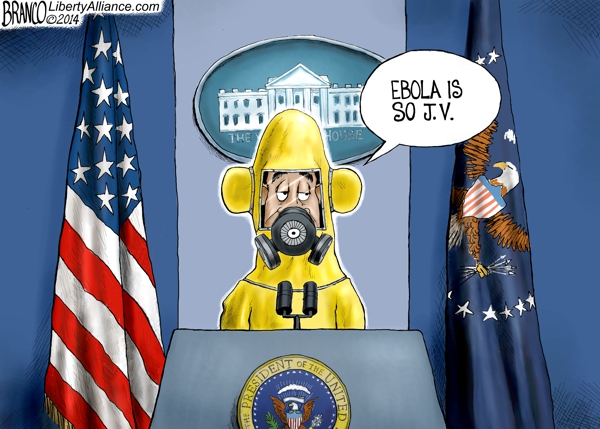
Ebola in America: Treatment By Confusion

EbolaFirst and foremost, I want the American people to know that our experts, here at the CDC and across our government, agree that the chances of an Ebola outbreak here in the United States are extremely low. We’ve been taking the necessary precautions, including working with countries in West Africa to increase screening at airports so that someone with the virus doesn’t get on a plane for the United States. In the unlikely event that someone with Ebola does reach our shores, we’ve taken new measures so that we’re prepared here at home. We’re working to help flight crews identify people who are sick, and more labs across our country now have the capacity to quickly test for the virus. We’re working with hospitals to make sure that they are prepared, and to ensure that our doctors, our nurses and our medical staff are trained, are ready, and are able to deal with a possible case safely. – President Barack Hussein Obama, “Remarks by the President on the Ebola Outbreak,  Centers for Disease Control and Prevention, Atlanta, Georgia, 9/16/2014

To quote Maxwell Smart, Agent 86,

Missed it by that much.

As more cases of Ebola are coming to light, here in the “Shining City on a Hill”, the question concerning the outbreak remains,

Who is in charge here?

USA Today reports that

As Thomas Eric Duncan’s family mourns the USA’s first Ebola death in Dallas, one question reverberates over a series of apparent missteps in the case: Who is in charge of the response to Ebola?

The answer seems to be — there really isn’t one person or agency. There is not a single national response.

The Atlanta-based Centers for Disease Control and Prevention has emerged as the standard-bearer — and sometimes the scapegoat — on Ebola.

Public health is the purview of the states, and as the nation anticipates more Ebola cases, some experts say the way the United States handles public health is not up to the challenge.

“One of the things we have to understand is the federal, state and local public health relationships,” says Michael Osterholm, director of the Center for Infectious Disease Research and Policy at the University of Minnesota. “Public health is inherently a state issue. The state really is in charge of public health at the state and local level. It’s a constitutional issue. The CDC can’t just walk in on these cases. They have to be invited in.”

…Though the CDC is tasked with readying the nation for an Ebola outbreak, then leading the national response, the Department of Homeland Security is responsible for protecting the borders, according to Thomas Skinner, a spokesman for the CDC, which is under the auspices of the Department of Health and Human Services.

The CDC collaborates with health departments and laboratories around the USA to make sure they are able to test for Ebola and respond rapidly if there is a case in their state, CDC spokeswoman Kirsten Nordlund said.

Uh huh.

Dr. Manny Alvarez, Fox News Senior Medical Editor for Health News, wrote the following:

Is the CDC in control?

I am not sure anymore. This latest case of Ebola in Texas has me wondering whether the CDC is prepared to eradicate any further contamination on U.S. soil.

CDC Director Dr. Tom Frieden stated that this latest case of Ebola was due to a breach in medical protocol. This current patient is a nurse who was part of the team treating Thomas Eric Duncan, who died last week from Ebola. 

As we all know, Mr. Duncan was very sick and he was in an isolation unit for more than a week. 

I would have imagined that the CDC would have been all over the supervision of this patient in the hospital, making sure that all protocols were being followed properly. 

So you see my conundrum. Did the CDC drop the ball? Or are we blaming this breach of protocol on hospital staff? 

I have been saying that not all hospitals are created equal and have the infrastructure necessary to fully protect its staff. The infrastructure is not available in many cities in the U.S. 

So the question is: How are we going to control further contamination? 

The time has come to have specific centers where patients with suspected Ebola need to be monitored and treated. Hospital staff needs to be better protected.

I think that Dr. Frieden needs to evaluate whether he is qualified for this national task. I think that Dr. Frieden needs to consider whether to delegate this responsibility to the Department of Defense, because dealing with Ebola warrants a military medical approach rather than a bureaucratic political Washington approach. 

Tough decisions need to be made. Dr. Frieden’s argument of not closing West Africa to commercial travel does not hold water. A better approach would be to have military flights bring supplies and volunteers to eradicate this epidemic in that continent. It would minimize the potential dangers to other communities around the planet as the world works on better treatment plans. Otherwise the Ebola war will continue for generations to come.

So, to summarize, a deadly disease, which has been contained in Africa for quite some time now, is now here in America, while 3,000 American Sons and Daughters, our Brightest and Best, have been sent by Obama to “combat it” and possibly become exposed to it.

What happens when they bring it back home with them?

Meanwhile, those tens of thousands of “unaccompanied minors” who invaded our Southern Border recently, have been spread all over America by Barack Hussein Obama.

And, as I reported before, they brought tuberculosis and other diseases with them.

The question remains,

Who is in charge here?

Until He Comes,

KJ

Obama, Ebola, and the Little Dutch Boy

AFBrancoObamaEbola1092014In response to the death of the first Ebola patient in our country, Obama and his Administration have announced that they are going to take drastic steps to prevent a pandemic…They’re going to take Airline Passengers’ temperatures.

The New York Times reports that

Federal health officials will require temperature checks for the first time at five major American airports for people arriving from the three West African countries hardest hit by the deadly Ebola virus. However, health experts said the measures were more likely to calm a worried public than to prevent many people with Ebola from entering the country.

Still, they constitute the first large-scale attempt to improve security at American ports of entry since the virus arrived on American soil last month.

They are also a notable policy shift at a time of rising concern about the disease. Public health officials had initially resisted the move, saying such checks would be an unnecessary use of thinly stretched resources. But pressure for tougher action mounted. Republicans sharply criticized President Obama for what they called a lax response. Many, including Senator Ted Cruz of Texas, have suggested looking at air travel restrictions from West Africa, something the administration has rejected.

The temperature check requirements were announced hours after the first Ebola patient to have the illness diagnosed in the United States, Thomas Eric Duncan, a Liberian, died in a Dallas hospital, intensifying questions about whether he might have survived had he been admitted to a hospital when he first sought care there in late September.

The president’s Republican critics were largely silent Wednesday after Mr. Duncan died and the administration announced the airport screenings. It was unclear if the Republicans saw the temperature checks as a sufficient response to the epidemic or if they did not want to be perceived as seeking political gain from Mr. Duncan’s death.

That Mr. Duncan was able to get from Liberia to Dallas as the disease surged out of control in West Africa underscored the risk of spreading disease in a globalized world. An infected Liberian-American, Patrick Sawyer, carried the disease to Nigeria, Africa’s most populous country, on a flight for business. Mr. Duncan had come to the United States to reunite with family.

“We are a global village,” said Howard Markel, a professor of the history of medicine at the University of Michigan. “Germs have always traveled. The problem now is they can travel with the speed of a jet plane.”

The new requirement of temperature checks has broad implications for health departments across the country.

In a conference call with state and local officials Wednesday afternoon, Mr. Obama expressed confidence in the procedures already in place to prevent the spread of Ebola, but urged them to be vigilant in the days and weeks ahead.

“As we saw in Dallas, we don’t have a lot of margin for error,” Mr. Obama told the group, according to a transcript released by the White House. “If we don’t follow protocols and procedures that are put in place, then we’re putting folks in our communities at risk.”

Gosh, really, Scooter? That’s not what you said…

First and foremost, I want the American people to know that our experts, here at the CDC and across our government, agree that the chances of an Ebola outbreak here in the United States are extremely low. We’ve been taking the necessary precautions, including working with countries in West Africa to increase screening at airports so that someone with the virus doesn’t get on a plane for the United States. In the unlikely event that someone with Ebola does reach our shores, we’ve taken new measures so that we’re prepared here at home. We’re working to help flight crews identify people who are sick, and more labs across our country now have the capacity to quickly test for the virus. We’re working with hospitals to make sure that they are prepared, and to ensure that our doctors, our nurses and our medical staff are trained, are ready, and are able to deal with a possible case safely. – President Barack Hussein Obama, “Remarks by the President on the Ebola Outbreak, Centers for Disease Control and Prevention, Atlanta, Georgia, 9/16/2014
Okay,. We know that the source of Ebola is Africa. Why don’t we install a quaratine?

Oh, no. Like every other part of the Obama Administration, the CDC is much too smart for common sense. After all, they are our intellectual superiors.

The first priority of federal health officials is to protect Americans from Ebola, but “an outbreak anywhere is potentially a threat everywhere,” the head of the Centers for Disease Control and Prevention said Sunday.

In recent days, a handful of lawmakers, including Louisiana Gov. Bobby Jindal, have called for restrictions on air travel between Ebola-affected countries in West Africa and the United States.

On Saturday, there was a brief scare at Newark Liberty International Airport when a passenger who had traveled from West Africa was ill on a flight from Brussels. A CDC official met the aircraft and the passenger was taken to a hospital, where “it became clear that the symptoms that individual had weren’t consistent with Ebola,” CDC Director Thomas Frieden said. The patient was discharged and was feeling better.

Despite the concerns sparked by such incidents, Frieden emphasized the importance of keeping the travel pipeline open to Ebola-stricken countries in order to fight the outbreak at its source.

“If we don’t control the outbreak, there’s a real risk that it could spread to other countries in Africa” and beyond, Frieden said. “To do that, we need regular travel.”

“If we make it harder to fight Ebola in West Africa, we actually increase our own risk,” he said. He noted that everyone leaving Guinea, Liberia and Sierra Leone is being screened and said the CDC is considering a plan to screen everyone coming into the U.S. from those countries.

“We’ve seen a lot of understandable concern because of the deadly nature of Ebola,” Frieden said. “We want (people) to be scared. We want them to have a healthy respect.”

Before Thomas Eric Duncan was diagnosed in Dallas, the CDC was getting 50 to 100 calls or e-mails daily. Now it’s getting about 800.

So, by “keeping the pipeline open”, we can better fight this disease?

That sort of twisted logic goes against every medical procedure that I have ever seen, and I worked 7 years with the physicians and the medical staff in a world-renowned hospital.

The normal protocol, which I have observed, firsthand, would be isolation, then treatment.

You don’t treat a deadly disease, like you are the little Dutch boy. holding his finger in the dam to keep it from busting open.

Now, with the death yesterday of the first Ebola Patient in the United States, and Ebola-like symptoms being reported by others, one has to wonder how long it will take before we receive reports of the infection of members of our Brightest and Best, 3,000 of whom have been sent into the Dante’s Inferno of Pestilence, Africa, by their Commander-in-Chief, Obama, to “combat” this disease.

May God protect them…and, us.

Until He Comes,

KJ


Kids Quarantined For Ebola in Dallas. Government Report From 2000 Warns about Sub-Sahara Africa.

ObamaEbola1012014With the arrival of Ebola on our shores, an Outbreak’s best friend, Panic, has tagged along for the ride. The Dallas Star-Telegram reports that

Parents rushed to get their children from school Wednesday after learning five students may have had contact with the Ebola victim in a Dallas hospital, as Gov. Rick Perry and other leaders reassured the public there is no cause for alarm.

The patient, identified by The Associated Press as Thomas Eric Duncan of Liberia, arrived in the U.S. on Sept. 20 to visit family. Dallas County Health and Human Services Director Zachary Thompson said county officials suspect 12 to 18 people may have come in contact with Duncan.

“Right now the base number is 18 people, and that could increase,” he said. Thompson said more details are expected by Thursday afternoon. The number includes five students at four different schools, Dallas school district Superintendent Mike Miles said.

“This case is serious,” Perry said at a press conference in Dallas at Texas Health Presbyterian Hospital, where Duncan is being treated. “Rest assured that our system is working as it should. Professionals on every level on the chain of command know what to do to minimize this potential risk to the people of Texas and of this country.”

Miles said DISD officials learned Wednesday morning that five students at four different schools — Tasby Middle School, L.L. Hotchkiss Elementary School, Dan D. Rogers Elementary and Conrad High School — had come in contact with Duncan. Lowe Elementary is also being watched because it connects to Tasby.

“Since none of the students had symptoms, I’m pretty confident that none of the kids were exposed,” Miles said.

At L.L. Hotchkiss Elementary, parents pulled their children out of school early Wednesday afternoon.

“I’m scared,” said parent Kia Collins, who has four children at the school ages 5-11. “I may keep them home all week.”

DISD officials said they planned to have counselors and translators reaching out to parents — 32 languages are spoken just at Conrad High School.

How long have our country’s leaders know about the potential of virulent, deadly diseases arriving at or shores? Well…would you believe…since 2000?

The National Intelligence Council supports the Director of National Intelligence in his role as head of the Intelligence Community (IC) and is the IC’s center for long-term strategic analysis.

Since its establishment in 1979, the NIC has served as a bridge between the intelligence and policy communities, a source of deep substantive expertise on intelligence issues, and a facilitator of Intelligence Community collaboration and outreach.

The NIC’s National Intelligence Officers — drawn from government, academia, and the private sector—are the Intelligence Community’s senior experts on a range of regional and functional issues.

In January of 2,000, the NIC published the following report titled, “The Global Infectious Disease Threat and Its Implications for the United States”. Given the outbreak of an enterovirus which is attacking children from coast-to-coast and diseases, such as tuberculosis, which have been brought into our country by the recent invasion of illegal minors, whom the Obama Administration has transported and settled throughout our country, and last, but not least, the appearance of the deadly Ebola Virus in our country, this report is surprisingly prophetic.

Impact Within the United States

Although the infectious disease threat in the United States remains relatively modest as compared to that of noninfectious diseases, the trend is up. Annual infectious disease-related death rates in the United States have nearly doubled to some 170,000 annually after reaching an historic low in 1980. Many infectious diseases–most recently, the West Nile virus–originate outside US borders and are introduced by international travelers, immigrants, returning US military personnel, or imported animals and foodstuffs. In the opinion of the US Institute of Medicine, the next major infectious disease threat to the United States may be, like HIV, a previously unrecognized pathogen. Barring that, the most dangerous known infectious diseases likely to threaten the United States over the next two decades will be HIV/AIDS, hepatitis C, TB, and new, more lethal variants of influenza. Hospital-acquired infections and foodborne illnesses also will pose a threat.

  • Although multidrug therapies have cut HIV/AIDS deaths by two-thirds to 17,000 annually since 1995, emerging microbial resistance to such drugs and continued new infections will sustain the threat.
  • TB, exacerbated by multidrug resistant strains and HIV/AIDS co-infection, has made a comeback. Although a massive and costly control effort is achieving considerable success, the threat will be sustained by the spread of HIV and the growing number of new, particularly illegal, immigrants infected with TB.
  • Influenza now kills some 30,000 Americans annually, and epidemiologists generally agree that it is not a question of whether, but when, the next killer pandemic will occur.
  • Highly virulent and increasingly antimicrobial resistant pathogens, such as Staphylococcus aureus, are major sources of hospital-acquired infections that kill some 14,000 patients annually. 
  • The doubling of US food imports over the last five years is one of the factors contributing to tens of millions of foodborne illnesses and 9,000 deaths that occur annually, and the trend is up.

Regional Trends

Developing and former communist countries will continue to experience the greatest impact from infectious diseases–because of malnutrition, poor sanitation, poor water quality, and inadequate health care–but developed countries also will be affected:

  • Sub-Saharan Africa–accounting for nearly half of infectious disease deaths globally–will remain the most vulnerable region. The death rates for many diseases, including HIV/AIDS and malaria, exceed those in all other regions. Sub-Saharan Africa’s health care capacity–the poorest in the world–will continue to lag.
  • Asia and the Pacific, where multidrug resistant TB, malaria, and cholera are rampant, is likely to witness a dramatic increase in infectious disease deaths, largely driven by the spread of HIV/AIDS in South and Southeast Asia and its likely spread to East Asia. By 2010, the region could surpass Africa in the number of HIV infections.
  • The former Soviet Union (FSU) and, to a lesser extent, Eastern Europe also are likely to see a substantial increase in infectious disease incidence and deaths. In the FSU especially, the steep deterioration in health care and other services owing to economic decline has led to a sharp rise in diphtheria, dysentery, cholera, and hepatitis B and C. TB has reached epidemic proportions throughout the FSU, while the HIV-infected population in Russia alone could exceed 1 million by the end of 2000 and double yet again by 2002.
  • Latin American countries generally are making progress in infectious disease control, including the eradication of polio, but uneven economic development has contributed to widespread resurgence of cholera, malaria, TB, and dengue. These diseases will continue to take a heavy toll in tropical and poorer countries.
  • The Middle East and North Africa region has substantial TB and hepatitis B and C prevalence, but conservative social mores, climatic factors, and the high level of health spending in the oil-producing states tend to limit some globally prevalent diseases, such as HIV/AIDS and malaria. The region has the lowest HIV infection rate among all regions, although this is probably due in part to above-average underreporting because of the stigma associated with the disease in Muslim societies.
  • Western Europe faces threats from several infectious diseases, such as HIV/AIDS, TB, and hepatitis B and C, as well as from several economically costly zoonotic diseases (that is, those transmitted from animals to humans). The region’s large volume of travel, trade, and immigration increases the risks of importing diseases from other regions, but its highly developed health care system will limit their impact.

The report also states that

Sub-Saharan Africa will remain the region most affected by the global infectious disease phenomenon–accounting for nearly half of infectious disease-caused deaths worldwide. Deaths from HIV/AIDS, malaria, cholera, and several lesser known diseases exceed those in all other regions. Sixty-five percent of all deaths in Sub-Saharan Africa are caused by infectious diseases. Rudimentary health care delivery and response systems, the unavailability or misuse of drugs, the lack of funds, and the multiplicity of conflicts are exacerbating the crisis. According to the AFMIC typology, with the exception of southern Africa, most of Sub-Saharan Africa falls in the lowest category. Investment in health care in the region is minimal, less than 40 percent of the people in countries such as Nigeria and the Democratic Republic of the Congo (DROC) have access to basic medical care, and even in relatively well off South Africa, only 50 to 70 percent have such access, with black populations at the low end of the spectrum.

So, our government has known that Sub-Sahara Africa has been a disease incubator for all these years…and, yet, now President Barack Hussein Obama has decided that their plight is an emergency, sending 3,000 of our Brightest and Best into the midst of that diseased land, risking the possibility that they will be come infected and bring their infection back home with them.

Given this fact, my question is:

Why have we not stopped travel to and from our Sovereign Nation, as regards these diseased countries? And, why did this Administration allow those diseased illegal “minors” into our country?

This scenario we see playing out before our very eyes, reminds me of the end scene in the second “Planet of the Apes” movie, where a diseased pilot, bitten by Caesar the Ape, prepares to board a plane, starting the spread of a disease which will wipe out the majority of the human population on Earth.

If you guys see any apes riding horseback, let me know.

If you see four weirdly dressed guys on horseback…run.

Until He Comes,

KJ