 Remember back in 2011, when the President of the United States, Barack Hussein Obama (mm mmm mmmm) announced that he was following the timetable laid out by President George W. Bush and His Administration years ago, and was withdrawing American Troops from the country of Iraq?
Courtesy of whitehouse.gov 10/21/2011:
…This December will be a time to reflect on all that we’ve been though in this war. I’ll join the American people in paying tribute to the more than 1 million Americans who have served in Iraq. We’ll honor our many wounded warriors and the nearly 4,500 American patriots — and their Iraqi and coalition partners — who gave their lives to this effort.
And finally, I would note that the end of war in Iraq reflects a larger transition. The tide of war is receding. The drawdown in Iraq allowed us to refocus our fight against al Qaeda and achieve major victories against its leadership — including Osama bin Laden. Now, even as we remove our last troops from Iraq, we’re beginning to bring our troops home from Afghanistan, where we’ve begun a transition to Afghan security and leadership. When I took office, roughly 180,000 troops were deployed in both these wars. And by the end of this year that number will be cut in half, and make no mistake: It will continue to go down.
Meanwhile, yesterday marked the definitive end of the Qaddafi regime in Libya. And there, too, our military played a critical role in shaping a situation on the ground in which the Libyan people can build their own future. Today, NATO is working to bring this successful mission to a close.
So to sum up, the United States is moving forward from a position of strength. The long war in Iraq will come to an end by the end of this year. The transition in Afghanistan is moving forward, and our troops are finally coming home. As they do, fewer deployments and more time training will help keep our military the very best in the world. And as we welcome home our newest veterans, we’ll never stop working to give them and their families the care, the benefits and the opportunities that they have earned.
This includes enlisting our veterans in the greatest challenge that we now face as a nation — creating opportunity and jobs in this country. Because after a decade of war, the nation that we need to build — and the nation that we will build — is our own; an America that sees its economic strength restored just as we’ve restored our leadership around the globe.
That was then. This is now.
Early on Thursday evening, The New York Times reported that
Airstrikes on towns in northern Iraq seized by Islamist militants began late Thursday in what Kurdish and Iraqi officials called the first stage of an American-led intervention to blunt the militants’ advance and provide emergency aid to tens of thousands of refugees.
Kurdish and Iraqi officials attributed the bombing campaign to American forces. But the Pentagon firmly denied that American forces had begun a bombing campaign. Pentagon officials said it was possible that allies of the United States, either the Iraqi or Turkish militaries, had conducted the bombing.
A Turkish official said the country’s air force had not conducted any operations. The official, who spoke on the condition of anonymity, said Turkey had been helping the Kurdish regional government in northern Iraq with humanitarian supplies. “There is no such thing,” he said, referring to airstrikes.
Early Friday in Ankara, the Turkish capital, Prime Minister Recep Tayyip Erdogan met with the country’s top national security officials to discuss the situation.
An announcement on Kurdish television of what was described as an American intervention prompted street celebrations and horn-honking by residents of towns under siege by the Islamic State in Iraq and Syria.
Anwar Haji Osman, deputy minister of the pesh merga, the Kurdish military force, said in the televised statement that his forces had been in contact with the Americans and that the bombings had been carried out by fighter jets.
Kurdish officials said the bombings had initially targeted ISIS fighters who had seized two towns, Gwer and Mahmour, near the main Kurdish city of Erbil. A top Iraqi official in Baghdad close to Prime Minister Nuri Kamal al-Maliki said that the Americans had consulted with the Iraqi government Thursday night about starting the campaign, the government had agreed and the bombing had begun.
Administration aides said on Thursday afternoon that Mr. Obama was considering airstrikes or airdrops of food and medicine to address a humanitarian crisis among as many as 40,000 members of religious minorities in Iraq, who have been dying of heat and thirst on a mountaintop where they took shelter after death threats from ISIS fighters.
In meetings with his national security team at the White House on Thursday morning, Mr. Obama weighed a series of options, ranging from dropping humanitarian supplies on Mount Sinjar to mounting military strikes on the fighters from ISIS who are now at the base of the mountain, a senior administration official said.
“There could be a humanitarian catastrophe there,” a second administration official said, adding that a decision from Mr. Obama was expected “imminently — this could be a fast-moving train.”
The Washington Free Beacon reported later last night that
President Obama announced he had ordered targeted airstrikes against the terrorist group Islamic State of Iraq and the Levant (ISIL) Thursday night, should they continue to advance toward the Iraqi city of Erbil.
“I said in June as the terrorist group ISIL began an advance across Iraq that the United States would be prepared to take targeted military action in Iraq if and when we determined that the situation required it,” Obama said. “In recent days, these terrorists have continued to move across Iraq and have neared the city of Erbil, where American diplomats serve at our consulate and American military personnel advise Iraqi forces. To stop the advance on Erbil, I have directed our military to take targeted strikes against ISIL terrorist convoys should they move toward the city. We intend to stay vigilant and take action if these terrorist forces threaten our personnel or facilities anywhere in Iraq, including our consulate and embassy in Baghdad.”
Obama said he would not be “dragged into fighting another war in Iraq,” saying combat troops would not return to the country since no American military solution existed for Iraq’s larger problems. He has been sharply criticized for the deteriorating situation and essential partitioning of Iraq since pulling troops out. The city of Fallujah, site of one of the bloodiest battles of the Iraq War for American troops, fell in January, and since then the entire nation has fallen into chaos as ISIL continues to seize key cities and facilities.
Obama also said Thursday he had ordered humanitarian assistance to the minority Iraqis stranded and dying of thirst on Mount Sinjar, who are facing threat of extermination by ISIL if they try to leave.
So, in 2014, with the American Embassy in Libya abandoned, due to the threat of occupation by Radical Muslims and now, with Obama ordering air strikes over Iraq, I say to myself, “Self, who could have predicted such an unrest and turmoil”?
“Self raises hand.”
Back on June 20, 2014, in a post titled “Will Iraq Be Obama’s Vietnam?”, I wrote the following summary…
Brilliant. Absolutely brilliant.
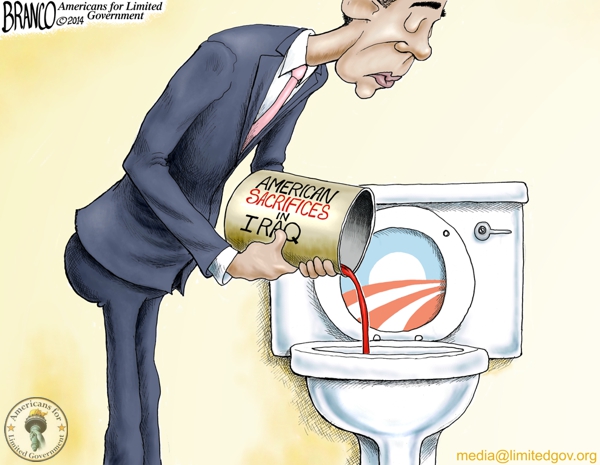
Obama got us out alright, blindly following a proposed schedule which President Bush had created years before, not taking into account the actual situation “on the ground”, “in country”.
As we found out in Vietnam, wars are best prosecuted in the Theater of War by our Military Leaders, NOT IN WASHINGTON, D.C. BY CLUELESS POLITICIANS.
Liberals like the President, trumpet their horns as “the smartest people in the room” over and over again, only to find out, the hard way, that they overestimated their own intelligence.
Remember “If you like your doctor, you can keep your doctor?”
If this escalates into another Vietnam, we will pay for his vanity with American lives…and that cost will be way too high.
“The best laid plans of mice and men oft-times go awry.”
Especially premature evacuations.
Now, six weeks later, we’re bombing Iraq.
I hate it when I’m right.
Until He Comes,
KJ
 Kingsjester's Blog