Israel, Hezbollah, and the 2024 Presidential Election

“The Israel Defense Forces (IDF) announced early Sunday morning local time that it had launched a preemptive strike on Hezbollah positions in southern Lebanon to thwart a major imminent attack by the Iran-backed terror group.

Residents of northern Israel were advised to enter bomb shelters and “safe rooms” in their homes in anticipation of a response by Hezbollah. Israel’s missile defense system, notably the Iron Dome, was said to be intercepting rockets.

Israel’s Army Radio reported that residents were being advised to take shelter even in cities relatively far from the northern border, such as the port city of Haifa, which is in the north of the country but typically safe from rockets.

The Home Front Command prohibited public gatherings of over 130 people, from the Tel Aviv region northwards.

In a statement in Hebrew, IDF spokesman Rear Admiral Daniel Hagari said that the military had detected that Hezbollah was about to fire a large barrage of rockets and missiles into Israel. Therefore, he said, the Israel Air Force (IAF) had taken preemptive action.” (Courtesy Breitbart.com)

Who lit the match that has caused all of this turmoil in the Middle East?

The Far Left Democratic Party, that’s who.

The failed appeasement strategy, which President Barack Hussein Obama employed as his Foreign Policy, was continued by Installed President Joe Biden in his ill-fated payoffs of the Mad Mullahs of Iran

This tactic has been tried numerous times throughout history.

The Ancient Romans, when they realized that their once mighty civilization was going to fall, tried to negotiated with the “Barbarians at the Gate”.

In more recent times, United States President Jimmy Carter thought that he could negotiate with barbarians from a position of weakness, also.

Remember the Iranian Hostage Crisis under President Jimmy Carter?

That’s what happens when you negotiate with barbarians.

For demented old fool Joe Biden’s handlers to have believed that the Radical Islamic Iranian Mullahs, who subjugate women, execute homosexuals, and anyone who does not worship Allah, would “negotiate” with an obvious dhimmi in any sort of truthful fashion, strains credulity to the breaking point.

Gentle Readers, think for a moment how the leadership of this Sovereign nation has changed since the Inauguration of Joe Biden as President.

We have literally gone from a Commander-in Chief who sincerely loved this country and her people to a Coward-in-Chief who surrendered to the Taliban, the same Radical Islamic Terrorists who killed over 3,000 Americans 22 years ago on September 11, 2001.

Our ally Israel experienced their own “9/11”, partially financed by the money of American Taxpayers, thanks to the ineptitude of the Biden Administration.

How far we have come…in the wrong direction.

Joe Biden eclipsed Jimmy Carter as the worst United States President in Modern Times.

Carter only allowed 52 Americans to be held hostage by Radical Islamists.

Biden left billions of dollars worth of American military weapons behind for the Taliban who, no doubt, sold some of those weapons to Hamas and Hezbollah.

How did we get here?

Whose fault is it?

Again, it is the fault of the Far Left Democratic Party, who were so desperate to regain the White House that they were forced to nominate a doddering old fool in the throes of dementia because all of the other primary candidates had the personality of a cardboard cutout.

To add to the problem, the professional politician that they chose had a 50-year track record of making horrible Foreign Policy decisions.

And, even though Biden ran as a Moderate, he governed as a Far Left Radical Socialist, even taking a knee at the White House with the NBA Champions.

All of our enemies, foreign and domestic, have been throwing a party for the last 3.5 years.

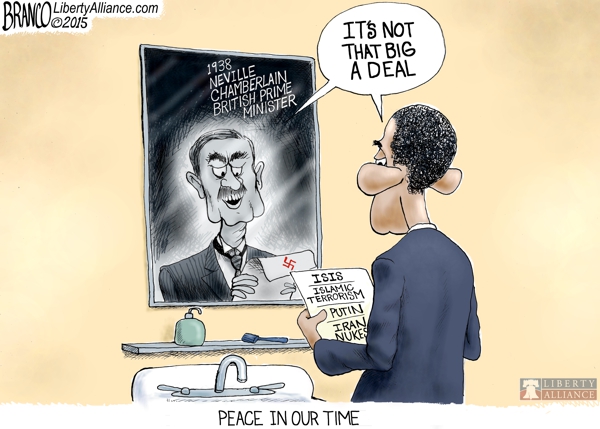
The Democrats installed Neville Chamberlain on Steroids as President of the Greatest Country on God’s Green Earth.

Nero fiddled and just burned down Rome.

Like Neville Chamberlain, the election of Joe Biden set the Free World on fire.

And now, the same people behind the installation of Joe Biden, want you to forget and ignore the Middle East Crisis and all the other hot spots in the world, and elect Kamala Harris, an obvious puppet under the machinations of the same handlers as Joe Biden.

May God protect us from stupid voters.

Until He Comes,

KJ

Neville Chamberlain II: Biden’s Failed Foreign Policy

“…how greatly I was encouraged on each of the journeys I made to Germany by the knowledge that I went with the good wishes of the Governments of the Dominions. They shared all our anxieties and all our hopes. They rejoiced with us that peace was preserved, and with us they look forward to further efforts to consolidate what has been done.

Ever since I assumed my present office my main purpose has been to work for the pacification of Europe, for the removal of those suspicions and those animosities which have so long poisoned the air. The path which leads to appeasement is long and bristles with obstacles. The question of Czechoslovakia is the latest and perhaps the most dangerous. Now that we have got past it, I feel that it may be possible to make further progress along the road to sanity.”

That was an excerpt from the infamous speech, “Peace in Our Time”, which was delivered by British Prime Minister Neville Chamberlain in 1938, in defense of the Munich Agreement, which he made with those infamous barbarians, German Chancellor Adolf Hitler and the National Socialist Party, or as the world came to call them, the Nazis, and Hitler’s good buddy, the Italian Fascist, Benito Mussolini.

We all know what happened next: World War II.

The failed appeasement strategy which President Barack Hussein Obama employed as his Foreign Policy, has been continued by Installed President Joe Biden in his ill-fated payoffs of the Mad Mullahs of Iran has been tried numerous times throughout history.

The Ancient Romans, when they realized that their once mighty civilization was going to fall, tried to negotiated with the “Barbarians at the Gate”.

In more recent times, United States President Jimmy Carter thought that he could negotiate with Barbarians from a position of weakness, also.

Remember the Iranian Hostage Crisis under President Jimmy Carter?

That’s what happens when you negotiate with barbarians.

For demented old fool Joe Biden to believe that the Radical Islamic Iranian Mullahs, who subjugate women, execute homosexuals, and anyone who does not worship Allah, will “negotiate” with an obvious dhimmi in any sort of truthful fashion, strains credulity to the breaking point.

Gentle Readers, think for a moment how the leadership of this Sovereign nation has changed since the Inauguration of Joe Biden as President.

We have literally gone from a Commander-in Chief who sincerely loved this country and her people to a Coward-in-Chief who has surrendered to the Taliban, the same Radical Islamic Terrorists who killed over 3,000 Americans 22 years ago on September 11, 2001.

And now, our ally Israel just experienced their own “9/11”, partially financed by the money of American Taxpayers, thanks to the ineptitude of the Biden Administration.

How far we have come…in the wrong direction.

Joe Biden has now eclipsed Jimmy Carter as the worst United States President in Modern Times.

Carter only allowed 52 Americans to be held hostage by Radical Islamists.

Biden left billions of dollars worth of American military weapons behind for the Taliban who, no doubt, sold some of those weapons to Hamas.

How did we get here?

Whose fault is it?

It is the fault of the Far Left Democratic Party, who were so desperate to regain the White House that they were forced to nominate a doddering old fool in the throes of dementia because all of the other primary candidates had the personality of a cardboard cutout.

To add to the problem, the professional politician that they chose had a 50-year track record of making horrible Foreign Policy decisions.

And, even though Biden ran as a Moderate, he has governed as a Far Left Radical Socialist, even taking a knee at the White House with the NBA Champions.

All of our enemies, foreign and domestic, are throwing a party.

The Democrats installed Neville Chamberlain on Steroids as President of the Greatest Country on God’s Green Earth.

Nero fiddled and just burned down Rome.

Like Neville Chamberlain, Joe Biden has set the Free World on fire.

Until He Comes,

KJ

Obama, Cuba, and Iran: The Politics of Purposeful Obtuseness

peace-our-time-600-la1 (2)Yesterday, 90 miles off of the Southern tip of these United States, the Obama Administration, once again, acquiesced to a repressive regime who hates our guts.

Reuters.com reports that

U.S. Secretary of State John Kerry declared a new era in relations as he celebrated restored diplomatic ties in Havana on Friday, but he also urged political change in Cuba, telling Cubans they should be free to choose their own leaders.The first U.S. secretary of state to visit the Caribbean island in 70 years, Kerry presided over a ceremony to raise the U.S. flag over the newly reopened American embassy.

“We remain convinced the people of Cuba would be best served by a genuine democracy, where people are free to choose their leaders,” he said in a country where the Communist Party is the only legal political party, the media is tightly controlled, and political dissent is repressed.

“We will continue to urge the Cuban government to fulfill its obligations under U.N. and Inter-American human rights covenants – obligations shared by the United States and every other country in the Americas,” Kerry said, his words accurately translated into Spanish and broadcast live on Cuban state television.

Uh huh.

To quote Petulant President Pantywaist, himself:

Words. Just words.

Yahoo News reports that

Cuba’s lead negotiator in talks with Washington told Reuters on Friday that the island’s internal affairs would never be on the table and Havana would never move “one millimeter” to placate enemies in the United States.”Decisions on internal matters are not negotiable and will never be put on the negotiating agenda in conversations with the United States,” Josefina Vidal, director of U.S. affairs for the Cuban Foreign Ministry, said in an exclusive interview.

“Cuba will never do absolutely anything, not move one millimeter, to try to respond,” she said after U.S. Secretary of State John Kerry said in Havana that the U.S. Congress was unlikely to ever lift a punishing economic embargo on Cuba unless the Communist government improved its human rights record.

This is the second time this summer that Obama has entered into a deal, which is the equivalent of buying a used car from “Honest Al’s Used Car Lot”, that stops in the middle of the street, as soon as you make a left turn out of the lot.

Regarding that first “lemon” of a deal, Radio Free Europe Radio Liberty reported that

Iranian Supreme Leader Ali Khamenei has said the Islamic republic’s opposition to the “arrogant” United States “will not change” despite a landmark nuclear agreement reached earlier this week with world powers.

The comments, broadcast live on state television on July 18, were greeted by chants of “Death to America” and “Death to Israel” at a ceremony at Tehran’s Mosala Mosque on the occasion of the Eid al-Fitr festival, which marks the end of Ramadan.

Meanwhile, U.S. President Barack Obama defended the accord amid skepticism from congressmen reviewing the deal.

Khamenei, who has the final say in all state affairs in Iran, said U.S. policy in the Middle East runs counter to Iran’s strategy and that Tehran will continue to support its allies in the region, including Lebanon’s Hizballah militant group and the regime of Syrian President Bashar al-Assad.

“Whether this [nuclear deal] is approved or disapproved, we won’t stop supporting our friends in the region,” he said. “The oppressed Palestinian nation, Yemen, Syria, Iraq, Bahrain, the honest resistance fighters in Lebanon and Palestine will enjoy our constant support.”

“Even after this deal our policy toward the arrogant U.S. will not change,” Khamenei added.

Khamenei maintained that Iran’s engagement with six world powers was solely to reach a nuclear deal that was in its national interest.

“We do not negotiate with the United States on various global, regional, or bilateral issues,” Khamenei said. “Sometimes — based on expedience — we have talked to them on exceptional matters, such as the nuclear issue, and it has not been only this one time.”

“U.S. policies in the region are 180 degrees in contrast to Iran’s policies,” he added.

Under the deal agreed in Vienna on July 14 after years of negotiations, sanctions against Tehran, which have hampered Iran’s economy, will be gradually removed in return for the Persian Gulf state accepting long-term curbs on its nuclear program. The talks involved Iran and the five veto-wielding Security Council members — the United States, Russia, China, Britain, and France — as well as Germany and the European Union.

Western countries accuse Iran of seeking to build nuclear weapons, a claim that Tehran denies.

Khamenei reiterated that position on July 18, mentioning a fatwa, or religious edict, he himself issued against any action seeking the bomb.

“The Americans say they stopped Iran from acquiring a nuclear weapon,” he said. “They know it’s not true.”

There was another famous “bad deal” in history, made by a “World Leader”, who also sacrificed his country’s safety, in his purposeful obtuseness and naiveté.

The speech, “Peace in Our Time”, was delivered by British Prime Minister Neville Chamberlain in 1938, in defense of the Munich Agreement, which he made with those infamous barbarians, German Chancellor Adolf Hitler and the National Socialist Party, or as the world came to call them, the Nazis, and Hitler’s good buddy, the Italian Fascist, Benito Mussolini.

The following is an excerpt:

…I would like to say a few words in respect of the various other participants, besides ourselves, in the Munich Agreement. After everything that has been said about the German Chancellor today and in the past, I do feel that the House ought to recognise the difficulty for a man in that position to take back such emphatic declarations as he had already made amidst the enthusiastic cheers of his supporters, and to recognise that in consenting, even though it were only at the last moment, to discuss with the representatives of other Powers those things which he had declared he had already decided once for all, was a real and a substantial contribution on his part. With regard to Signor Mussolini, . . . I think that Europe and the world have reason to be grateful to the head of the Italian government for his work in contributing to a peaceful solution.

In my view the strongest force of all, one which grew and took fresh shapes and forms every day war, the force not of any one individual, but was that unmistakable sense of unanimity among the peoples of the world that war must somehow be averted. The peoples of the British Empire were at one with those of Germany, of France and of Italy, and their anxiety, their intense desire for peace, pervaded the whole atmosphere of the conference, and I believe that that, and not threats, made possible the concessions that were made. I know the House will want to hear what I am sure it does not doubt, that throughout these discussions the Dominions, the Governments of the Dominions, have been kept in the closest touch with the march of events by telegraph and by personal contact, and I would like to say how greatly I was encouraged on each of the journeys I made to Germany by the knowledge that I went with the good wishes of the Governments of the Dominions. They shared all our anxieties and all our hopes. They rejoiced with us that peace was preserved, and with us they look forward to further efforts to consolidate what has been done.

Ever since I assumed my present office my main purpose has been to work for the pacification of Europe, for the removal of those suspicions and those animosities which have so long poisoned the air. The path which leads to appeasement is long and bristles with obstacles. The question of Czechoslovakia is the latest and perhaps the most dangerous. Now that we have got past it, I feel that it may be possible to make further progress along the road to sanity.

We all know what happened next:  World War II.

That’s what happens when you strike an “Gentlemen’s Agreement” with barbarians, liars, and madmen.

As I have written before, I believe that Obama’s zeal to leave some sort of enormous historical legacy has led to a purposeful naiveté and obtuseness on his part, not only to history, but also, to the present wishes and wellbeing of not only those who have be maimed, slaughtered, and who still live under these repressive regimes that he has dealt with, but, also, to the continued sovereignty and very evistence of the United States of America.

The Mad Mullahs of Iran and the Castro Brothers of Cuba do not play by the Marquis of Queensbury Rules, like “civilized countries” do.

The only respect strength and resolve.

Unfortunately, Obama and Kerry have shown them neither of those qualities, during their negotiations.

Hence, their continued rhetoric.

…and, the faint sound of uncontrollable laughter.

Until He Comes,

KJ


Obama Meets With Jewish American Groups to Sell Them on his “Iran Deal”

Iran-Cheat-600-LAPresident Barack Hussein Obama is trying to assuage the concerns of Jewish Americans over what appears to be his selling out our country to a Nuclear Iran.

The Washington Post reports that

President Obama met with Jewish American leaders at the White House on Monday in a bid to defuse antagonism toward him and to convince them that he shares their concerns about the safety of Israel and the threat of a nuclear-armed Iran.

The meetings in the Roosevelt Room were designed to improve prospects for a deal being negotiated to limit Iran’s nuclear program — and hang on to the support of a key Democratic constituency.

At the first meeting, the president spent an hour with the leaders of major Jewish organizations. Then the discussion continued with Obama’s national security adviser, Susan Rice; Vice President Biden’s national security adviser, Colin Kahl; and three other senior officials.

At the second session, Obama met with “community leaders,” many of them major political contributors. White House press secretary Josh Earnest said they were “outspoken advocates who may not hold official positions or leadership positions in those organizations but are, in their own right, effective advocates.”

One person who attended the first meeting called the session “positive” and said Obama was “heartfelt about his connection to Israel. Very moving.”

Another said that “the president talked about how deeply he feels about Israel and the Jewish people and anti-Semitism. It was not just about Iran. It was much, much deeper in terms of the president sharing with us how he felt.”

“All of us begin with sense of skepticism knowing what Iran is,” one Jewish leader said. “A lot of questions were asked. How would this deal with this, how it would deal with that?”

As the Senate Foreign Relations Committee takes up a bill that would force Obama to bring an Iran deal to Congress for approval, the administration’s meetings with Jewish leaders were just part of an offensive to drum up support in Congress.

Secretary of State John F. Kerry and Energy Secretary Ernest Moniz this week are briefing members of Congress about the current framework of a deal they hope to hammer out by June 30. At the White House briefing Monday, Earnest said any lawmaker can request a classified briefing that would also include members of the intelligence agencies.

I’ll wager that what Obama said in that meeting probably sounded something like this…

…I would like to say a few words in respect of the various other participants, besides ourselves, in the Munich Agreement. After everything that has been said about the German Chancellor today and in the past, I do feel that the House ought to recognise the difficulty for a man in that position to take back such emphatic declarations as he had already made amidst the enthusiastic cheers of his supporters, and to recognise that in consenting, even though it were only at the last moment, to discuss with the representatives of other Powers those things which he had declared he had already decided once for all, was a real and a substantial contribution on his part. With regard to Signor Mussolini, . . . I think that Europe and the world have reason to be grateful to the head of the Italian government for his work in contributing to a peaceful solution.

In my view the strongest force of all, one which grew and took fresh shapes and forms every day war, the force not of any one individual, but was that unmistakable sense of unanimity among the peoples of the world that war must somehow be averted. The peoples of the British Empire were at one with those of Germany, of France and of Italy, and their anxiety, their intense desire for peace, pervaded the whole atmosphere of the conference, and I believe that that, and not threats, made possible the concessions that were made. I know the House will want to hear what I am sure it does not doubt, that throughout these discussions the Dominions, the Governments of the Dominions, have been kept in the closest touch with the march of events by telegraph and by personal contact, and I would like to say how greatly I was encouraged on each of the journeys I made to Germany by the knowledge that I went with the good wishes of the Governments of the Dominions. They shared all our anxieties and all our hopes. They rejoiced with us that peace was preserved, and with us they look forward to further efforts to consolidate what has been done.

Ever since I assumed my present office my main purpose has been to work for the pacification of Europe, for the removal of those suspicions and those animosities which have so long poisoned the air. The path which leads to appeasement is long and bristles with obstacles. The question of Czechoslovakia is the latest and perhaps the most dangerous. Now that we have got past it, I feel that it may be possible to make further progress along the road to sanity.

That was an excerpt from the infamous speech, “Peace in Our Time”, which was delivered by British Prime Minister Neville Chamberlain in 1938, in defense of the Munich Agreement, which he made with those infamous barbarians, German Chancellor Adolf Hitler and the National Socialist Party, or as the world came to call them, the Nazis, and Hitler’s good buddy, the Italian Fascist, Benito Mussolini.

We all know what happened next: World War II.

This appeasement strategy, which President Obama is employing, in his most assuredly ill-fated negotiations with the Mad Mullahs of Iran, has been tried numerous times throughout history.

The Ancient Romans, when they realized that their once mighty civilization was going to fall, tried to negotiated with the “Barbarians at the Gate”.

In more recent times, United States President Jimmy Carter thought that he could negotiate with Barbarians from a position of weakness, also.

Remember the Iranian Hostage Crisis under President Jimmy Carter?

That’s what happens when you negotiate with barbarians.

For Obama to believe that the Radical Islamic Iranian Mullahs, who subjugate women, execute homosexuals, and anyone who does not worship Allah, will “negotiate” with an obvious dhimmi in any sort of truthful fashion, strains credulity to the breaking point.

If Obama, whom I have called “Scooter” for years, is this unintentionally gullible, then he is destined to achieve the legacy he so desperately seeks as president.

Unfortunately for him…and us…it will be a horrific…and possibly…a final one.

Until He Comes,

KJ

The “Obama Doctrine”: Ignoring History

Non-Negotiable-600-LIThomas L Friedman, of the New York Times, was recently invited to the White House to interview President Barack Hussein Obama.

Here is an excerpt from his subsequent article:

…What struck me most was what I’d call an “Obama doctrine” embedded in the president’s remarks. It emerged when I asked if there was a common denominator to his decisions to break free from longstanding United States policies isolating Burma, Cuba and now Iran. Obama said his view was that “engagement,” combined with meeting core strategic needs, could serve American interests vis-à-vis these three countries far better than endless sanctions and isolation. He added that America, with its overwhelming power, needs to have the self-confidence to take some calculated risks to open important new possibilities — like trying to forge a diplomatic deal with Iran that, while permitting it to keep some of its nuclear infrastructure, forestalls its ability to build a nuclear bomb for at least a decade, if not longer.

“We are powerful enough to be able to test these propositions without putting ourselves at risk. And that’s the thing … people don’t seem to understand,” the president said. “You take a country like Cuba. For us to test the possibility that engagement leads to a better outcome for the Cuban people, there aren’t that many risks for us. It’s a tiny little country. It’s not one that threatens our core security interests, and so [there’s no reason not] to test the proposition. And if it turns out that it doesn’t lead to better outcomes, we can adjust our policies. The same is true with respect to Iran, a larger country, a dangerous country, one that has engaged in activities that resulted in the death of U.S. citizens, but the truth of the matter is: Iran’s defense budget is $30 billion. Our defense budget is closer to $600 billion. Iran understands that they cannot fight us. … You asked about an Obama doctrine. The doctrine is: We will engage, but we preserve all our capabilities.”

The notion that Iran is undeterrable — “it’s simply not the case,” he added. “And so for us to say, ‘Let’s try’ — understanding that we’re preserving all our options, that we’re not naïve — but if in fact we can resolve these issues diplomatically, we are more likely to be safe, more likely to be secure, in a better position to protect our allies, and who knows? Iran may change. If it doesn’t, our deterrence capabilities, our military superiority stays in place. … We’re not relinquishing our capacity to defend ourselves or our allies. In that situation, why wouldn’t we test it?”

Obviously, Israel is in a different situation, he added. “Now, what you might hear from Prime Minister [Benjamin] Netanyahu, which I respect, is the notion, ‘Look, Israel is more vulnerable. We don’t have the luxury of testing these propositions the way you do,’ and I completely understand that. And further, I completely understand Israel’s belief that given the tragic history of the Jewish people, they can’t be dependent solely on us for their own security. But what I would say to them is that not only am I absolutely committed to making sure that they maintain their qualitative military edge, and that they can deter any potential future attacks, but what I’m willing to do is to make the kinds of commitments that would give everybody in the neighborhood, including Iran, a clarity that if Israel were to be attacked by any state, that we would stand by them. And that, I think, should be … sufficient to take advantage of this once-in-a-lifetime opportunity to see whether or not we can at least take the nuclear issue off the table.”

Alright, you students of history…does the message delivered by the president, during the above-referenced interview, seem familiar to any of you?

It should. 

The speech, “Peace in Our Time”, was delivered by British Prime Minister Neville Chamberlain in 1938, in defense of the Munich Agreement, which he made with those infamous barbarians, German Chancellor Adolf Hitler and the National Socialist Party, or as the world came to call them, the Nazis, and Hitler’s good buddy, the Italian Fascist, Benito Mussolini.

The following is an excerpt from that historic speech:

…I would like to say a few words in respect of the various other participants, besides ourselves, in the Munich Agreement. After everything that has been said about the German Chancellor today and in the past, I do feel that the House ought to recognise the difficulty for a man in that position to take back such emphatic declarations as he had already made amidst the enthusiastic cheers of his supporters, and to recognise that in consenting, even though it were only at the last moment, to discuss with the representatives of other Powers those things which he had declared he had already decided once for all, was a real and a substantial contribution on his part. With regard to Signor Mussolini, . . . I think that Europe and the world have reason to be grateful to the head of the Italian government for his work in contributing to a peaceful solution.

In my view the strongest force of all, one which grew and took fresh shapes and forms every day war, the force not of any one individual, but was that unmistakable sense of unanimity among the peoples of the world that war must somehow be averted. The peoples of the British Empire were at one with those of Germany, of France and of Italy, and their anxiety, their intense desire for peace, pervaded the whole atmosphere of the conference, and I believe that that, and not threats, made possible the concessions that were made. I know the House will want to hear what I am sure it does not doubt, that throughout these discussions the Dominions, the Governments of the Dominions, have been kept in the closest touch with the march of events by telegraph and by personal contact, and I would like to say how greatly I was encouraged on each of the journeys I made to Germany by the knowledge that I went with the good wishes of the Governments of the Dominions. They shared all our anxieties and all our hopes. They rejoiced with us that peace was preserved, and with us they look forward to further efforts to consolidate what has been done.

Ever since I assumed my present office my main purpose has been to work for the pacification of Europe, for the removal of those suspicions and those animosities which have so long poisoned the air. The path which leads to appeasement is long and bristles with obstacles. The question of Czechoslovakia is the latest and perhaps the most dangerous. Now that we have got past it, I feel that it may be possible to make further progress along the road to sanity.

We all know what happened next: World War II.

In more recent times, United States President Jimmy Carter thought that he could negotiate from a position of weakness, also.

Remember the Iranian Hostage Crisis under President Jimmy Carter?

That’s what happens when you negotiate with barbarians.

Those who ignore history are doomed to repeat it.

Until He Comes,

KJ

Today’s the Day. Bibi’s ‘Bout to Burst Barry’s Bubble.

Shifty-600-LI (2)Today is a very historic day in the history of our nation.

The Prime Minister of one of America’s most steadfast allies will speak to a Joint Session of Congress…without the invitation or the blessings of The President of the United States of America…who is defending a Rogue Nation who continues its quest to build a nuclear bomb, which it plans to use to annihilate both the United States and Israel.

Grab your popcorn. This is gonna be good.

Reuters News on Yahoo.com reports that

WASHINGTON (Reuters) – President Barack Obama and Benjamin Netanyahu clashed over Iran nuclear diplomacy on Monday on the eve of the Israeli prime minister’s hotly disputed address to Congress, underscoring the severity of U.S.-Israeli strains over the issue.

Even as the two leaders professed their commitment to a strong partnership and sought to play down the diplomatic row, they delivered dueling messages – Netanyahu in a speech to pro-Israeli supporters and Obama in an interview with Reuters – that hammered home their differences on Iran’s nuclear ambitions.

Neither gave any ground ahead of Netanyahu’s speech to Congress on Tuesday when he plans to detail his objections to ongoing talks between Iran and world powers that he says will inevitably allow Tehran to become a nuclear-armed state.

Netanyahu opened his high-profile visit to Washington on Monday with a stark warning to the Obama administration that the deal being negotiated with Tehran could threaten Israel’s survival, saying he had a “moral obligation” to sound the alarm about the dangers.

He insisted he meant no disrespect for Obama, with whom he has a history of testy encounters, and appreciated U.S. military and diplomatic support for Israel.

Just hours after Netanyahu’s speech to AIPAC, the largest U.S. pro-Israel lobby, Obama told Reuters that Iran should commit to a verifiable freeze of at least 10 years on its most sensitive nuclear activity for a landmark atomic deal to be reached. But with negotiators facing an end-of-March deadline for a framework accord, he said the odds were still against sealing a final agreement.

The Reuters interview gave Obama a chance to try to preemptively blunt the impact of Netanyahu’s closely watched address to Congress.

Previewing his coming appearance on Capitol Hill, Netanyahu told a cheering audience at the annual conference of the American Israel Public Affairs Committee (AIPAC): “As prime minister of Israel, I have a moral obligation to speak up in the face of these dangers while there’s still time to avert them.”

At the same time, Netanyahu said the relationship between his country and the United States was “stronger than ever” and not in crisis.

EASING TENSIONS

Obama also sought to lower the temperature by describing Netanyahu’s planned speech to Congress as a distraction that would not be “permanently destructive” to U.S.-Israeli ties and by saying the rift was not personal.

Obama refused to meet Netanyahu during the visit, on the grounds that doing so could be seen as interference on the cusp of Israel’s March 17 elections when the prime minister is seeking re-election against a tough center-left challenger. On Monday, the president said he would be willing to meet Netanyahu if the Israeli leader wins re-election.

But he said Netanyahu’s U.S. visit gave the impression of “politicizing” the two countries’ normally close partnership and of going outside the normal channels of U.S. foreign policy in which the president holds greatest sway. Netanyahu’s planned speech has driven a wedge between Israel and congressional Democrats. Forty two of them plan to boycott the address, according to The Hill, a political newspaper.

Netanyahu, who was given rousing bipartisan welcomes in his two previous addresses to Congress, is expected to press U.S. lawmakers to block a deal with Iran that he contends would endanger Israel’s existence but which Obama’s aides believe could be a signature foreign policy achievement.

The invitation to Netanyahu was orchestrated by Republican congressional leaders with the Israeli ambassador without advance word to the White House, a breach of protocol that infuriated the Obama administration and the president’s fellow Democrats.

The partisan nature of this dispute has turned it into the worst rift in decades between the United States and Israel, which normally navigates carefully between Republicans and Democrats in Washington.

Netanyahu wants Iran to be completely barred from enriching uranium, which puts him at odds with Obama’s view that a deal should allow Tehran to engage in limited enrichment for peaceful purposes but under close international inspection.

Obama said a final deal must create a one-year “breakout period” for Iran, which means it would take at least a year for Tehran to get a nuclear weapon if it decides to develop one, thereby giving time for military action to prevent it.

Netanyahu has said such a deal would allow Iran to become a “threshold” nuclear weapons state, that it would inevitably cheat on any agreement and that the lifting of nuclear restrictions in as little of 10 years would be an untenable risk to Israel. He has hinted at the prospect for Israeli military strikes on Iranian nuclear facilities as a last resort, though he made no such threat in his AIPAC speech on Monday.

So, today, the Prime Minister of Israel, who, unlike the present occupant of our White House, actually excelled on his own at Harvard University, addresses a Joint Session of Congress to speak about the plans of the current American Administration to allow Iran to, after a 10 year waiting period, develop a nuclear bomb.

By the way, how in the world does Obama believe that they can stop the Mad Mullahs of Iran from working on developing a nuclear bomb, while his flimsy proposed sanctions are in in place, anyway?

Obama is acting positively Chamberlain-esque in his naiveté, as regards the true intentions of the Religious Leaders of the Barbaric Muslim Rogue Nation of Iran.

Why have Obama and his minions been so relentless in their attack of Prime Minister Netanyahu?

It is well known, through his words and actions, that America’s current (P)resident Barack Hussein Obama, cares more for Israel’s enemies, than he does for God’s Chosen People. If it were up to Obama, Israel would be forced to give the nomadic people known as Palestinians, half of the land that the nation of Israel sits on. Not only that, but he and his talking horse, (at least he has the face of one) Secretary of State John F. Kerry,”are negotiating”, and I use the term loosely, an agreement with the Mullahs of Iran, to stop building a nuclear bomb, in exchange for allowing them to continue their Uranium Enrichment, an agreement which makes about as much sense as Pee Wee Herman starring in the title role in the next “Terminator” movie.

Obama is indeed making the same mistake that Neville Chamberlain made in dealing with Adolph Hitler’s Nazi-led German Occupation of Europe.

Obama believes that his superior intellect, combined with his acceptance of the word of blood-thirst Radical Islamists. will cement this ill-conceived agreement with Iran and his Presidential Legacy.

Today, Bibi is about to burst his bubble and tell the American people just how badly both of our nations are being screwed by “The Leader of the Free World”.

And, that is what ol’ Scooter is afraid of.

Until He Comes,

KJ

“Peace in Our Time II?”

obamabowOn October 3, 1938, British Prime Minister Neville Chamberlain, gave the following infamous speech in from of his nation’s Parliament, announcing the appeasement of Hitler’s Barbaric Third Reich…

Before I come to describe the Agreement which was signed at Munich in the small hours of Friday morning last, I would like to remind the House of two things which I think it very essential not to forget when those terms are being considered. The first is this: We did not go there to decide whether the predominantly German areas in the Sudetenland should be passed over to the German Reich. That had been decided already. Czechoslovakia had accepted the Anglo-French proposals. What we had to consider was the method, the conditions and the time of the transfer of the territory. The second point to remember is that time was one of the essential factors. All the elements were present on the spot for the outbreak of a conflict which might have precipitated the catastrophe. We had populations inflamed to a high degree; we had extremists on both sides ready to work up and provoke incidents; we had considerable quantities of arms which were by no means confined to regularly organised forces. Therefore, it was essential that we should quickly reach a conclusion, so that this painful and difficult operation of transfer might be carried out at the earliest possible moment and concluded as soon as was consistent, with orderly procedure, in order that we might avoid the possibility of something that might have rendered all our attempts at peaceful solution useless. . . .

. . . To those who dislike an ultimatum, but who were anxious for a reasonable and orderly procedure, every one of [the] modifications [of the Godesberg Memorandum by the Munich Agreement] is a step in the right direction. It is no longer an ultimatum, but is a method which is carried out largely under the supervision of an international body.

Before giving a verdict upon this arrangement, we should do well to avoid describing it as a personal or a national triumph for anyone. The real triumph is that it has shown that representatives of four great Powers can find it possible to agree on a way of carrying out a difficult and delicate operation by discussion instead of by force of arms, and thereby they have averted a catastrophe which would have ended civilisation as we have known it. The relief that our escape from this great peril of war has, I think, everywhere been mingled in this country with a profound feeling of sympathy.

[Hon. Members: Shame.] I have nothing to be ashamed of. Let those who have, hang their heads. We must feel profound sympathy for a small and gallant nation in the hour of their national grief and loss. Mr. Bellenger: It is an insult to say it.

The Prime Minister: I say in the name of this House and of the people of this country that Czechoslovakia has earned our admiration and respect for her restraint, for her dignity, for her magnificent discipline in face of such a trial as few nations have ever been called upon to meet.

The army, whose courage no man has ever questioned, has obeyed the order of their president, as they would equally have obeyed him if he had told them to march into the trenches. It is my hope and my belief, that under the new system of guarantees, the new Czechoslovakia will find a greater security than she has ever enjoyed in the past. . . .

I pass from that subject, and I would like to say a few words in respect of the various other participants, besides ourselves, in the Munich Agreement. After everything that has been said about the German Chancellor today and in the past, I do feel that the House ought to recognise the difficulty for a man in that position to take back such emphatic declarations as he had already made amidst the enthusiastic cheers of his supporters, and to recognise that in consenting, even though it were only at the last moment, to discuss with the representatives of other Powers those things which he had declared he had already decided once for all, was a real and a substantial contribution on his part. With regard to Signor Mussolini, . . . I think that Europe and the world have reason to be grateful to the head of the Italian government for his work in contributing to a peaceful solution.

In my view the strongest force of all, one which grew and took fresh shapes and forms every day war, the force not of any one individual, but was that unmistakable sense of unanimity among the peoples of the world that war must somehow be averted. The peoples of the British Empire were at one with those of Germany, of France and of Italy, and their anxiety, their intense desire for peace, pervaded the whole atmosphere of the conference, and I believe that that, and not threats, made possible the concessions that were made. I know the House will want to hear what I am sure it does not doubt, that throughout these discussions the Dominions, the Governments of the Dominions, have been kept in the closest touch with the march of events by telegraph and by personal contact, and I would like to say how greatly I was encouraged on each of the journeys I made to Germany by the knowledge that I went with the good wishes of the Governments of the Dominions. They shared all our anxieties and all our hopes. They rejoiced with us that peace was preserved, and with us they look forward to further efforts to consolidate what has been done.

Ever since I assumed my present office my main purpose has been to work for the pacification of Europe, for the removal of those suspicions and those animosities which have so long poisoned the air. The path which leads to appeasement is long and bristles with obstacles. The question of Czechoslovakia is the latest and perhaps the most dangerous. Now that we have got past it, I feel that it may be possible to make further progress along the road to sanity.

History repeats itself…

Last night, President Barack Hussein Obama addressed the nation for the White House

While today’s announcement is just a first step, it achieves a great deal. For the first time in nearly a decade, we have halted the progress of the Iranian nuclear program, and key parts of the program will be rolled back. Iran has committed to halting certain levels of enrichment and neutralizing part of its stockpiles. Iran cannot use its next-generation centrifuges, which are used for enriching uranium. Iran cannot install or start up new centrifuges, and its production of centrifuges will be limited. Iran will halt work at its plutonium reactor. And new inspections will provide extensive access to Iran’s nuclear facilities and allow the international community to verify whether Iran is keeping its commitments.

These are substantial limitations which will help prevent Iran from building a nuclear weapon. Simply put, they cut off Iran’s most likely paths to a bomb. Meanwhile, this first step will create time and space over the next six months for more negotiations to fully address our comprehensive concerns about the Iranian program. And because of this agreement, Iran cannot use negotiations as cover to advance its program.

On our side, the United States and our friends and allies have agreed to provide Iran with modest relief, while continuing to apply our toughest sanctions. We will refrain from imposing new sanctions, and we will allow the Iranian government access to a portion of the revenue that they have been denied through sanctions. But the broader architecture of sanctions will remain in place and we will continue to enforce them vigorously. And if Iran does not fully meet its commitments during this six-month phase, we will turn off the relief and ratchet up the pressure.

Over the next six months, we will work to negotiate a comprehensive solution. We approach these negotiations with a basic understanding: Iran, like any nation, should be able to access peaceful nuclear energy. But because of its record of violating its obligations, Iran must accept strict limitations on its nuclear program that make it impossible to develop a nuclear weapon.

In these negotiations, nothing will be agreed to unless everything is agreed to. The burden is on Iran to prove to the world that its nuclear program will be exclusively for peaceful purposes.

… The world is united in support of our determination to prevent Iran from developing a nuclear weapon. Iran must know that security and prosperity will never come through the pursuit of nuclear weapons — it must be reached through fully verifiable agreements that make Iran’s pursuit of nuclear weapons impossible.

As we go forward, the resolve of the United States will remain firm, as will our commitments to our friends and allies –- particularly Israel and our Gulf partners, who have good reason to be skeptical about Iran’s intentions.

Ultimately, only diplomacy can bring about a durable solution to the challenge posed by Iran’s nuclear program. As President and Commander-in-Chief, I will do what is necessary to prevent Iran from obtaining a nuclear weapon. But I have a profound responsibility to try to resolve our differences peacefully, rather than rush towards conflict. Today, we have a real opportunity to achieve a comprehensive, peaceful settlement, and I believe we must test it.

The first step that we’ve taken today marks the most significant and tangible progress that we’ve made with Iran since I took office. And now we must use the months ahead to pursue a lasting and comprehensive settlement that would resolve an issue that has threatened our security — and the security of our allies — for decades. It won’t be easy, and huge challenges remain ahead. But through strong and principled diplomacy, the United States of America will do our part on behalf of a world of greater peace, security, and cooperation among nations.

Three questions and an observation…

1 The Iranian Government is not secular. It is the product of a fanatical political ideology, disguised as a “faith. The Ayatollahs rule Iran. The president and “secular Government” carry out their wishes, and are simply figureheads.

2. Nowhere in this pending agreement is a call for the halt of Uranium Enrichment in Iran. 

3. A Christian American Pastor, Saeed Abedini, has been held in jail by the Iranian Government, since the summer of 2012. Why does the Obama Administration care more about negotiating appeasement with a hostile, barbaric Foreign Government, than securing the freedom of an American Christian Pastor?

Wars have been started for less than that.

President Reagan advised to “Trust, but Verify.

Evidently, Obama’s message is to “Trust Islam…Limit American Christianity”.

Until He Comes,

KJ


The Afghanistan Agreement…Thank You, Neville Chamberlain

Last night, at 6:30 p.m. Central, the 44th president of the United States of America, Barack Hussein Obama, gave a 15 minute address concerning the “end of the war” in Afghanistan.

The speech was given at Bagram Air Force Base, in front of a phony backdrop consisting of the machines of war, while our Brightest and Best were barred from the area.

And, with good reason.  Their CIC sounded more like he was repeating “Peace in Our Time” than the end to a successful military campaign.

He announced a five-step plan to end our military involvement in Afghanistan:

First, we’ve begun a transition to Afghan responsibility for security. Already, nearly half of the Afghan people live in places where Afghan security forces are moving into the lead. This month, at a NATO Summit in Chicago, our coalition will set a goal for Afghan forces to be in the lead for combat operations across the country next year. International troops will continue to train, advise and assist the Afghans, and fight alongside them when needed. But we will shift into a support role as Afghans step forward.

As we do, our troops will be coming home. Last year, we removed 10,000 U.S. troops from Afghanistan. Another 23,000 will leave by the end of the summer. After that, reductions will continue at a steady pace, with more and more of our troops coming home. And as our coalition agreed, by the end of 2014 the Afghans will be fully responsible for the security of their country.

Second, we are training Afghan security forces to get the job done. Those forces have surged, and will peak at 352,000 this year. The Afghans will sustain that level for three years, and then reduce the size of their military. And in Chicago, we will endorse a proposal to support a strong and sustainable long-term Afghan force.

Third, we’re building an enduring partnership. The agreement we signed today sends a clear message to the Afghan people: As you stand up, you will not stand alone. It establishes the basis for our cooperation over the next decade, including shared commitments to combat terrorism and strengthen democratic institutions. It supports Afghan efforts to advance development and dignity for their people. And it includes Afghan commitments to transparency and accountability, and to protect the human rights of all Afghans — men and women, boys and girls.

Within this framework, we’ll work with the Afghans to determine what support they need to accomplish two narrow security missions beyond 2014 — counter-terrorism and continued training. But we will not build permanent bases in this country, nor will we be patrolling its cities and mountains. That will be the job of the Afghan people.

Fourth, we’re pursuing a negotiated peace. In coordination with the Afghan government, my administration has been in direct discussions with the Taliban. We’ve made it clear that they can be a part of this future if they break with al Qaeda, renounce violence and abide by Afghan laws. Many members of the Taliban — from foot soldiers to leaders — have indicated an interest in reconciliation. The path to peace is now set before them. Those who refuse to walk it will face strong Afghan security forces, backed by the United States and our allies.

Fifth, we are building a global consensus to support peace and stability in South Asia. In Chicago, the international community will express support for this plan and for Afghanistan’s future. And I have made it clear to its neighbor — Pakistan — that it can and should be an equal partner in this process in a way that respects Pakistan’s sovereignty, interests and democratic institutions. In pursuit of a durable peace, America has no designs beyond an end to al Qaeda safe havens and respect for Afghan sovereignty.

“Peace in Our Time” was delivered by British Prime Minister Neville Chamberlain in 1938, in defense of the Munich Agreement, which he made with those infamous barbarians, German Chancellor Adolf Hitler and the National Socialist Party, or as the world came to call them, the Nazis, and Hitler’s good buddy, the Italian Fascist, Benito Mussolini.

The following is an excerpt:

…I would like to say a few words in respect of the various other participants, besides ourselves, in the Munich Agreement. After everything that has been said about the German Chancellor today and in the past, I do feel that the House ought to recognise the difficulty for a man in that position to take back such emphatic declarations as he had already made amidst the enthusiastic cheers of his supporters, and to recognise that in consenting, even though it were only at the last moment, to discuss with the representatives of other Powers those things which he had declared he had already decided once for all, was a real and a substantial contribution on his part. With regard to Signor Mussolini, . . . I think that Europe and the world have reason to be grateful to the head of the Italian government for his work in contributing to a peaceful solution.

In my view the strongest force of all, one which grew and took fresh shapes and forms every day war, the force not of any one individual, but was that unmistakable sense of unanimity among the peoples of the world that war must somehow be averted. The peoples of the British Empire were at one with those of Germany, of France and of Italy, and their anxiety, their intense desire for peace, pervaded the whole atmosphere of the conference, and I believe that that, and not threats, made possible the concessions that were made. I know the House will want to hear what I am sure it does not doubt, that throughout these discussions the Dominions, the Governments of the Dominions, have been kept in the closest touch with the march of events by telegraph and by personal contact, and I would like to say how greatly I was encouraged on each of the journeys I made to Germany by the knowledge that I went with the good wishes of the Governments of the Dominions. They shared all our anxieties and all our hopes. They rejoiced with us that peace was preserved, and with us they look forward to further efforts to consolidate what has been done.

Ever since I assumed my present office my main purpose has been to work for the pacification of Europe, for the removal of those suspicions and those animosities which have so long poisoned the air. The path which leads to appeasement is long and bristles with obstacles. The question of Czechoslovakia is the latest and perhaps the most dangerous. Now that we have got past it, I feel that it may be possible to make further progress along the road to sanity.

We all know what happened next:  World War II.

That’s what happens when you negotiate with barbarians.