
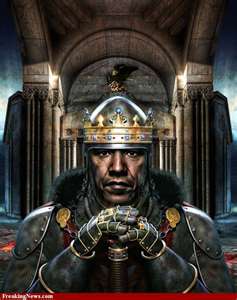
 On January 20, 2009. newly elected United States President Barack Hussein Obama, said the following,
As for our common defense, we reject as false the choice between our safety and our ideals. Our Founding Fathers, faced with perils we can scarcely imagine, drafted a charter to assure the rule of law and the rights of man, a charter expanded by the blood of generations. Those ideals still light the world, and we will not give them up for expedience’s sake. And so to all other peoples and governments who are watching today, from the grandest capitals to the small village where my father was born: know that America is a friend of each nation and every man, woman, and child who seeks a future of peace and dignity, and that we are ready to lead once more.
Recall that earlier generations faced down fascism and communism not just with missiles and tanks, but with sturdy alliances and enduring convictions. They understood that our power alone cannot protect us, nor does it entitle us to do as we please. Instead, they knew that our power grows through its prudent use; our security emanates from the justness of our cause, the force of our example, the tempering qualities of humility and restraint.
We are the keepers of this legacy. Guided by these principles once more, we can meet those new threats that demand even greater effort – even greater cooperation and understanding between nations. We will begin to responsibly leave Iraq to its people, and forge a hard-earned peace in Afghanistan. With old friends and former foes,
On January 21, 2013, newly re-elected United States President Barack Hussein Obama, said the following,
We, the people, still believe that enduring security and lasting peace do not require perpetual war. Our brave men and women in uniform, tempered by the flames of battle, are unmatched in skill and courage. Our citizens, seared by the memory of those we have lost, know too well the price that is paid for liberty. The knowledge of their sacrifice will keep us forever vigilant against those who would do us harm. But we are also heirs to those who won the peace and not just the war; who turned sworn enemies into the surest of friends — and we must carry those lessons into this time as well.
We will defend our people and uphold our values through strength of arms and rule of law. We will show the courage to try and resolve our differences with other nations peacefully –- not because we are naïve about the dangers we face, but because engagement can more durably lift suspicion and fear.
On May 29, 2012, The New York Times, in an article about Obama’s Drone Strike Counterterrorism Campaign, titled “Secret ‘Kill List’ Proves a Test of Obama’s Principles and Will”, opined that
Nothing else in Mr. Obama’s first term has baffled liberal supporters and confounded conservative critics alike as his aggressive counterterrorism record. His actions have often remained inscrutable, obscured by awkward secrecy rules, polarized political commentary and the president’s own deep reserve.
In interviews with The New York Times, three dozen of his current and former advisers described Mr. Obama’s evolution since taking on the role, without precedent in presidential history, of personally overseeing the shadow war with Al Qaeda.
They describe a paradoxical leader who shunned the legislative deal-making required to close the detention facility at Guantánamo Bay in Cuba, but approves lethal action without hand-wringing. While he was adamant about narrowing the fight and improving relations with the Muslim world, he has followed the metastasizing enemy into new and dangerous lands. When he applies his lawyering skills to counterterrorism, it is usually to enable, not constrain, his ferocious campaign against Al Qaeda — even when it comes to killing an American cleric in Yemen, a decision that Mr. Obama told colleagues was “an easy one.”
His first term has seen private warnings from top officials about a “Whac-A-Mole” approach to counterterrorism; the invention of a new category of aerial attack following complaints of careless targeting; and presidential acquiescence in a formula for counting civilian deaths that some officials think is skewed to produce low numbers.
Everyone’s concern about Obama’s used of Drone Strikes, has been well-founded.
The local CBS Affiliate, in Washington, DC, reported yesterday, that,
Mark Halperin and John Heilemann’s book “Double Down: Game Change 2012” notes President Obama commenting on drone strikes, reportedly telling his aides that he’s “really good at killing people.”
The quote from the book was first reported in Peter Hamby’s review in the Washington Post.
The White House had not officially commented on the alleged remarks, but senior adviser Dan Pfeiffer dismissed a series of reports from the book, including one that showed Obama campaign officials deciding whether to replace Vice President Joe Biden with Hillary Clinton.
“The president is always frustrated about leaks,” Pfeiffer said on ABC’s “This Week.” “I haven’t talked to him about this book. I haven’t read it. He hasn’t read it. But he hates leaks.”
The Bureau of Investigative Journalism estimates that a total of 2,528-3,648 people have been killed by CIA drone strikes in Pakistan since 2004, and between 416-948 of them being civilians. The group labels 326 of such events as “Obama strikes.”
President Obama has taken considerable criticism for the expansion of the CIA targeted killing program – especially from the man who was awarded the Nobel Peace Prize in 2009 for “his extraordinary efforts to strengthen international diplomacy and cooperation between peoples.”
FoxNews.com reported on May 14th, 2012,
Unmanned drones could soon be buzzing in the skies above many U.S. cities, as the federal government green-lights the technology for local law enforcement amid widespread privacy concerns.
The Federal Aviation Administration on Monday began to explain the rules of the sky for these newly licensed drones at potentially dozens of sites across the country. The agency, on its website, said that government “entities” will have to obtain a special certificate in order to fly the aircraft, adding that the FAA is “streamlining the process for public agencies to safely fly (drones) in the nation’s airspace.”
In doing so, the government is taking a tool that has become synonymous with U.S. counterterror warfare in countries like Pakistan and Yemen — and putting it in the hands of U.S. law enforcement.
Unlike some of the drones used overseas, these will not be equipped with missiles. They are to be used purely for surveillance. But that alone has raised serious privacy concerns on Capitol Hill and beyond.
How long until these proposed Domestic Drones are also armed?
By lining up all of these stories, I hoped to paint a very dangerous picture…of a United States President, who publicly proclaimed that he rejested “as false the choice between our safety and our ideals”, while in the privacy of the Oval Office, brags about his ability to kill people by remote control, in a scenario like playing a video game, except the target for assassination does not get any “extra lives”.
In 1985, a movie titled “Real Genius” came out. Starring Val Kilmer, the movie concerned a group of child prodigies at a University, who were all given assignments by a Professor, who unbeknownst to them, was working for the Federal Government. These assignments were all parts of a project: a Space Shuttle, equipped with a Conjugate Tracking System, designed to fire a laser from Earth’s orbit, which would vaporize its target, be it a foreign leader, or a domestic troublemaker.
The students, once they figured out what was going on, sabotaged the testing of the firing system, stopping the weapon, before it had a chance to be used.
Back then, everybody thought that movie was pretty far-fetched.
Now, 28 years later, “Death By Remote Control” is a reality.
And, we have a president who says that he’s “really good at it”.
Somehow, I don’t think that is an attribute that his favorite President, Abraham Lincoln, would be proud of.
Until He Comes,
KJ

 Kingsjester's Blog