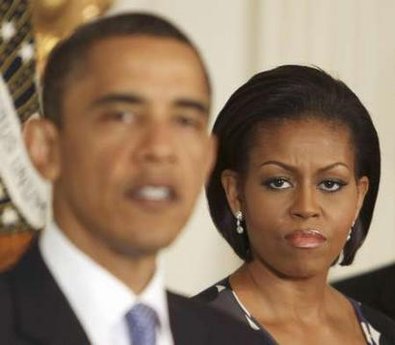
 Michelle (ma belle) Obama appeared on the nationally syndicated Tom Joyner Show yesterday morning to send a new message out to potential Black voters:
BlackAmericaWeb.com reports:
The “It Takes One” program encourages supporters to make a difference in this year’s election, and to “start by taking one action that will help grow our campaign,” Mrs. Obama says. In a three-minute video message to supporters, Mrs. Obama tells supporters that in light of a tighter election than 2008 likely this fall, “in the end, it could all come down to those last few thousand votes in a single state.”
The first lady spoke with the Tom Joyner Morning show today and urged supporters to fight voter suppression and get out and vote.
Here’s an excerpt from the interview:
Tom Joyner: We’re less than a hundred days away from the election.
Mrs. Obama: Yes, indeed.
Tom Joyner: And you have a project you call, “It Takes Ones,” right?
Mrs. Obama: Yes, yes. The idea — really it’s a simple one. This election is going to be closer than the last one. That’s the only guarantee we have. And really what’s going to make the difference are people talking to people. So what I tell folks when I’m out there doing grassroots events, I tell them, multiply yourselves. And really all it will take is just that one person that you register to vote, that one person that you get out to the polls, that one person that you talk to and help them understand what’s at stake.
I want people to be thinking that that one could be the one that puts us over the top. Especially when you think about how an election is broken down over precincts and counties and communities. We’ve seen close elections. It could come down to the last 500 people. So for anyone who doesn’t feel like — the thing I can do won’t make a difference, we’re just trying to change that, because all it will take is one.
And if each of us does our one, and all of us know that one person in our lives, that one knucklehead nephew that’s not registered to vote, that one neighbor that’s not really paying attention, or that one person in your office that’s confused about how Barack’s tax plan will benefit that individual — those are going to be the conversations that make a difference.
And in this election, we’re going to be making a choice about how we want our democracy run. Do we want our President selected by people rolling their sleeves up, knocking on doors, or are we going to hand it over to a couple of people who write big checks? And we’ve invested throughout not just this campaign but throughout Barack’s first term in building organizations on the ground — because it’s not just about choosing the next President, it’s about choosing what the next tax plan is going to be, or whether we actually tackle global warming, or whether or kids can go to school without a mountain of debt.
These are the issues that we’re really talking about. And it extends far beyond who’s in the White House, but who’s in the Congress, who’s in the statehouse, who are our mayors, how are these campaigns funded, do we support that? So we want people focusing on the one thing I can do. And everybody can do one thing, and it will be that one-on-one kind of contact that’s going to get us over the finish line in the end.
So “It Takes One.”
Tom Joyner: I’ve got the perfect mechanism to do this. We have partnered with the NAACP and the National Urban League and the National Action Network, and we have a number that you can simply call and register someone over the phone. It’s 1-866-MY-VOTE-1. You know that one person that’s not a registered voter —
Mrs. Obama: Absolutely.
Tom Joyner: — and they should be — you could dial them the number.
Mrs. Obama: Absolutely.
Tom Joyner: Put it in your contacts — 1-866-MY-VOTE-1. And all that’s done on the phone.
Mrs. Obama: Yes, it’s as easy as that. And that’s the one thing we’ve got to keep emphasizing to people — that voting, registering to vote is a simple thing to do. And we don’t want anybody to be intimidated by the political process. Because essentially — sometimes that’s what keeps people from engaging. They just feel like, I’m going to run into problems, it’s going to be a challenge. But we just have to keep reminding people this is as simple as a phone call. It’s as simple as going to the website. We also have a website called gottavote.org — where people can go online and do the same thing.
So the fact that you, the NAACP, so many organizations are focused on voter registration — again, it is critical because this is our power in the end. And again, it’s not just about this presidential election. It’s about the future of our communities and our families. And that’s the way you make change — in the voting booths.
Tom Joyner: That’s right.
Mrs. Obama: So thank you so much for that initiative.
Sybil Wilkes: Mrs. Obama, we have so much information here, and we have it on BlackAmericaWeb.com, we have it at barackobama.com/one. But there’s so much there — and on Black America Web, and on The Tom Joyner Morning Show — we get it every day. How is it that you keep people engaged or get people engaged? Because 2008 was just such an incredible year, and you saw the groundswell, obviously, of support and people standing in line for hours at a time. How are you keeping them engaged in this one?
Mrs. Obama: We have thousands of offices that — and many of them in the important swing states. And that’s something that we try to explain to people, because some people feel like, well, I don’t feel the campaign, I don’t feel that energy in my place. But the point is, is that swing states are going to play a crucial role strategically in this. So if you go to Ohio or Iowa, Florida, Pennsylvania, where I’m about to go, you will see an organization that has been on the ground for years, and that’s a huge advantage that this campaign has had in the past and will continue to have. Because our opponents haven’t invested anything — or not as much as we have — on that kind of grassroots support. And that’s been going on since Barack was elected.
But we have thousands of organizations. Whenever I’m going to a rally — now, there’s going to be a couple thousand people there. But people in that audience are team leaders who are working every day, making calls and pulling their neighbors in, and we organize a set of events around team leaders. And again, in places like Ohio and Iowa, this process has been on the ground for four years. So we’re not recreating the wheel.
So the swing state focus is really a critical focus because in a presidential election, where you’re counting electoral votes — and we all heard about that in the last election – the swing states strategically make a huge difference. And when you’re dealing with limited amounts of resources — like our campaign is, as compared to the other guy who’s got millions and millions pouring in — we have to be really strategic about where we put our resources.
So that’s why you’re going to feel the campaign in those swing states. Even more so in places like my hometown, like Illinois, or places like California or New York, where our view is we should have that sewed up — and we will, but we don’t take anything for granted. No one should take anything for granted, because we’ve seen how these elections, they can go any way. And if it’s close — we don’t want it to be close, right?
Harry J. Enten, writing for guardian.co.uk opines:
It has been the belief of many in the analyst class, including myself, that Obama would hold on to his African-American base. The great Washington Post polling unit points out that Obama is cruising among them in their polling. His average lead in their polls is 85 percentage points. Pew research gave Obama an 89 percentage point lead in their last poll. NBC/Wall Street Journal pegged the Obama lead at 86 percentage points, while Obama is ahead by 81 points among blacks in the latest Gallup survey. Clearly, Obama is leading by a long way among African Americans.
There is a tremendous difference, however, between leading by “a long way” and repeating his 2008 levels.
You are correct, ol’ chap. More Black Americans had jobs in 2008, than now.
In fact, as of June the Black Unemployment rate was sitting at 14.4%. For black youths aged 16 to 19, the unemployment rate was at an unbelievable 39.3%, up from 36.5% in May.
It’s been a long 4 years.
Like other Americans, their hope is greatly diminished…and they’ve run out of change.
 Kingsjester's Blog